
Jahorina
Jahorina served as the venue for the women’s alpine skiing events during the 1984 Winter Olympics, hosting the Downhill, Giant Slalom, and Slalom competitions. Known as a “mountain in the city” due to its proximity to Sarajevo, it was an established winter sports centre long before the Games, offering a vast fan of natural slopes that required precise technical adaptation for Olympic racing.
Fast facts
- Location: Approx. 28–34 km southeast of Sarajevo (part of the Dinaric Alps)
- Olympic role: Women’s Alpine Skiing
- Events hosted: Downhill, Giant Slalom, Slalom
- Key dates: 8–19 February 1984 (Downhill held 16 Feb; originally scheduled 11 Feb)
- Highest peak: Ogorjelica (1,916 m / 6,286 ft)
- Course elevations (1984): Downhill start at 1,871 m; Finish area at 1,326 m
- 1984 Lift capacity: 7 cable cars and 6 ski lifts
- Spectator capacity: 25,000
- Pre-1984 history: First hotel opened 1923; first single-seater lift 1952
- Status today: Active ski resort; hosted EYOF 2019
The Olympic site: A “mountain in the city”
Located approximately 28 to 34 km southeast of Sarajevo, the Jahorina massif is often described as a “mountain in the city” due to its accessibility. While the range extends for 30 km, the central Olympic site focused on the north-oriented slopes beneath the highest peak, Ogorjelica (1,916 m).
The venue is characterised by a “wide fan” of natural, open slopes at the summit which funnel down through coniferous forests into narrower, technically demanding trails. For the 1984 Games, the site was prepared to host the women’s alpine programme, featuring a finish area at Kadino Vrelo (1,326 m).
During the Games, the venue infrastructure included:
- Competition courses: A network of runs officially homologated by the International Ski Federation (FIS), including a downhill course starting at 1,871 m and a slalom start at 1,840 m.
- Lift network: A system of 7 cable cars and 6 ski lifts served the slopes, connecting the high alpine start zones with the accommodation and finish areas below.
- Capacity: The site was designed to accommodate up to 25,000 spectators along the courses and in the finish stadium.
- Press facilities: The Hotel Jahorina served as the sub-press centre, housing 70 workstations and telecommunications for reporting on the women’s events.
Landscape and orientation
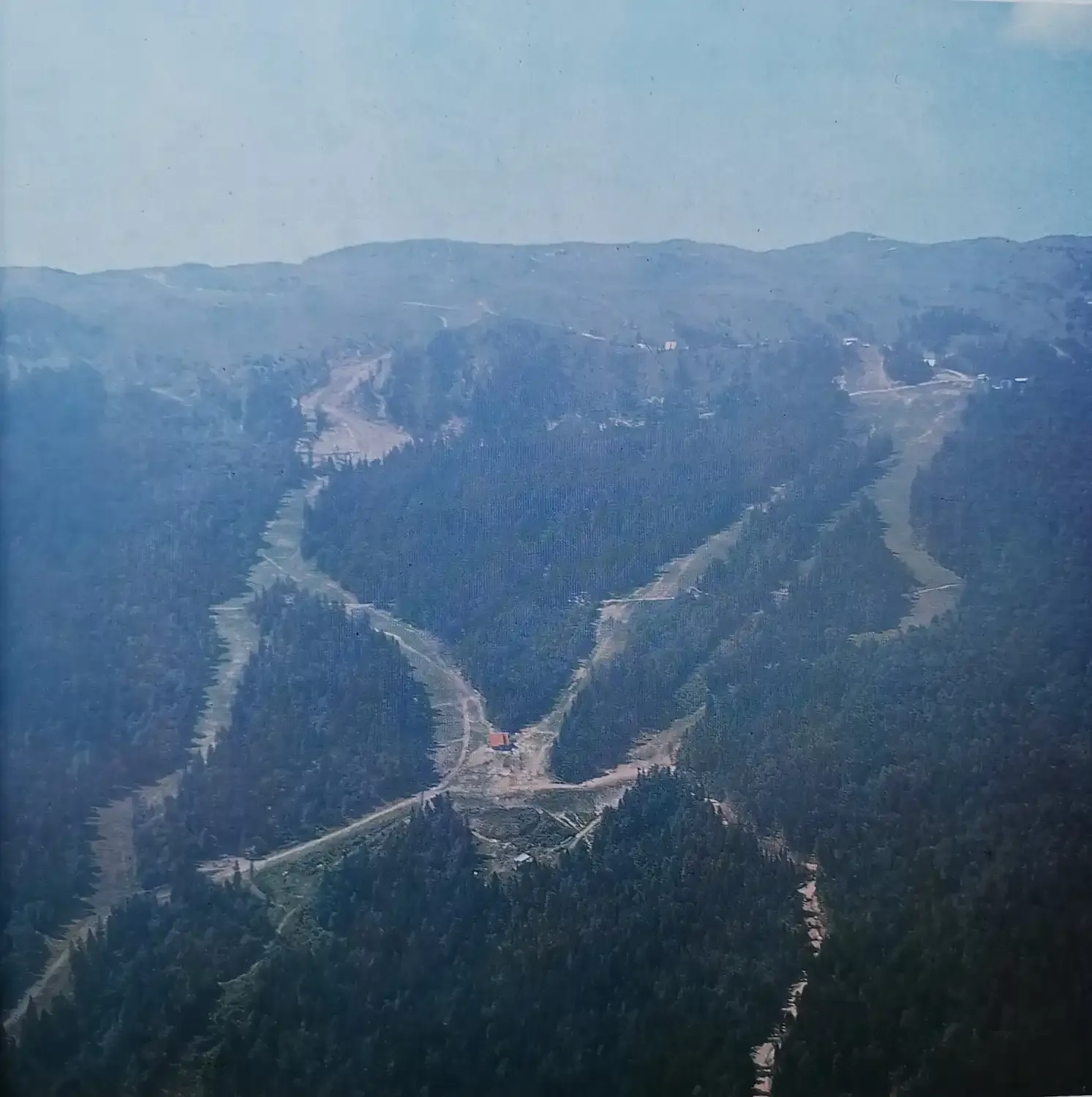
An aerial summer view shows the broad fan of Jahorina runs descending from the Ogorjelica ridge.
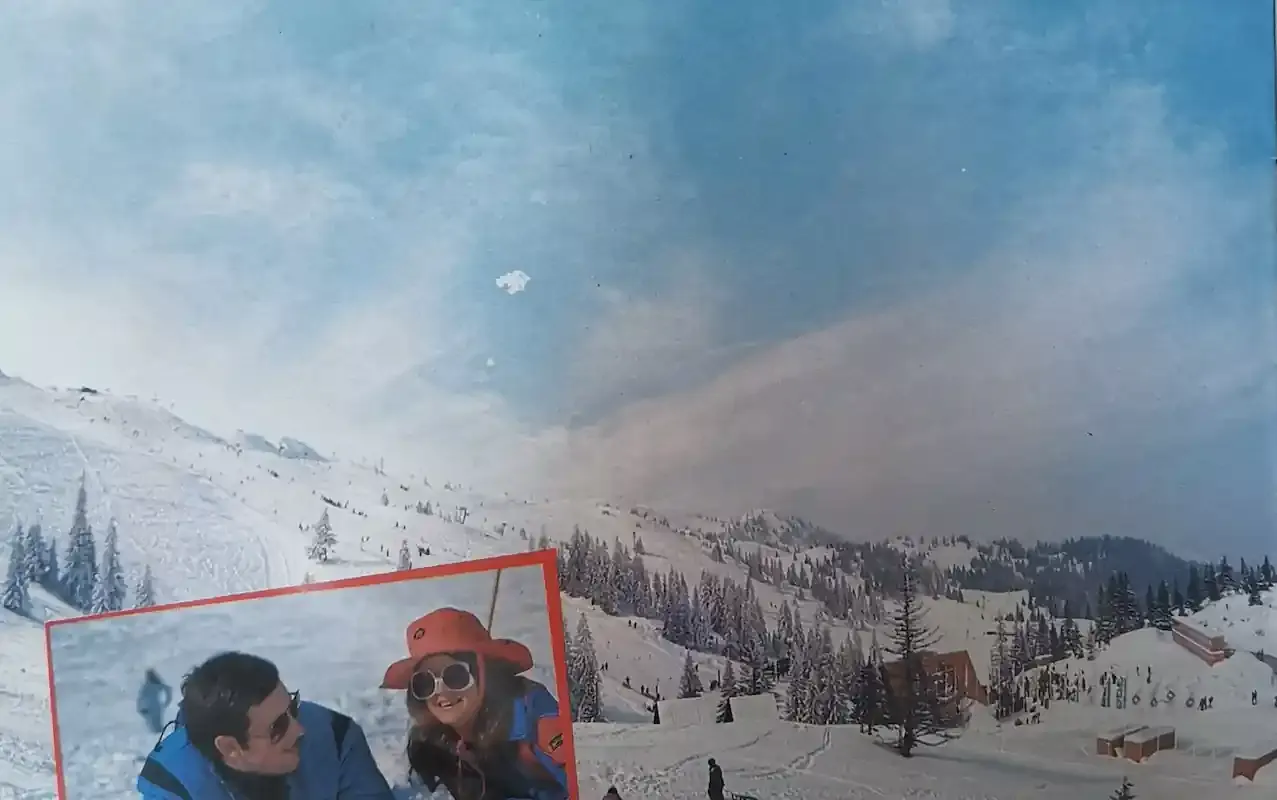
This winter panorama captures the open upper slopes where the women's Olympic courses were set.
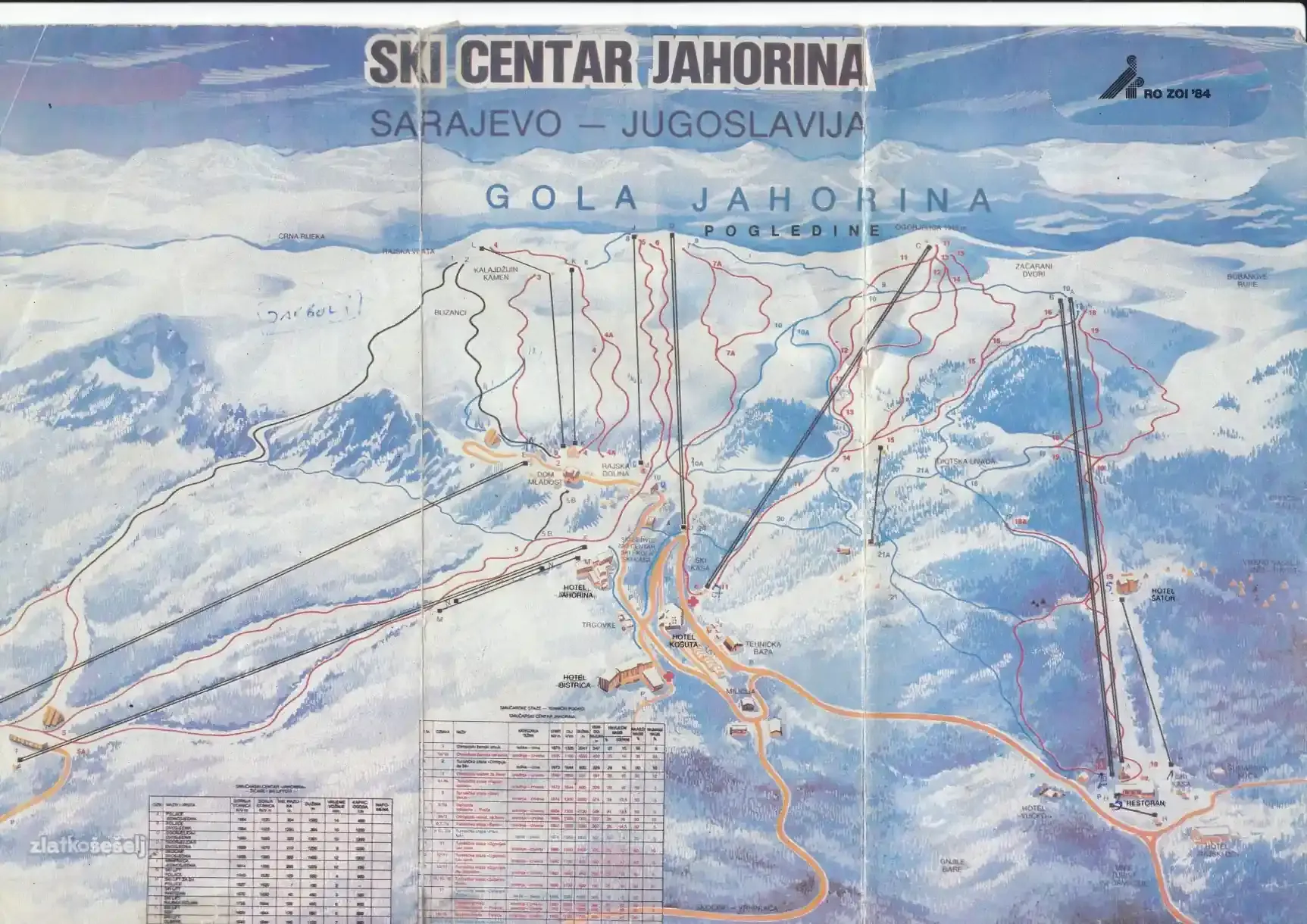
A period ski-centre map outlines Jahorina's piste network and lift corridors around Gola Jahorina.
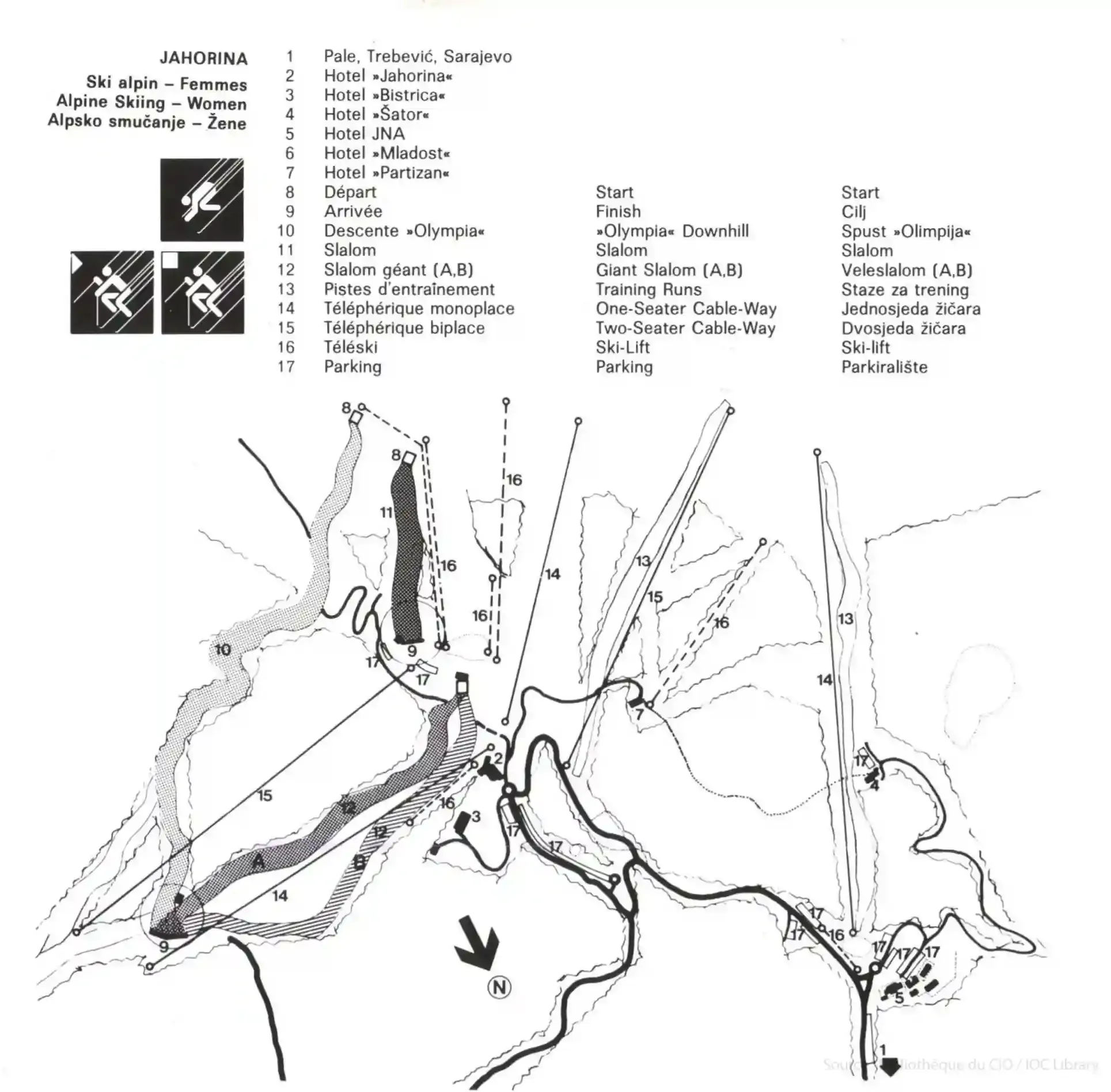
This Olympic-era site diagram maps the start zones, finish areas, and service access routes.
Before 1984: The rise of a winter sports centre
Long before the Olympic flame arrived, Jahorina was an active site for timber extraction and early recreational skiing. In 1912, the Austro-Hungarian administration constructed a forest railway to transport timber from Pale to Poljice (1,530 m), a route that later influenced the development of the mountain’s first access roads.
Organised tourism began in 1923 with the construction of the mountain's first hotel, "Šator," near the Vukelina Voda spring. This period marked the arrival of the first skiers, and by 1937, Jahorina hosted the first Yugoslav skiers’ rally. The post-war era brought significant infrastructure upgrades, most notably the installation of the first single-seater chairlift in November 1952. Starting near the Hotel Jahorina (1,660 m), this 1,050-metre lift carried skiers to the summit of Gola Jahorina in eight minutes.
By the 1970s, the mountain had evolved into a serious competitive venue. New access roads were asphalted, and in 1971, the resort acquired its first snow-grooming machine, allowing for consistent piste preparation. This modernization enabled Jahorina to host major international events, proving its capability to the skiing world:
- 1955: Hosted the 3rd International Student Winter Week.
- 1974: Site of the World Downhill Championship.
- 1975: Hosted the women’s "Golden Fox" World Cup race (relocated from Maribor due to lack of snow), confirming the venue's technical readiness for top-tier women’s alpine events.
- 1977: Included in the FIS European Cup calendar.
Early resort growth and hotels
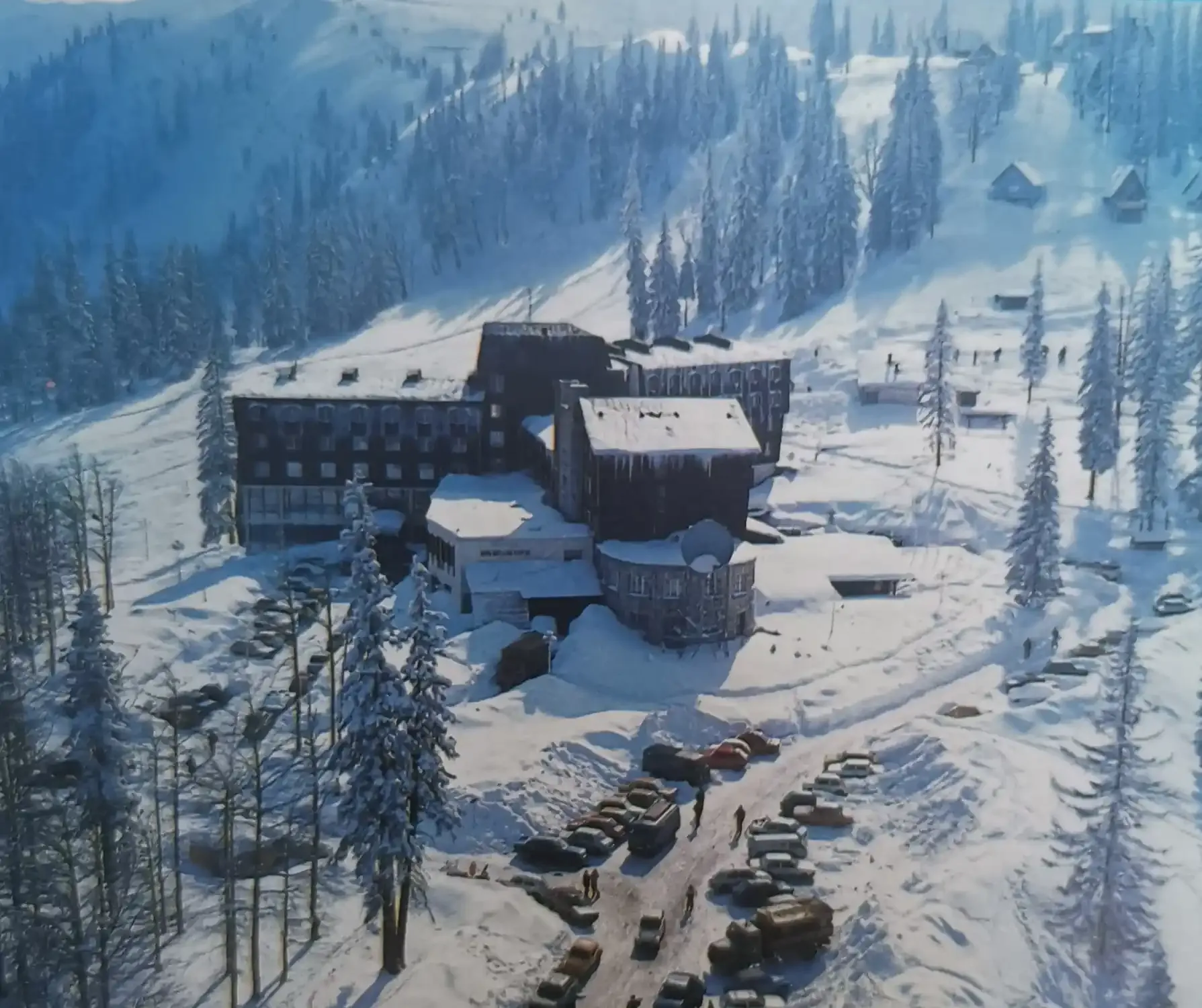
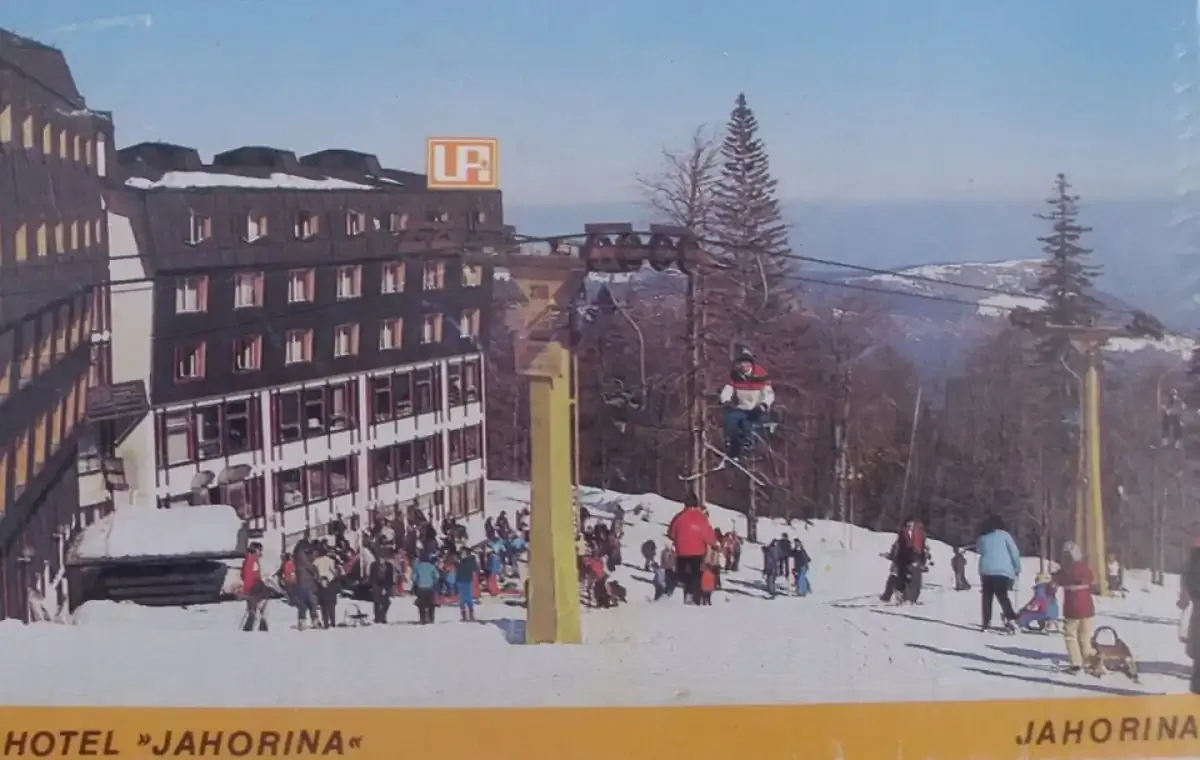
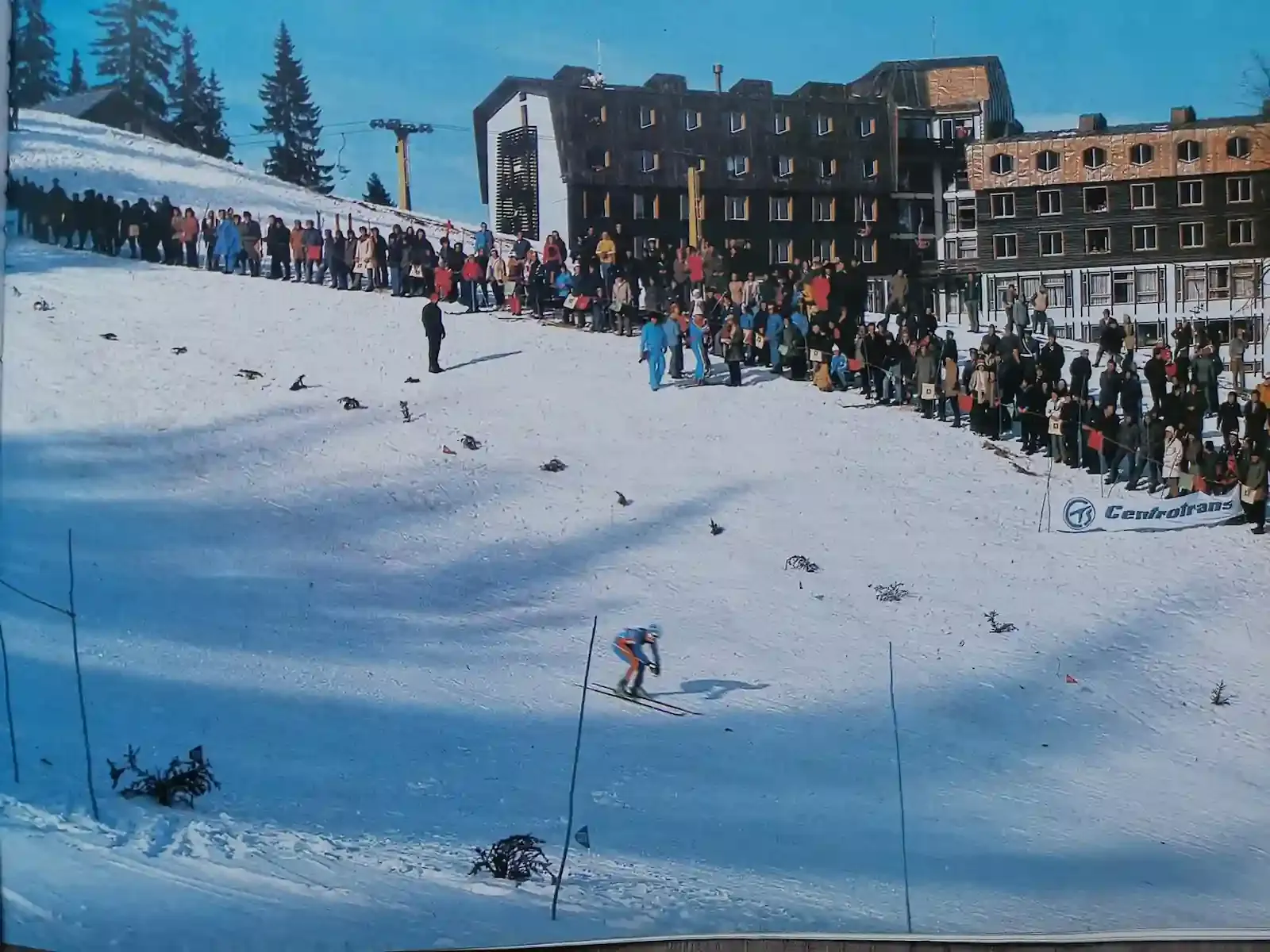
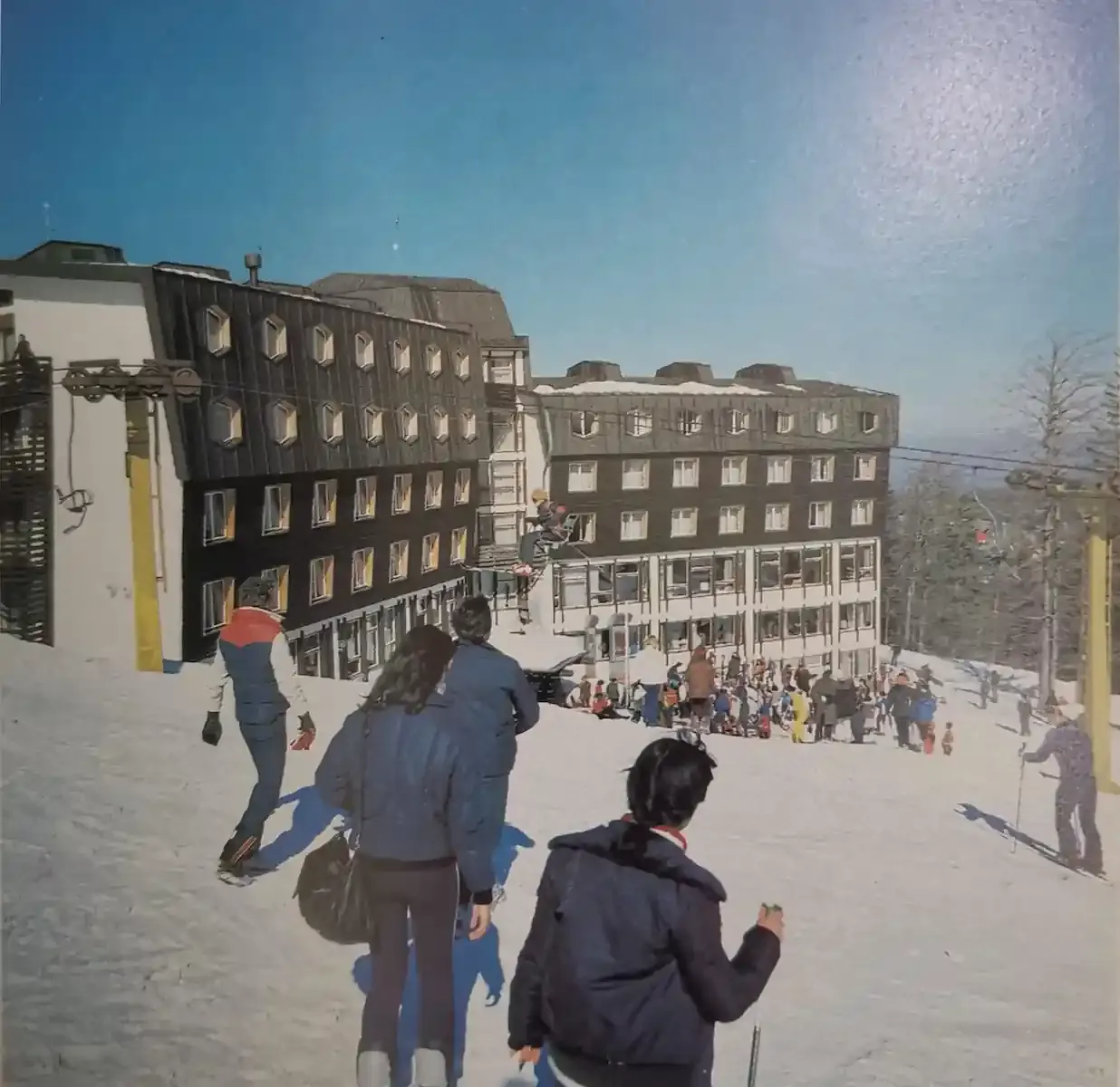
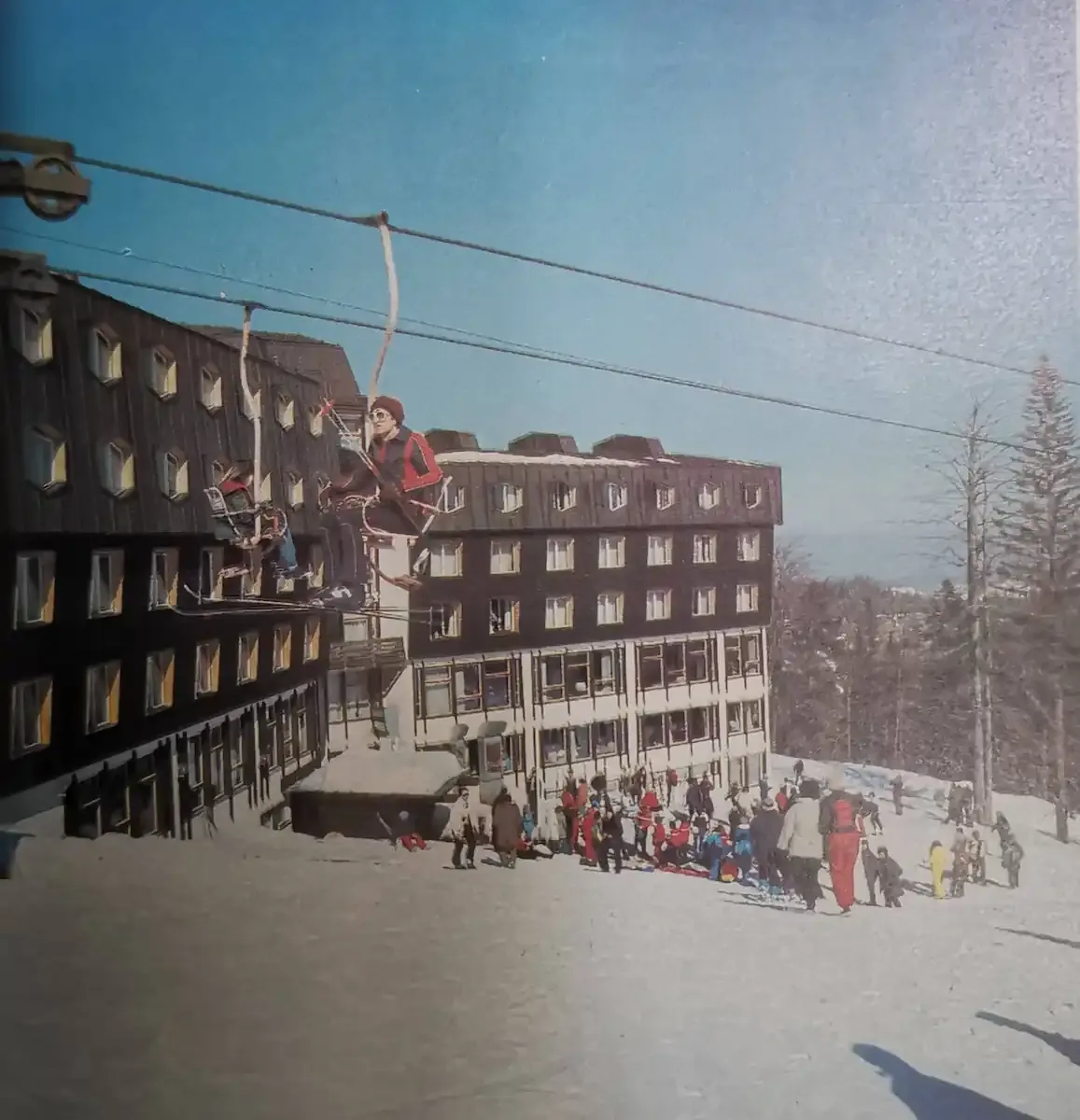
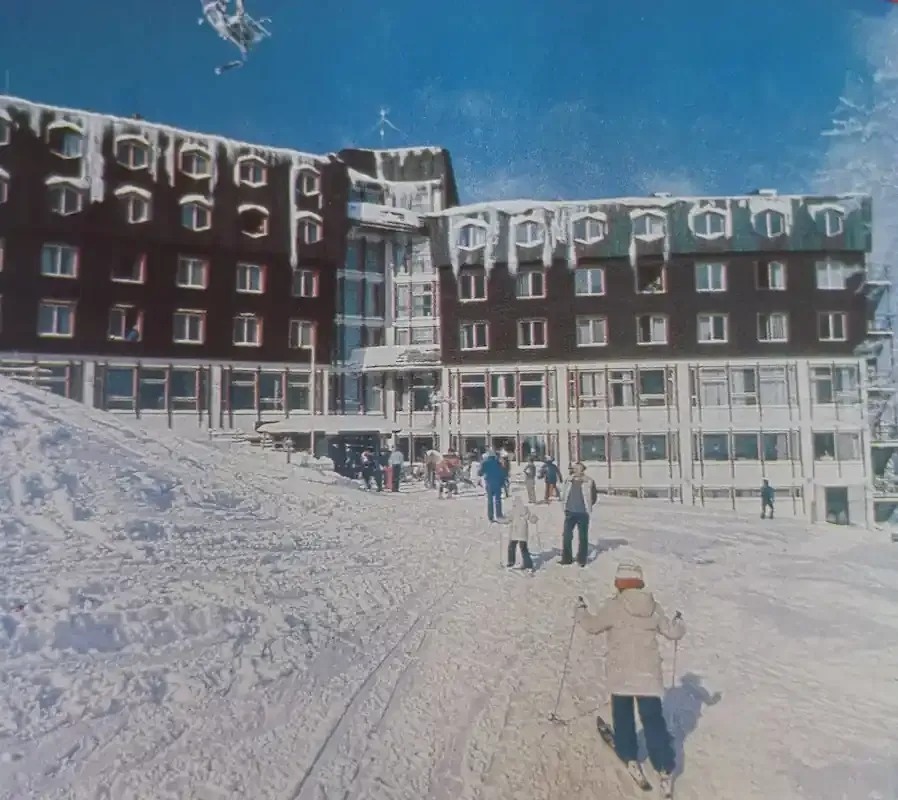
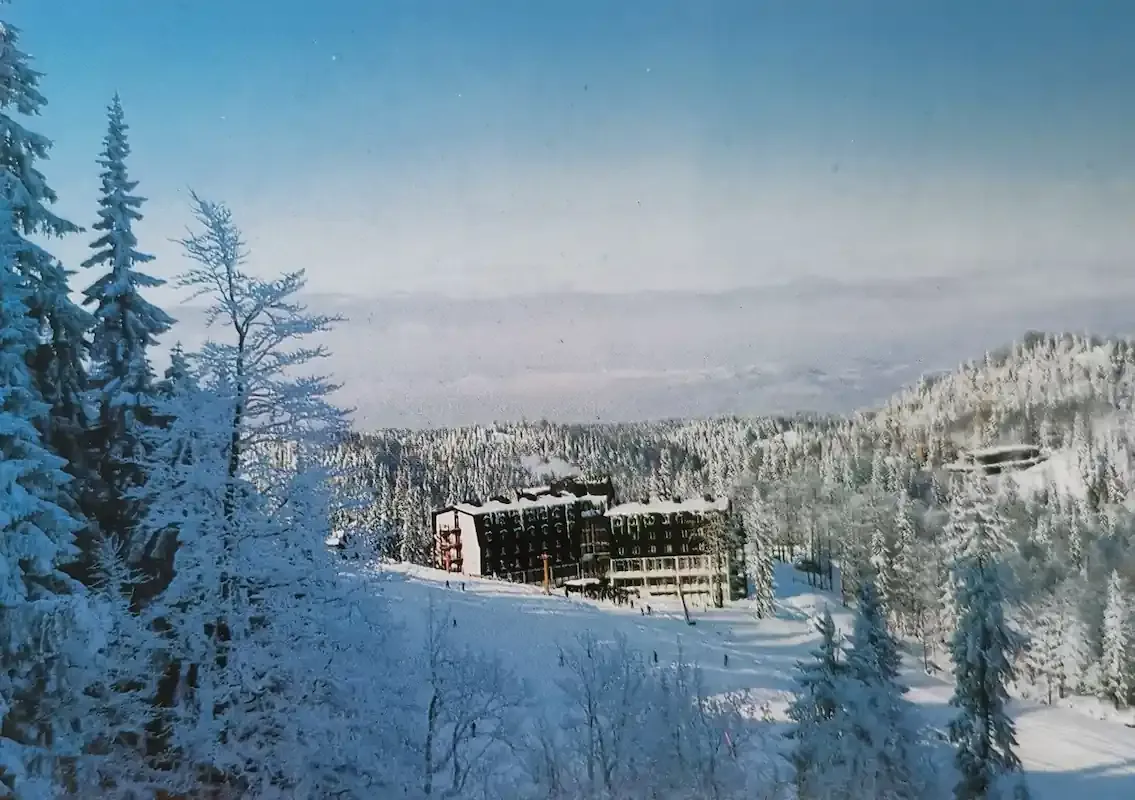
A snowy aerial view of Hotel Jahorina shows the main accommodation hub at the base of the slopes.
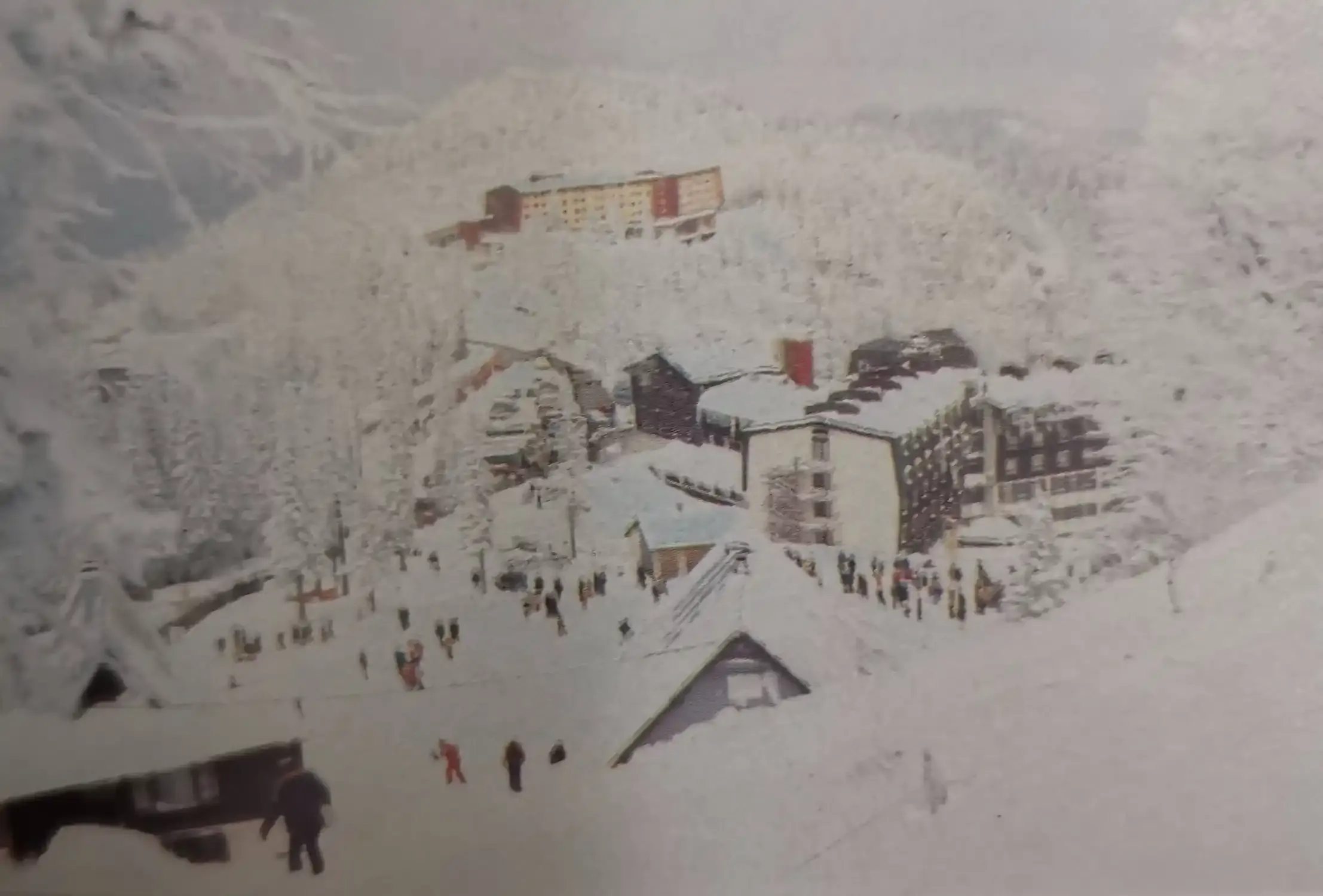
This high-winter scene shows the Bistrica area hotels and village core during the Olympic period.
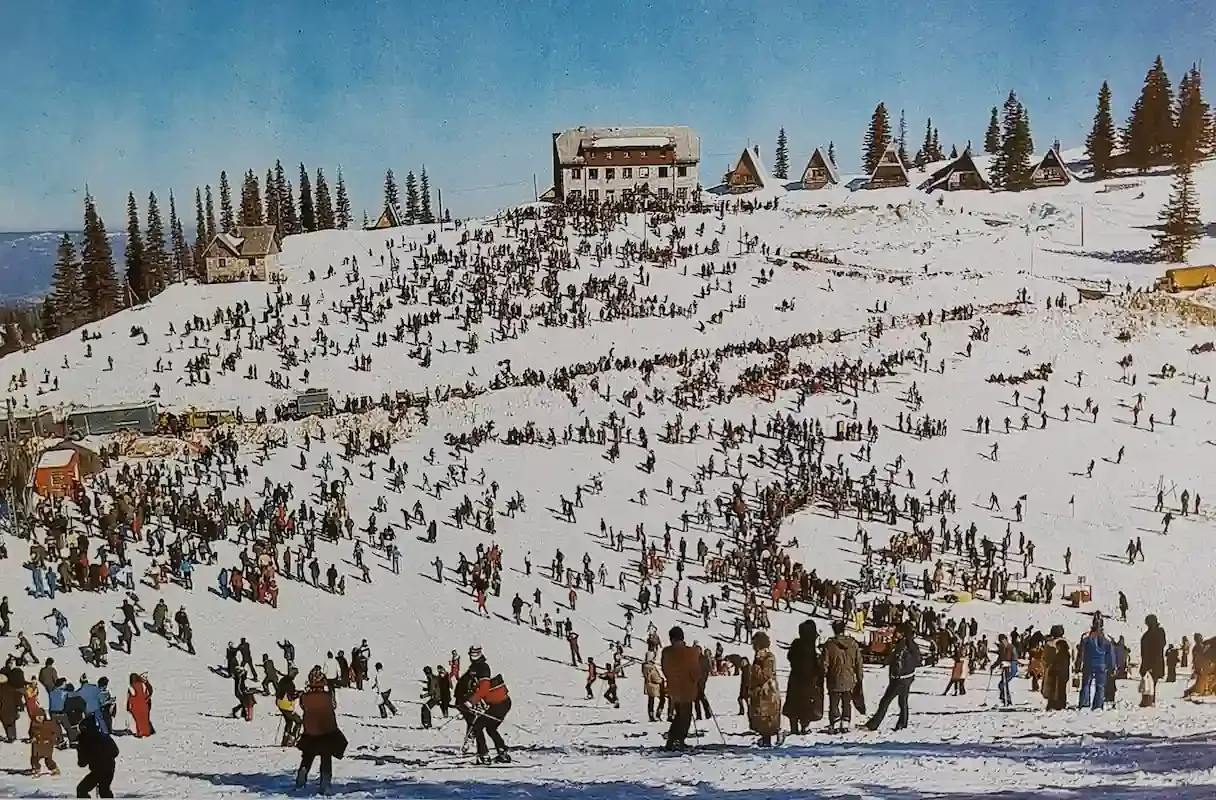
A packed slope-side crowd near Dom Mladost illustrates the mountain's festival atmosphere during major events.
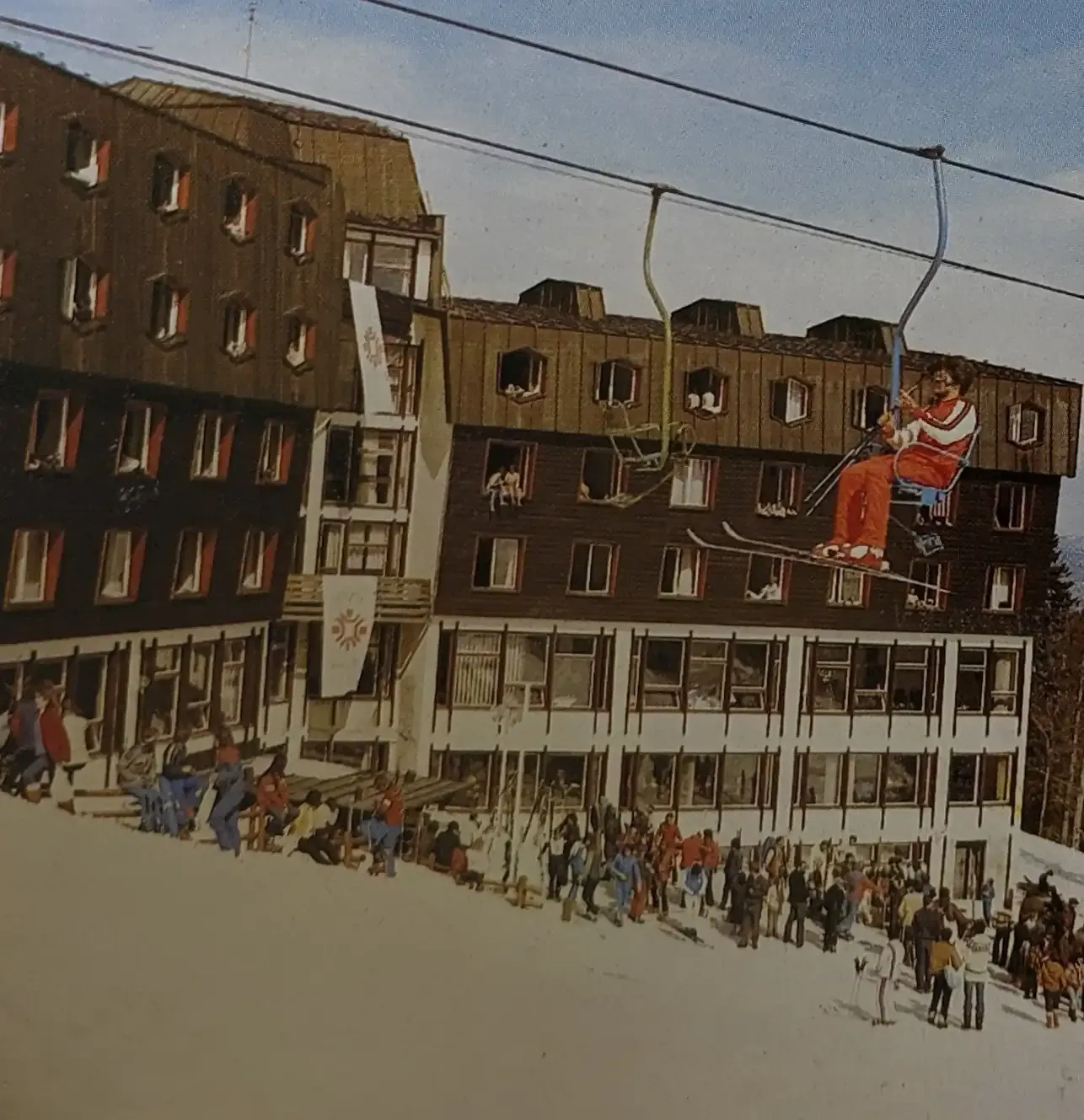
The Hotel Jahorina frontage is shown with flags and heavy pedestrian traffic in the 1980s.
This postcard view frames the hotel complex with skiers moving through the base-area circulation zone.
A wide base-area shot shows race spectators, service structures, and the main hotel block.
Skiers cross the forecourt in front of Hotel Jahorina in this everyday Olympic-era scene.
The same frontage appears from a lower angle, highlighting dense crowd movement around the hotel entrance.
This winter view shows the hotel facade and snow-covered access routes at the base station.
A distant hillside view places the hotel complex within Jahorina's forested terrain.
Preparing for 1984: Building a world-class venue
To meet Olympic standards, the mountain underwent significant physical adaptation between 1980 and 1983. While the natural terrain was promising, organisers had to "tame" the wilder sections of the mountain. This involved widening the courses, digging extensive drainage channels, and installing underground electronic lines for timing and data.
Construction crews, including thousands of young volunteers, focused on specific technical upgrades:
- Start facilities: Permanent starting cabins were constructed at key elevations: 1,871 m (almost at the summit) for the Downhill, 1,840 m for the Slalom, and 1,665 m for the Giant Slalom.
- Infrastructure: The project required laying 2,100 metres of new asphalt roads, along with 890 metres of power lines and upgraded water and sewage systems to support the influx of visitors.
- Lift network: New installations included a two-seater chairlift from Skočine to Vrhprača (1,200 m length) and a chairlift at Ogorjelica (1,260 m length), significantly increasing uphill capacity.
The accommodation sector saw a major transformation with the construction of several new facilities designed to house athletes, press, and guests:
- Hotel Vučko: Completed in 1983 and named after the Olympic mascot, this "Feroelektro" resort was designed by architect Zlatko Ugljen. It featured steeply pitched roofs to shed heavy snow and merge with the forest landscape.
- Hotel Bistrica: Built on the site of a villa destroyed by fire in 1974, this A-category hotel became a central hub for the Games.
- Hotel Jahorina: Already the largest hotel on the mountain, it was renovated and expanded to serve as the sub-press centre, housing 70 workstations and telecommunications equipment for the accredited media.
- Hotel Košuta: A B-category hotel built on the site of a dilapidated mountain home, providing additional capacity near the Ogorjelica sector.
Lift infrastructure built for the Games
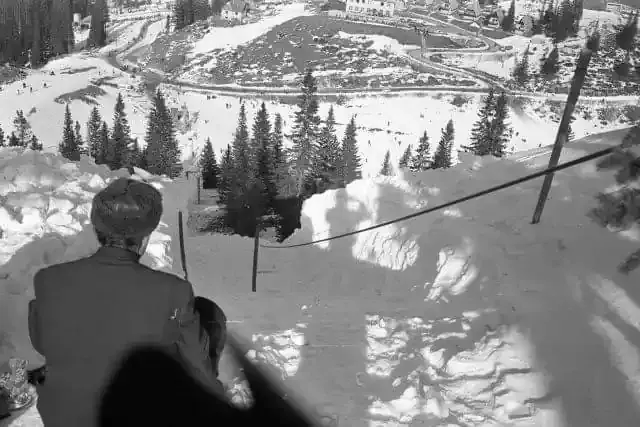
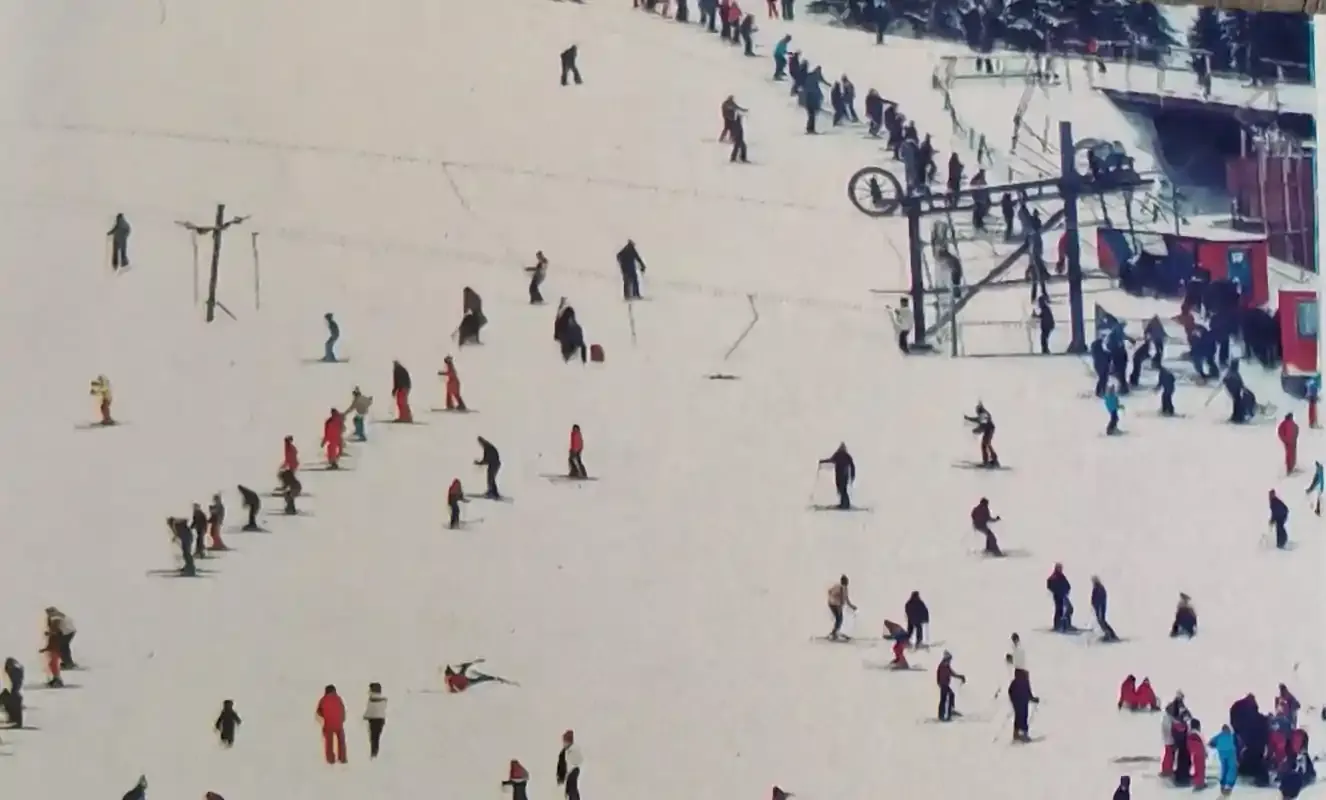
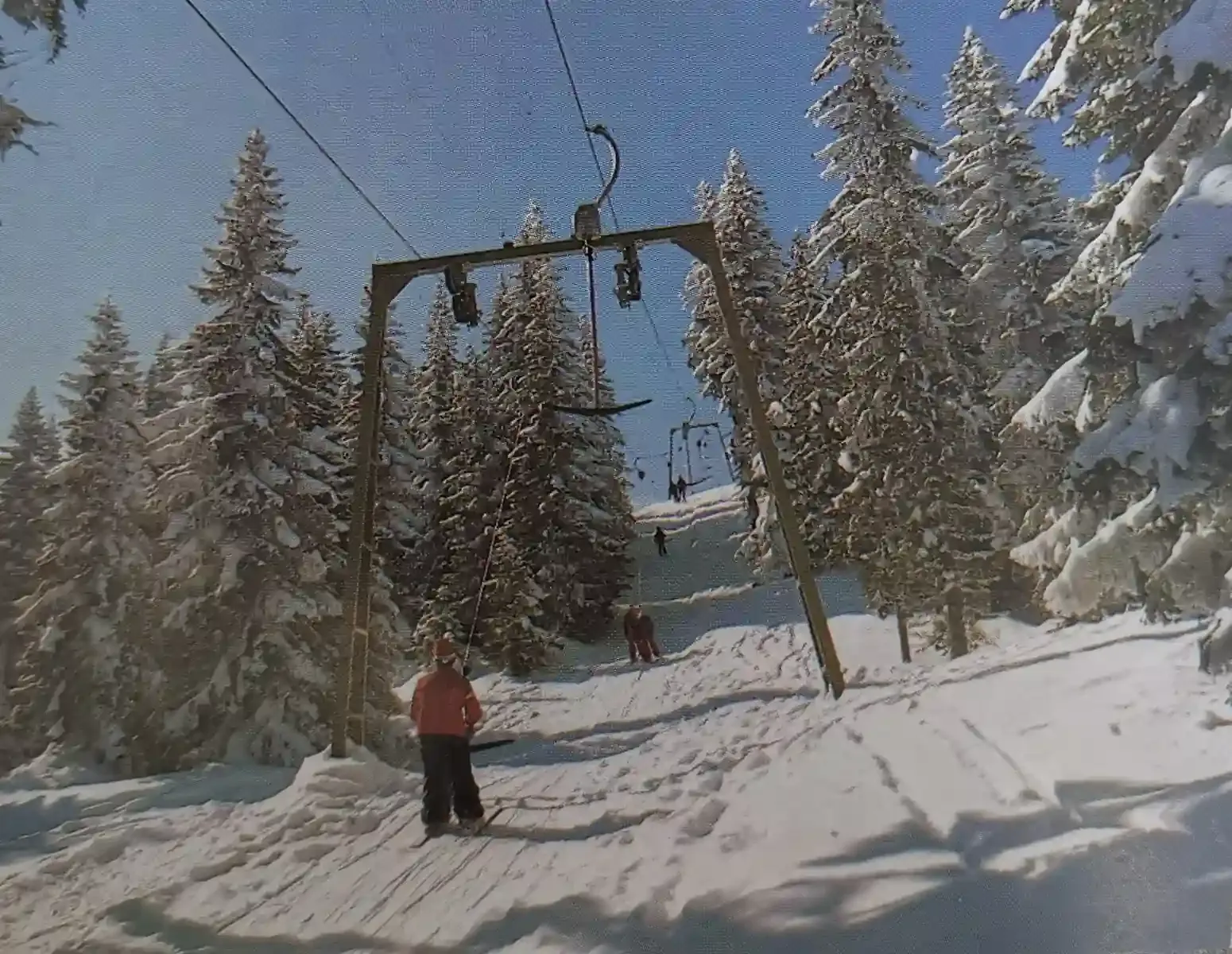
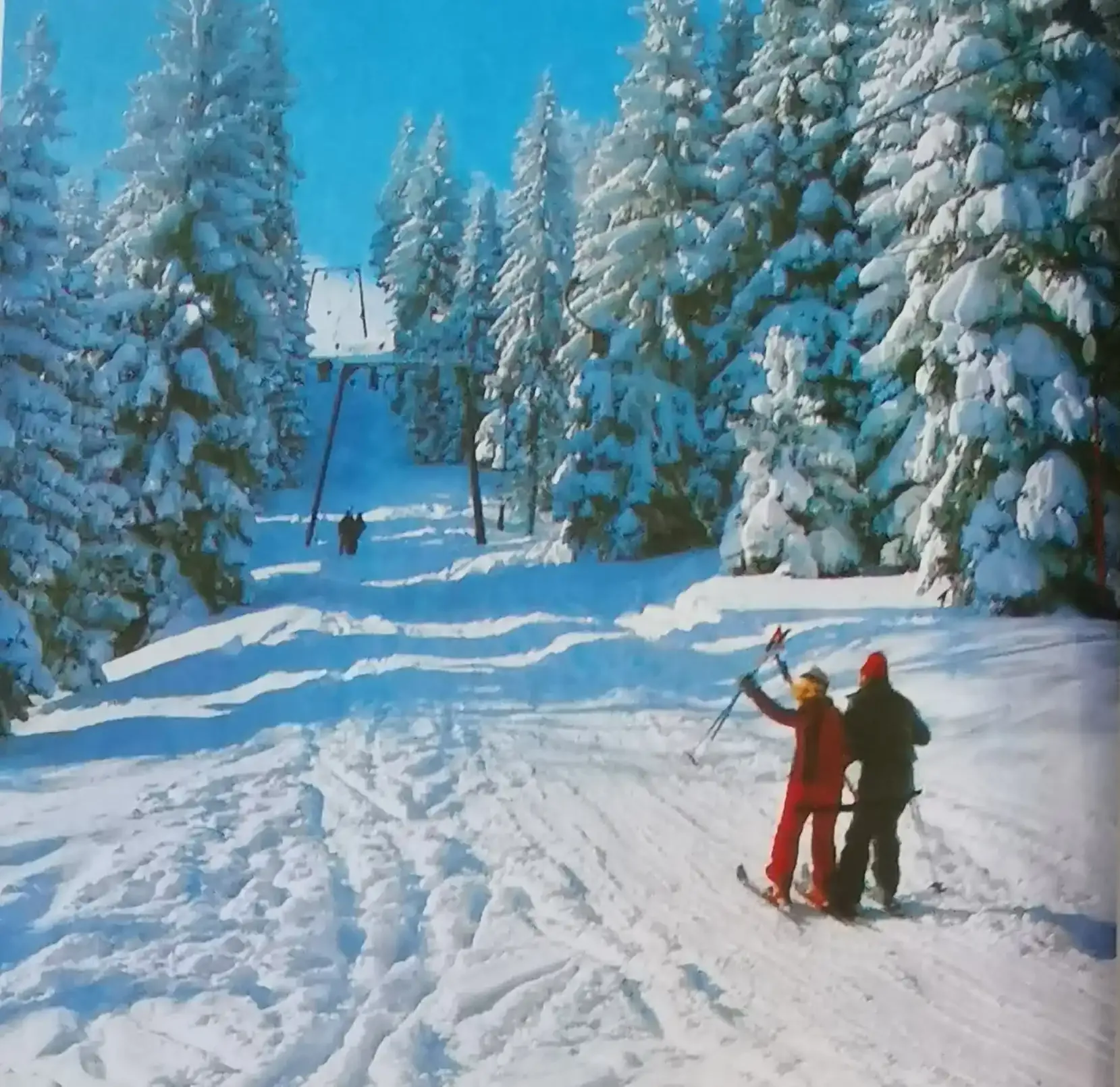
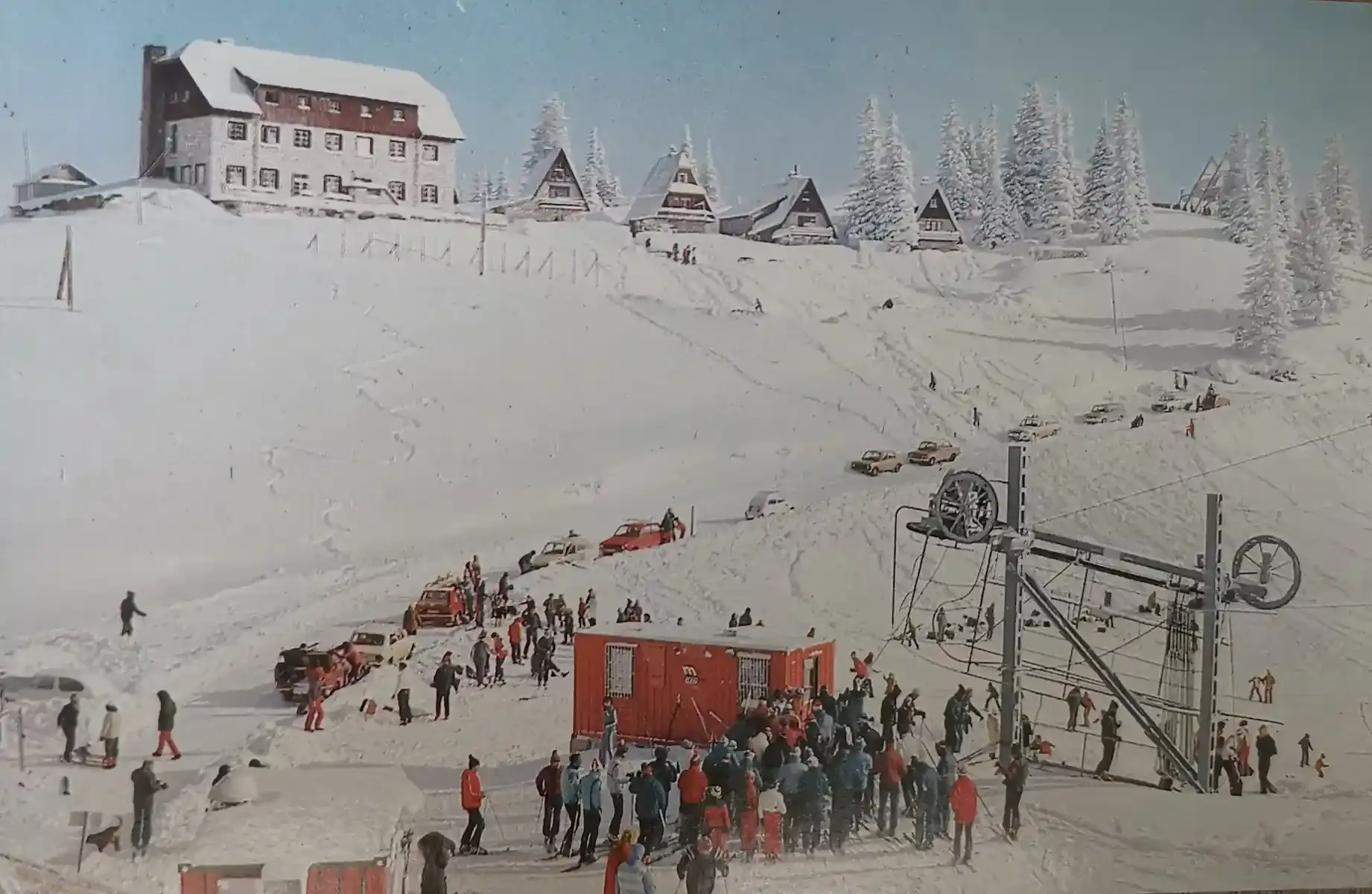
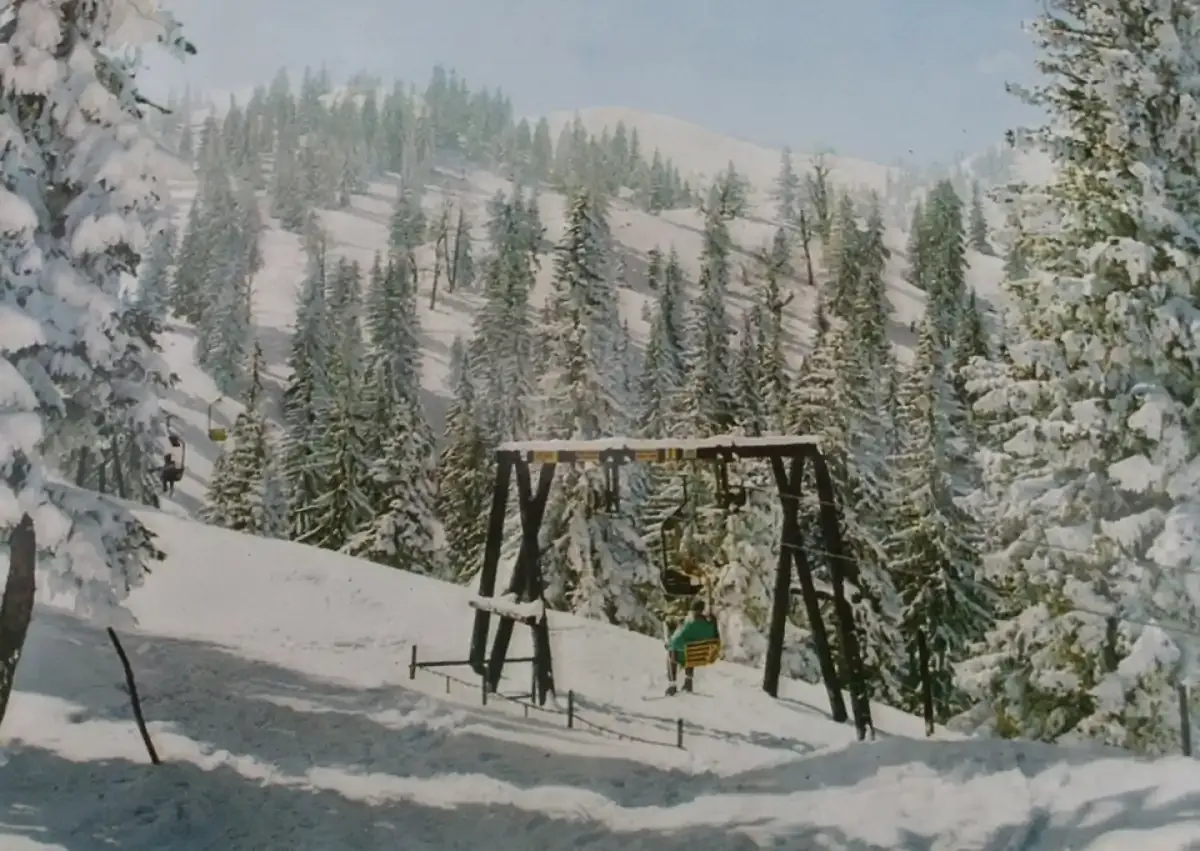
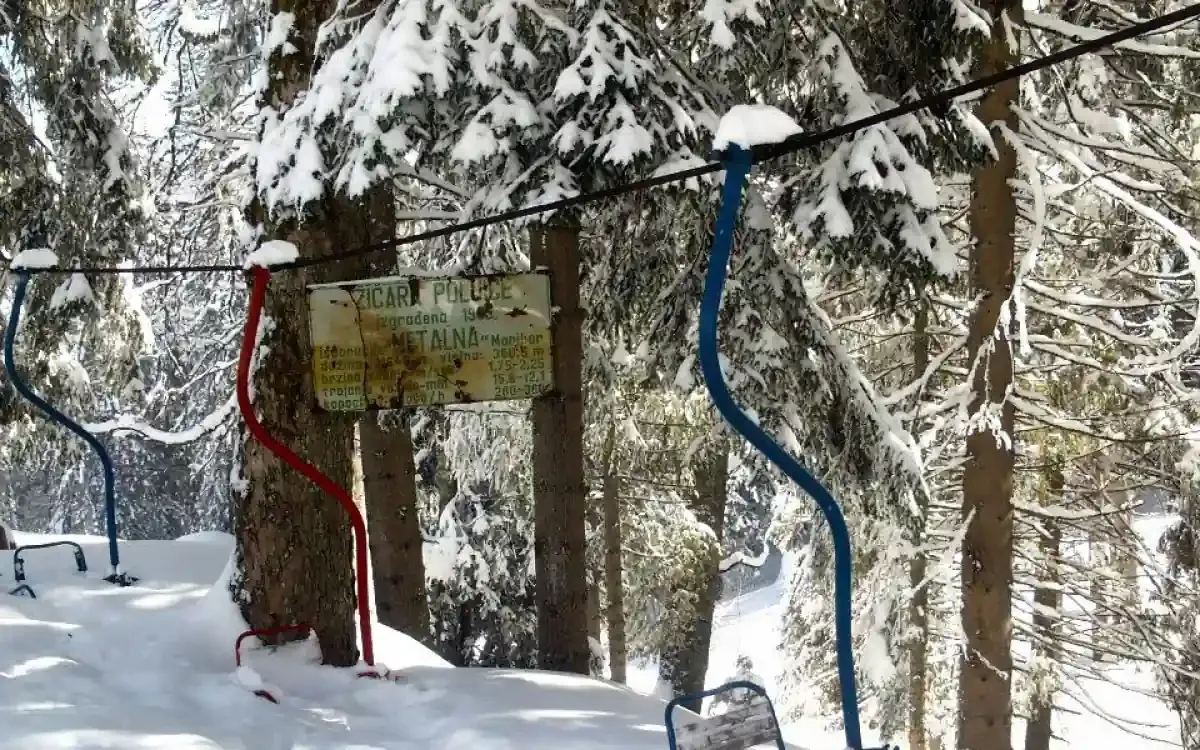
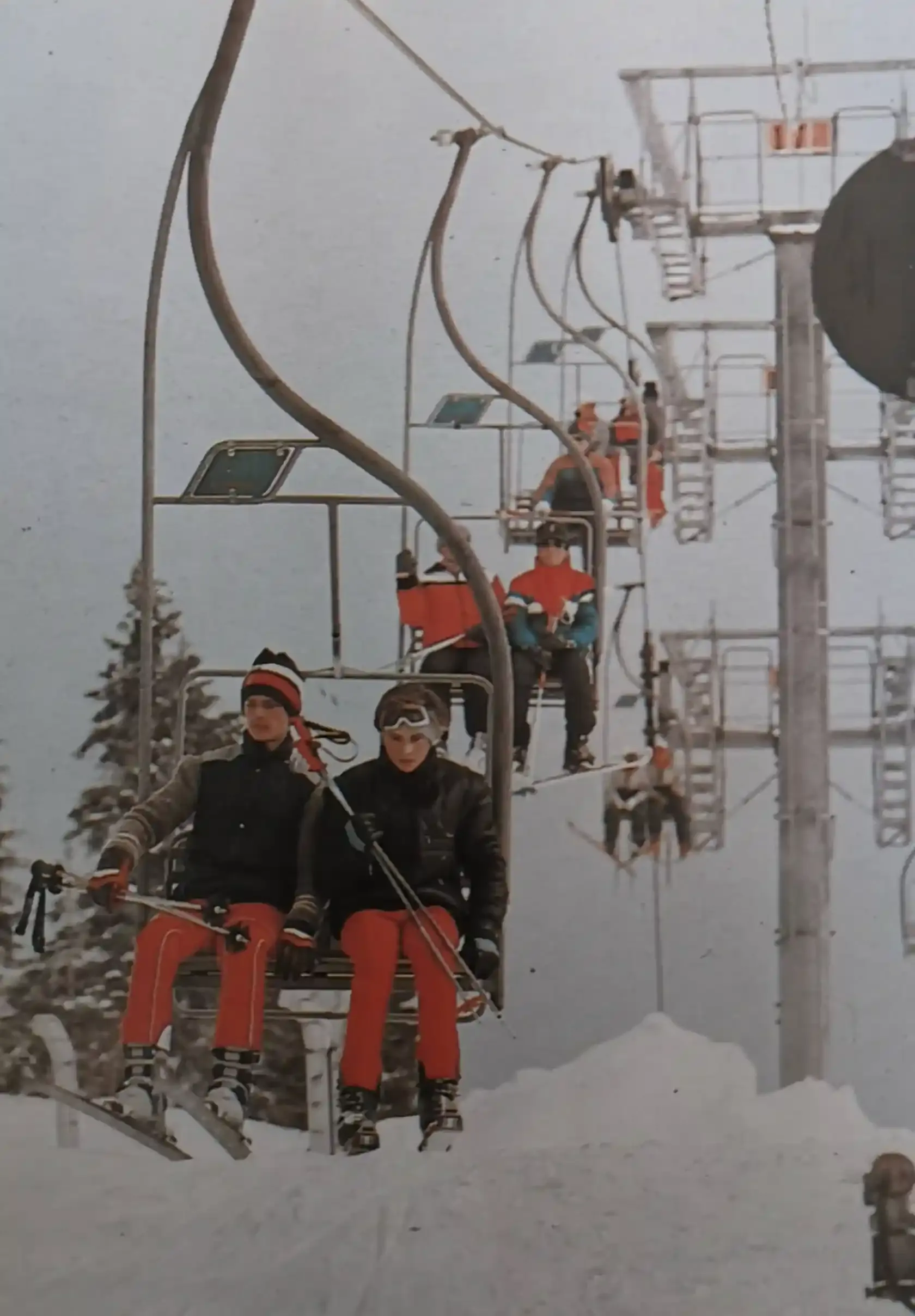
An early lift photo from the 1960s documents Jahorina's pre-Olympic uphill infrastructure.
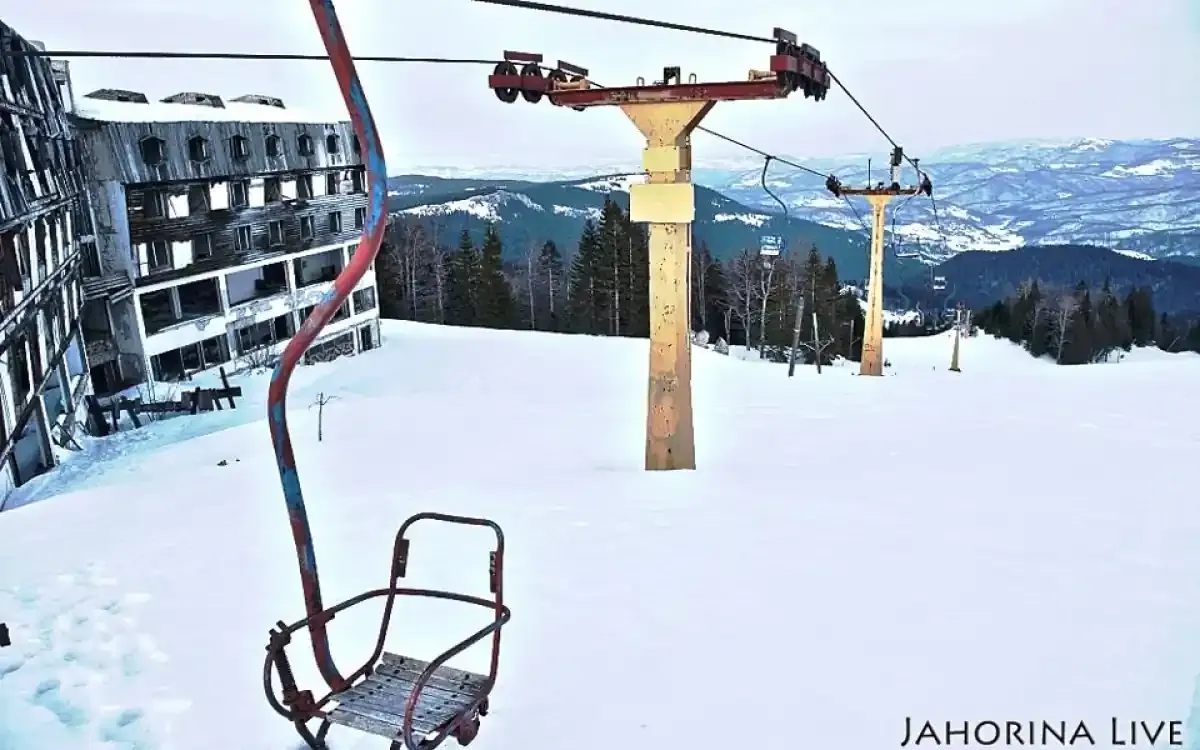
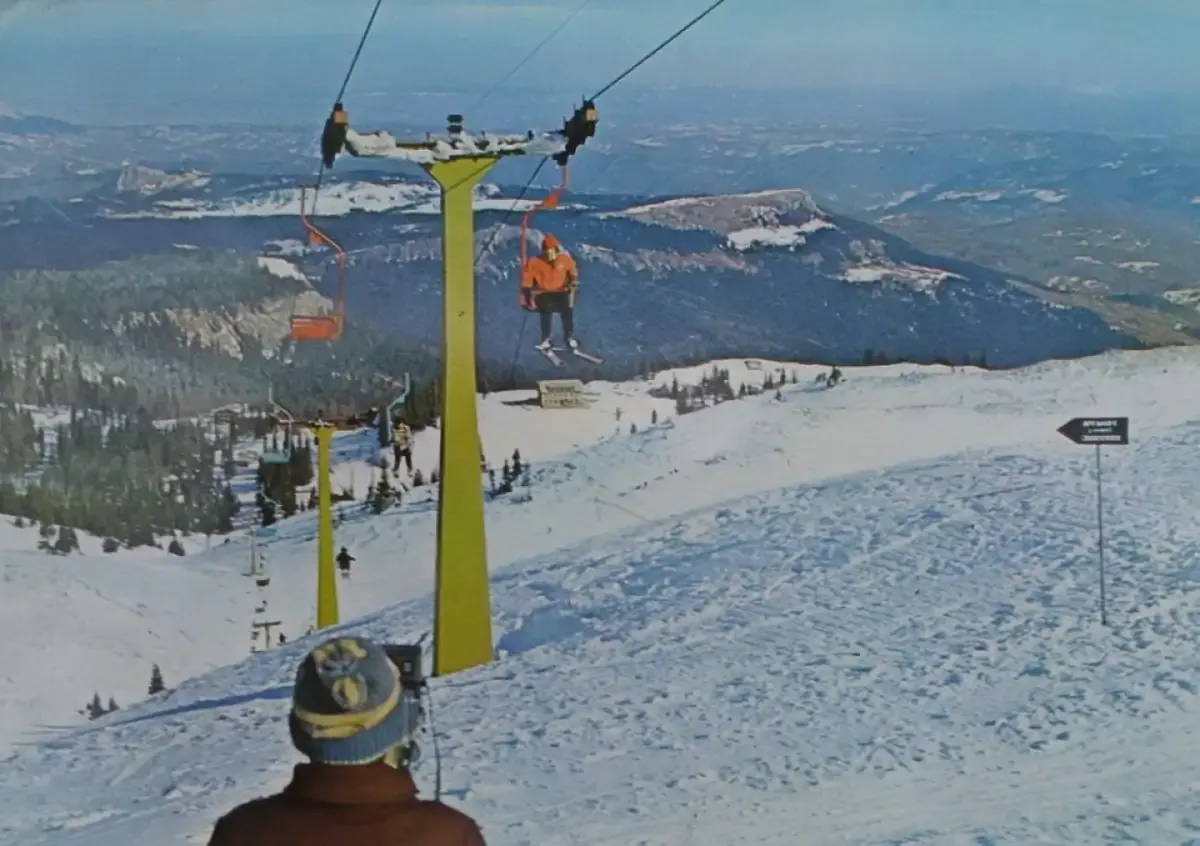
This tower and cable detail shows the fixed-grip lift engineering used on Jahorina's classic lines.
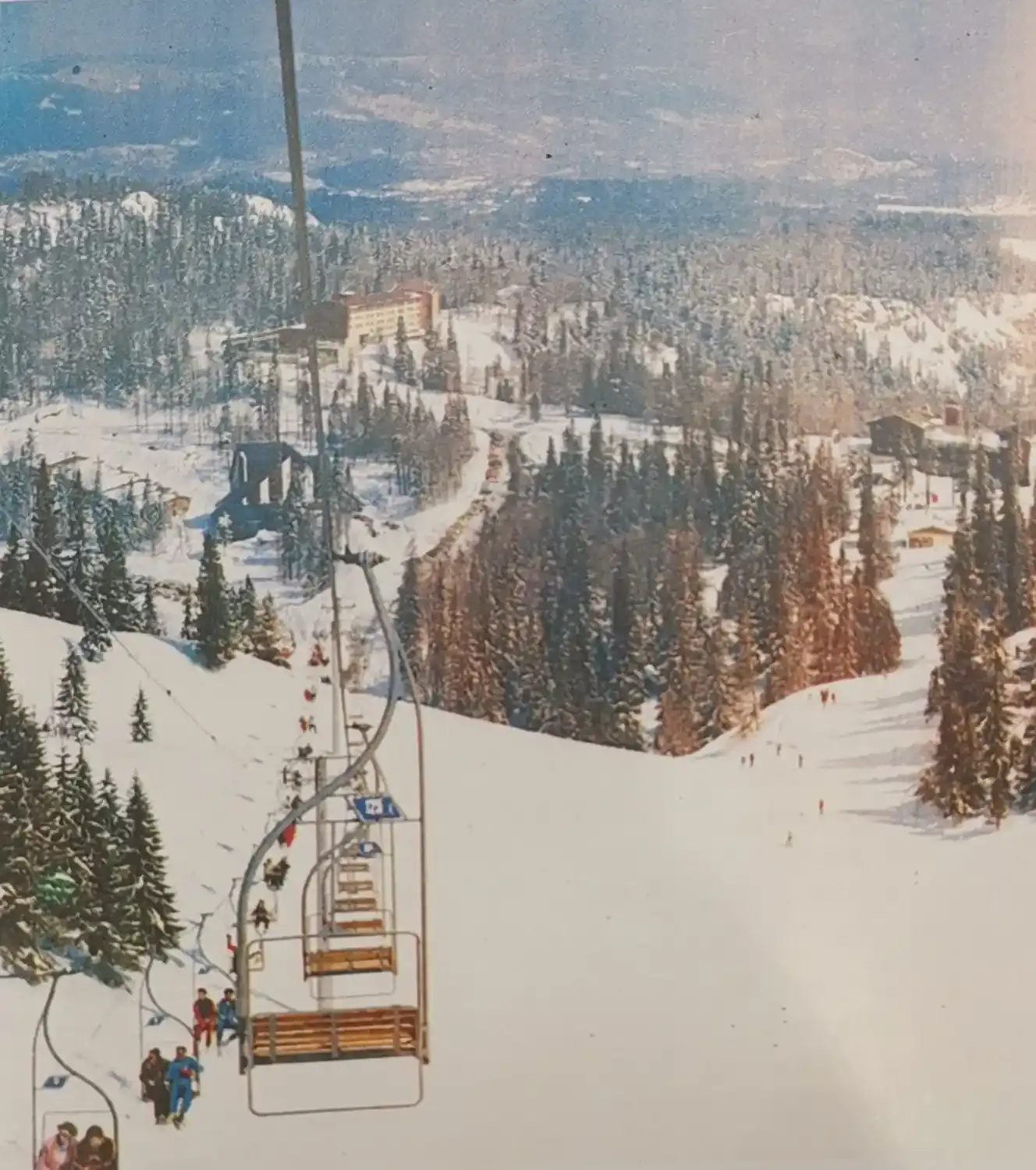
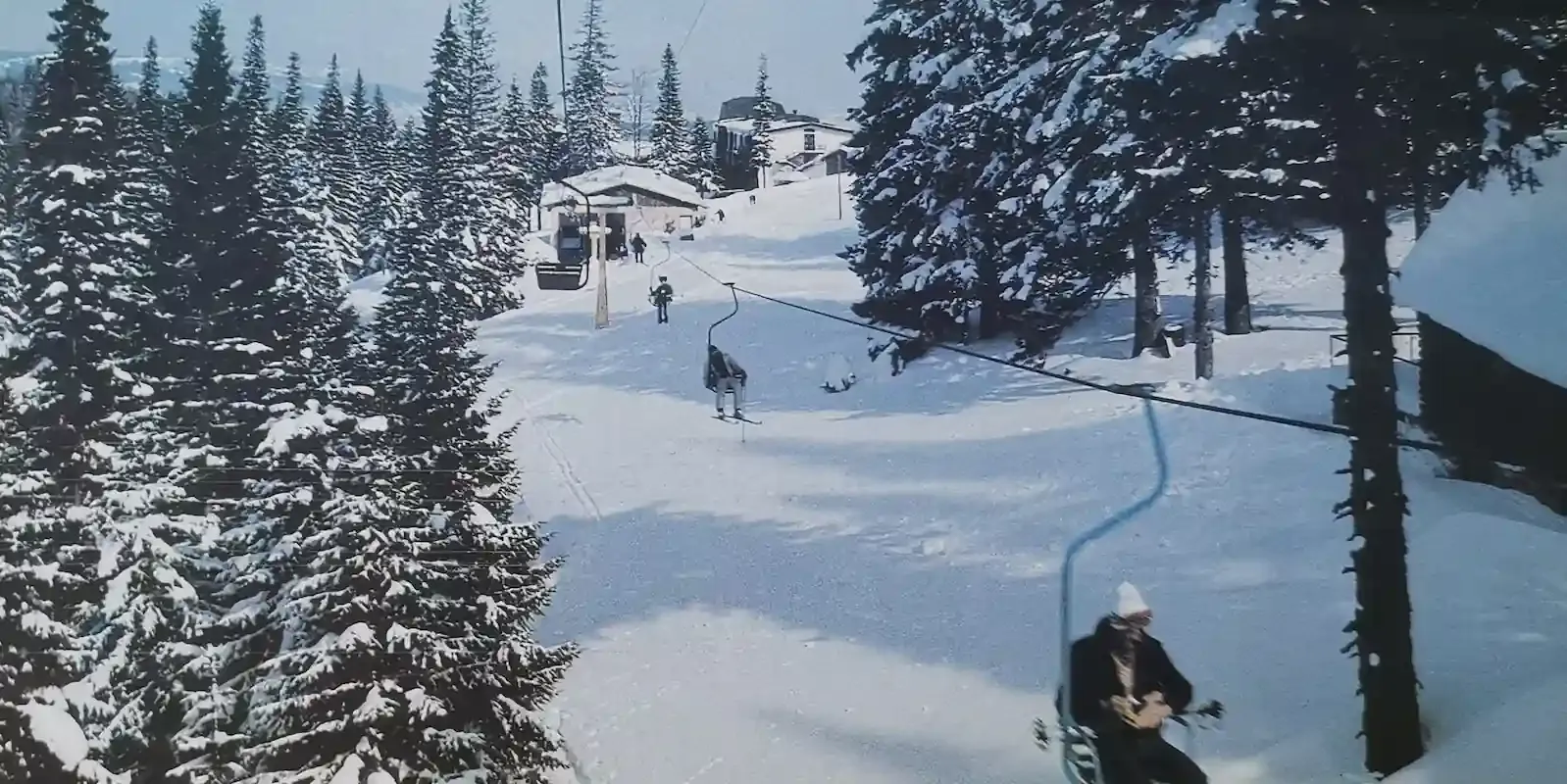
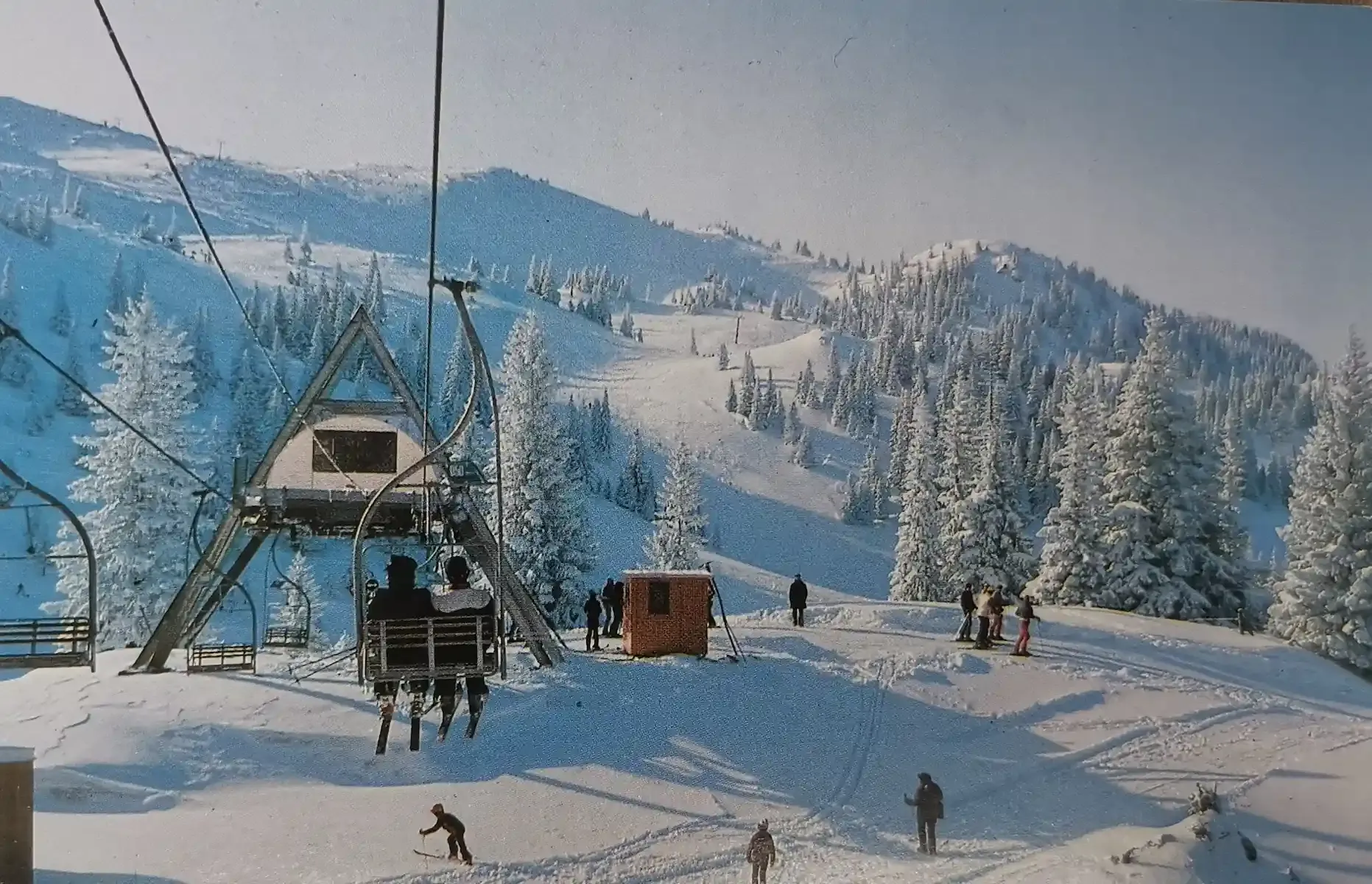
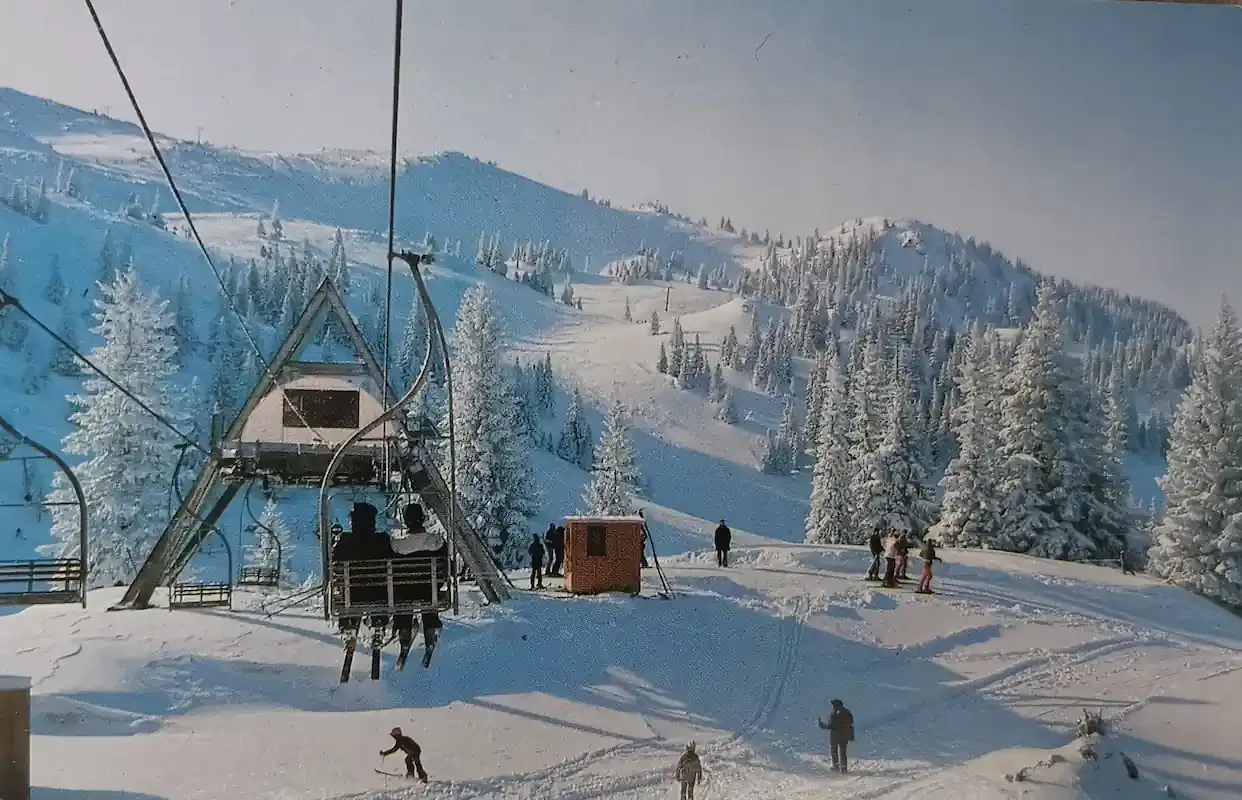
A two-seat chairlift climbs the open ridge, illustrating the mountain's mid-century transport system.
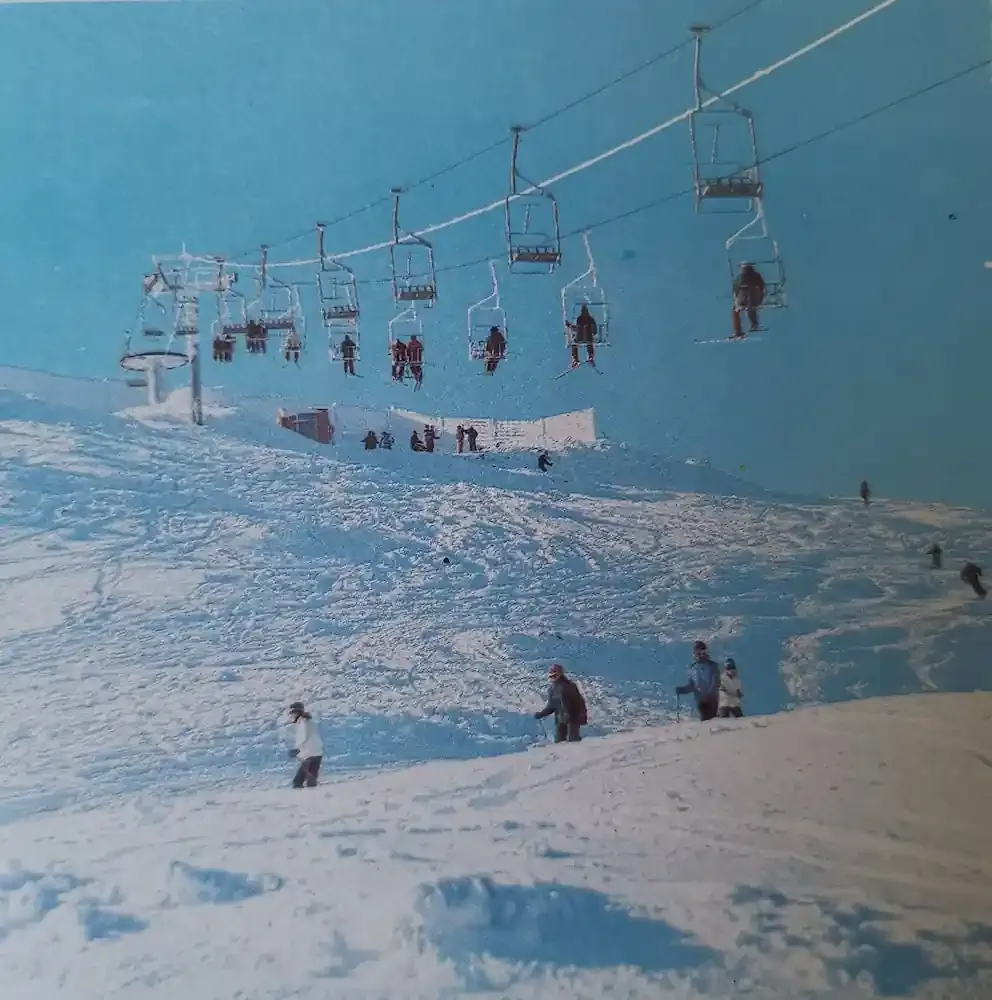
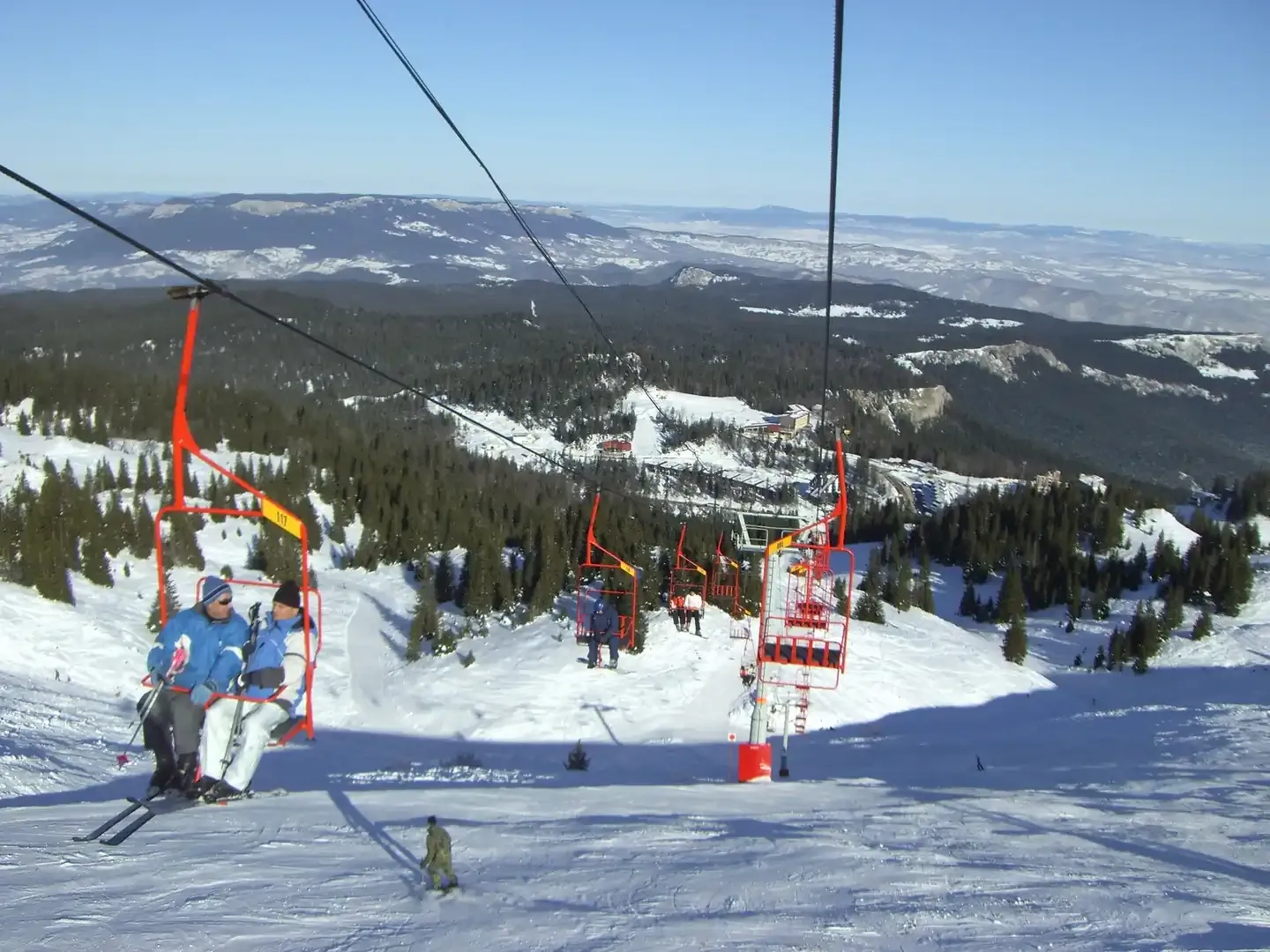
Passengers ride a packed chairlift line over the summit sector in a typical winter operating scene.
Red chairs on the Mladost line show one of the upgraded lifts serving Olympic-era circulation.
A 1970s chairlift crossing captures the low-capacity system that preceded the major Olympic upgrades.
This Poljice line view shows older lift supports above the main resort approach.
The Vrhprača corridor appears with narrow lift alignment cut through dense conifer forest.
Skiers pass gate banners near the Bistrica-Košuta sector during a busy training or race day.
A skier's-eye view follows a lift line through the trees on one of Jahorina's steeper approaches.
The lower lift station is shown with queues and support buildings during peak mountain use.
February 1984: The women’s alpine competitions
The run-up to the Games was marked by intense anxiety regarding snow cover, with the mountains reportedly "nearly bare" just weeks before the event. However, a massive snowstorm arrived just one day before the Opening Ceremony, "saving the day" but introducing new challenges. While the fresh snow ensured the events could proceed, volatile weather (including heavy fog) forced organisers to reschedule alpine races daily throughout the Games.
Despite the difficult visibility, the courses on Jahorina provided a stern test. The Downhill run was noted for a critical "S" combination, a technical section described by race officials as the place where "the race would be won," requiring competitors to ski "with brains, not just with guts."
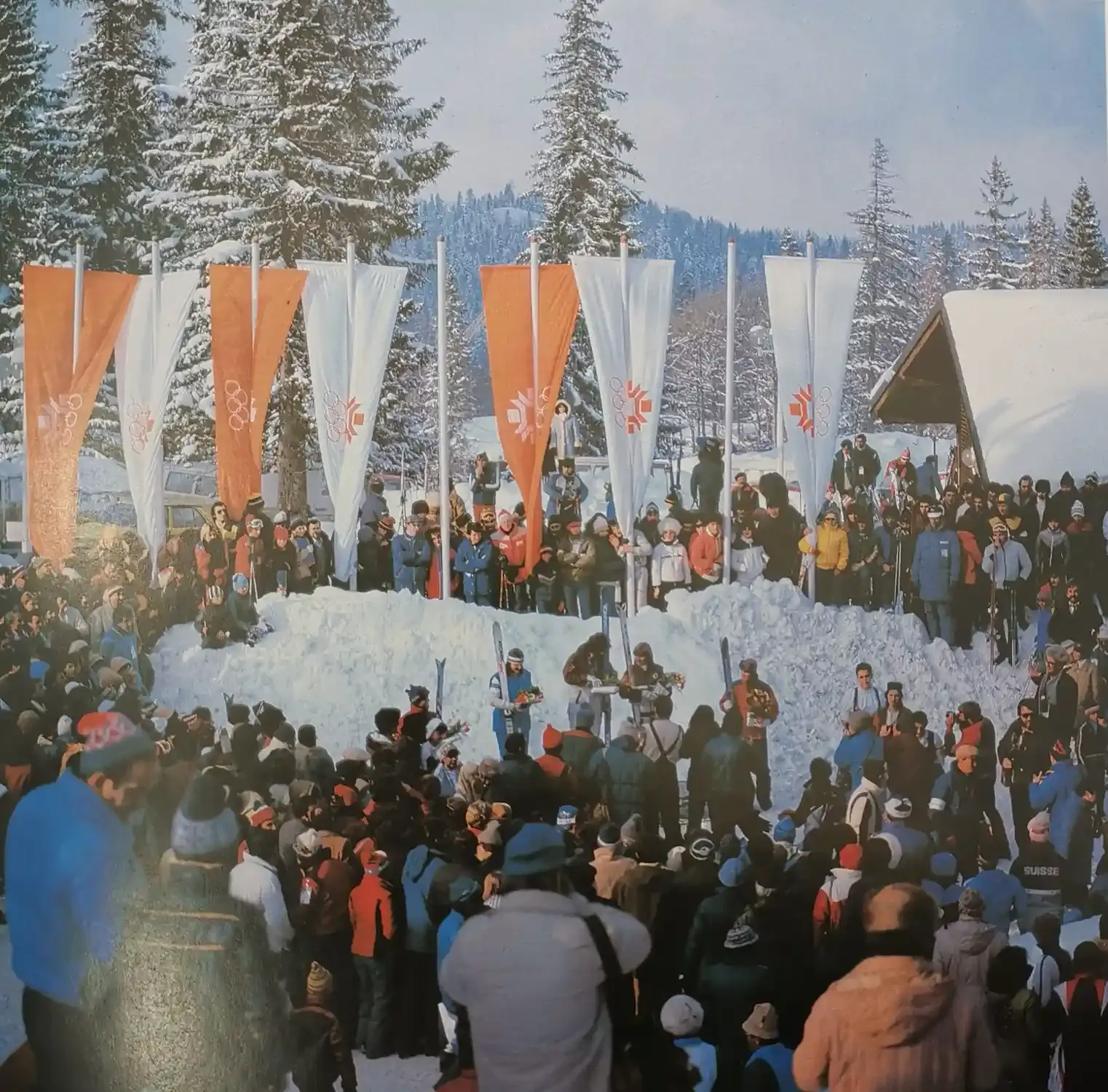
Against a backdrop of "multi-coloured flags" and thousands of spectators, the three women’s alpine events produced the following podiums:
- Downhill: Michela Figini (Switzerland) claimed the gold medal, leading a Swiss 1–2 with Maria Walliser taking silver. Olga Charvatova (Czechoslovakia) won bronze.
- Giant Slalom: The United States dominated the event, with Debbie Armstrong winning gold and Christin Cooper securing silver. Perrine Pelen (France) took the bronze.
I hadn't won a World Cup race before, but I was skiing well in training... When I got to the start gate for the second run, I told myself, 'Have a good time. Just go out there and have fun.' I had a great time. — Debbie Armstrong, USA Gold Medalist
- Slalom: Paoleta Magoni (Italy) won gold, followed by Perrine Pelen (France) with silver and Ursula Konzett (Liechtenstein) with bronze.
Olympic race operations on the mountain
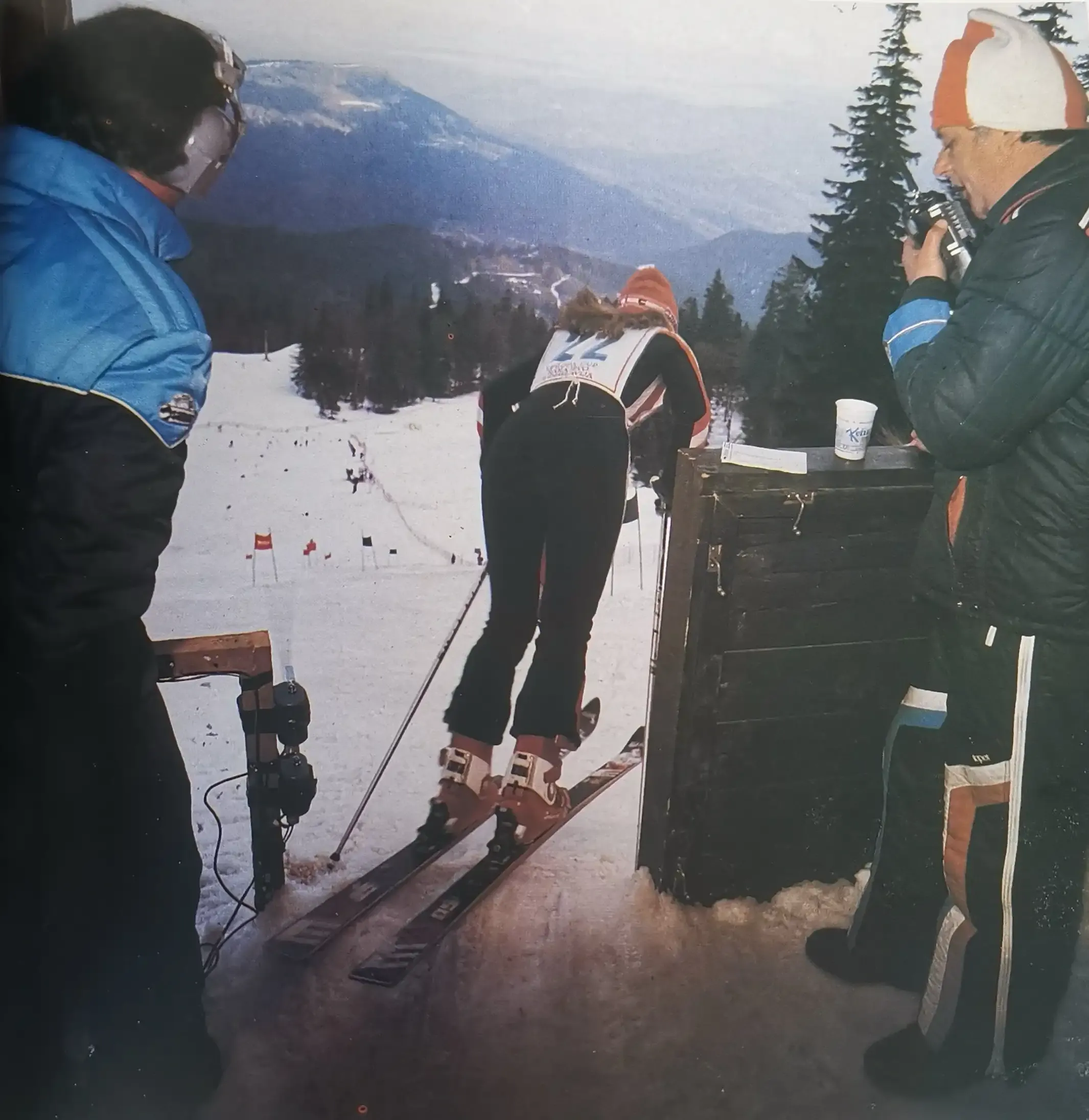
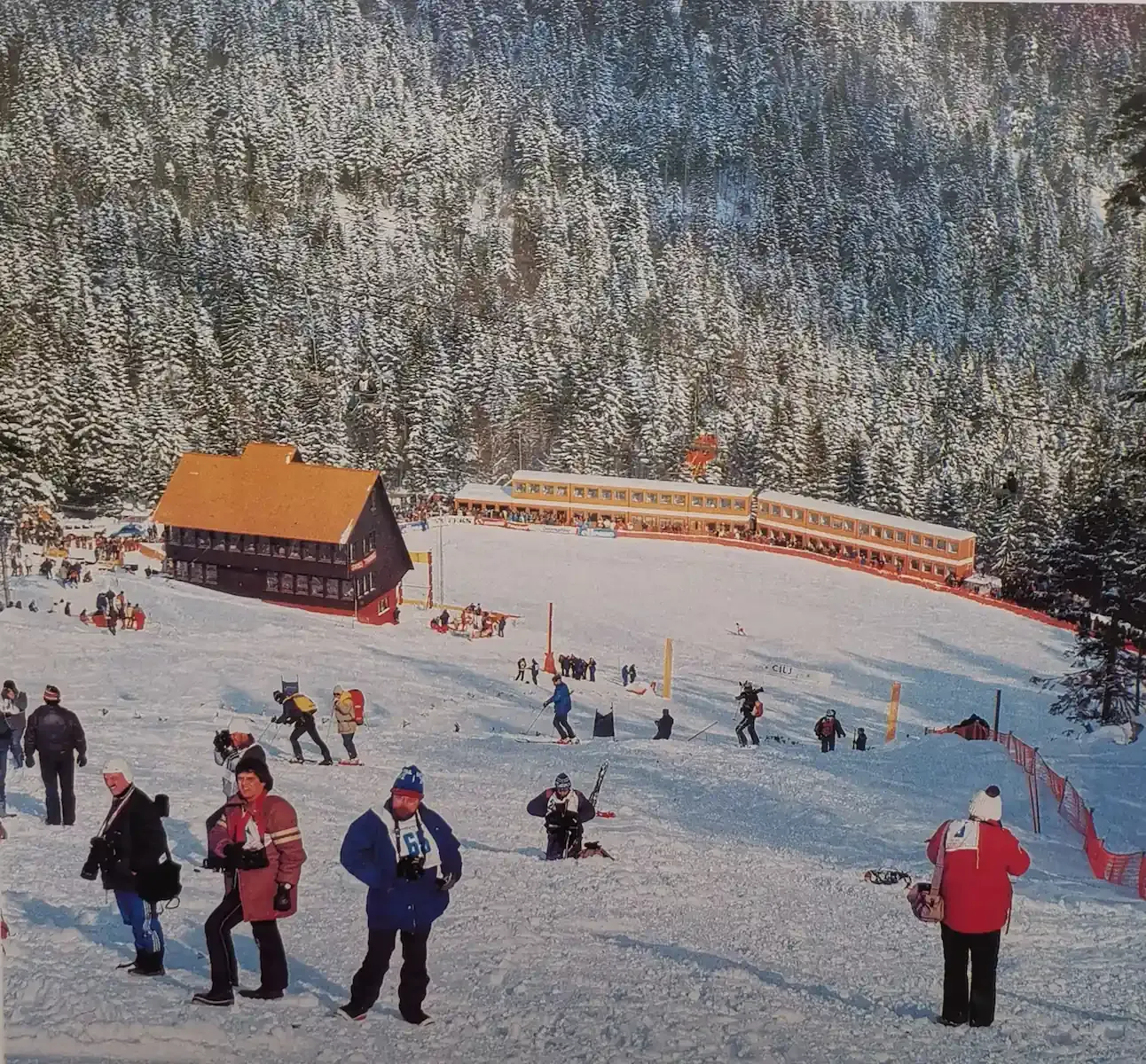
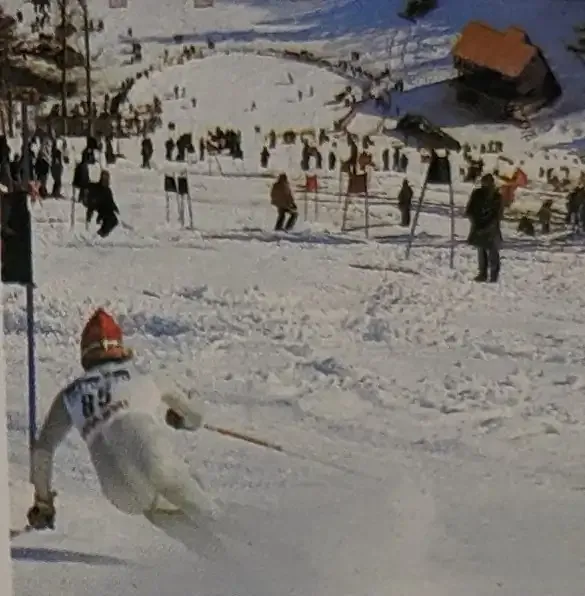
Officials and racers gather at the start cabin where Olympic alpine runs began.
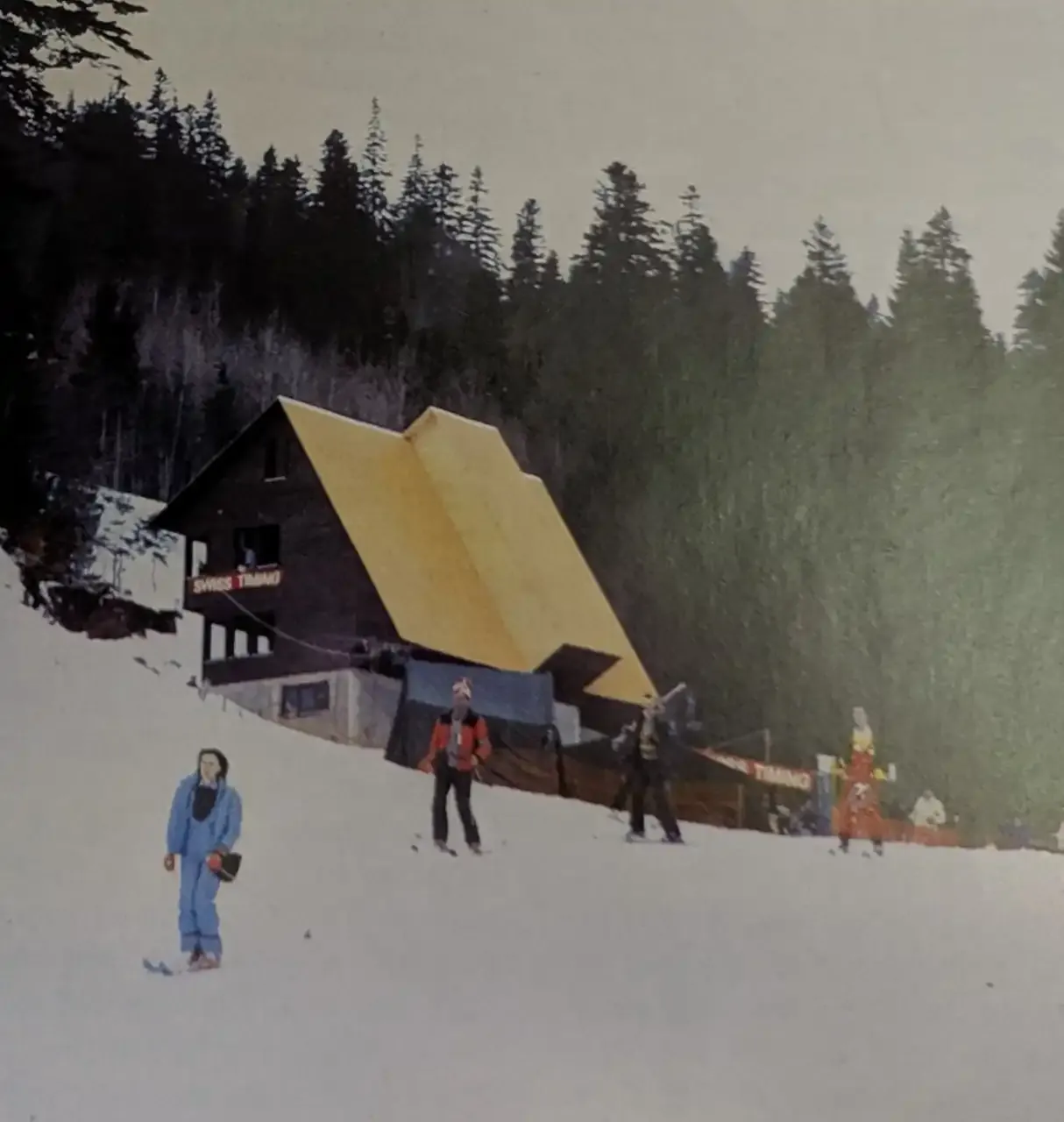
The yellow timing hut marks a technical operations point used for race control and measurement.
A course-side view shows the Vrhprača finish area with lift traffic moving above spectators.
This wide finish-stadium shot captures fencing, officials, and crowd lines at race level.
A slalom finish moment in Rajska Dolina shows the steep final section and spectator edge.
Race personnel and athletes stand at a start platform beside technical barriers and broadcast positions.
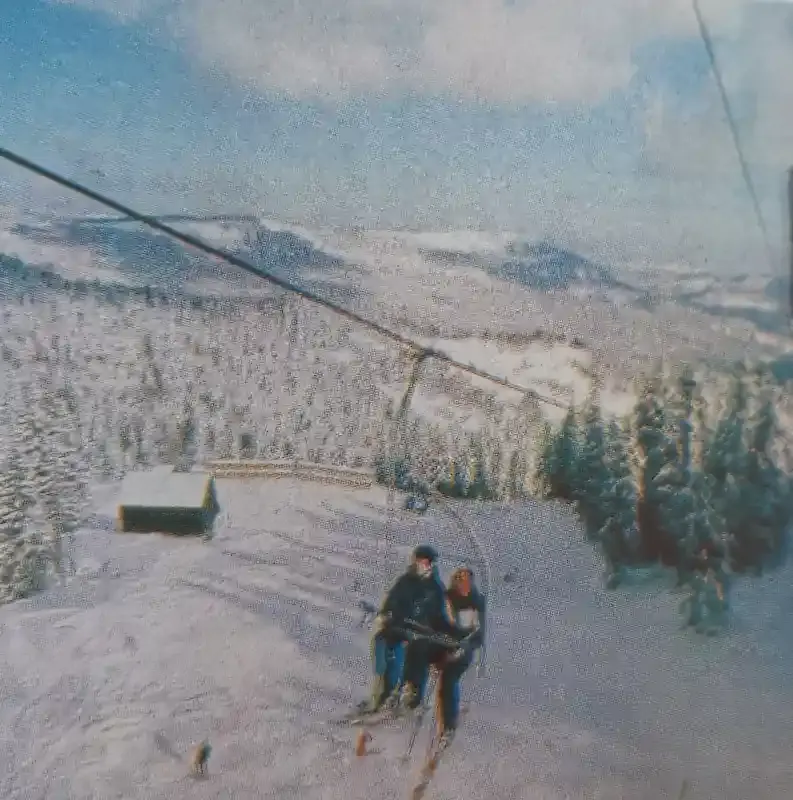
A rider's perspective from the chairlift looks down toward the active race corridor and valley floor.
Large crowds beneath Olympic flags gather for a medal ceremony at the mountain venue.
By 18 February, the venue had concluded its Olympic programme. As the teams departed, the mountain was immediately opened to the public, allowing tourists and locals to test themselves on the same slopes where Figini and Armstrong had just competed.
Technical profile: The 1984 courses
The venue was specifically configured for the technical demands of women’s alpine skiing, utilizing the high-altitude, open terrain near the summit and the forested lower slopes for speed and protection.
-
Elevations:
-
Downhill Start: 1,871 m (near the Ogorjelica summit)
-
Slalom Start: 1,840 m
-
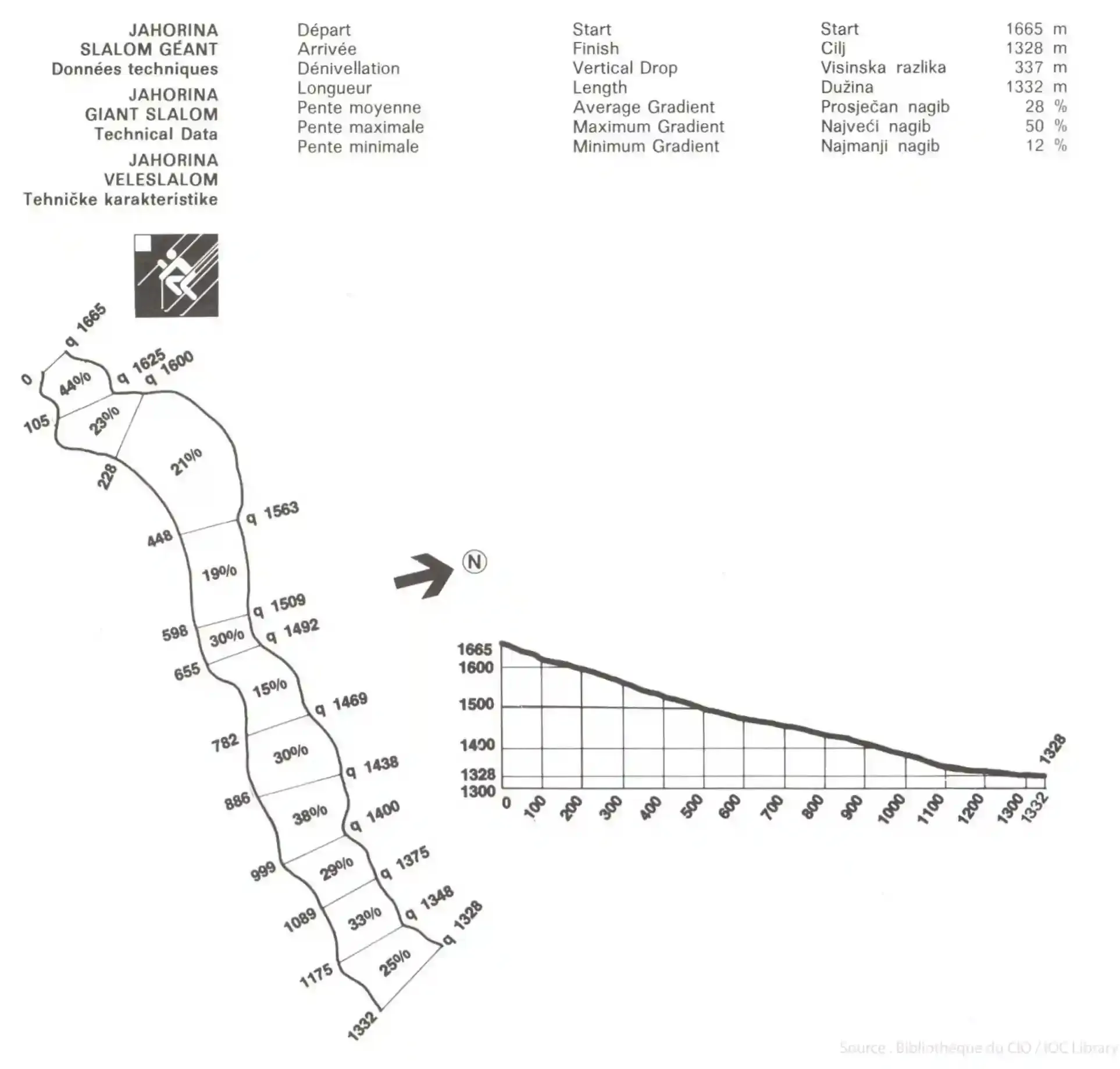
Giant Slalom Start: 1,665 m
-
Finish Area: 1,326 m (Kadino Vrelo)
-
Vertical Drop: Approximately 545 m for the Downhill course.
-
Course Characteristics: The 2,500 m Downhill course featured a distinct "S" combination and a fast upper section on the open face of Gola Jahorina before diving into the tree line.
-
Capacity: The stadium area and course-side viewing locations accommodated 25,000 spectators.
-
Infrastructure:
-
Lifts: A network of 7 cable cars and 6 ski lifts provided uphill transport for athletes and officials.
-
Preparation: Slopes were fitted with extensive drainage channels and underground electronic cabling for timing and communications.
-
Snow Reliability: The venue had a reputation for reliable snow cover (approx. 150 days/year), supported by snow-grooming machinery introduced in the 1970s.
Course diagrams and period publications
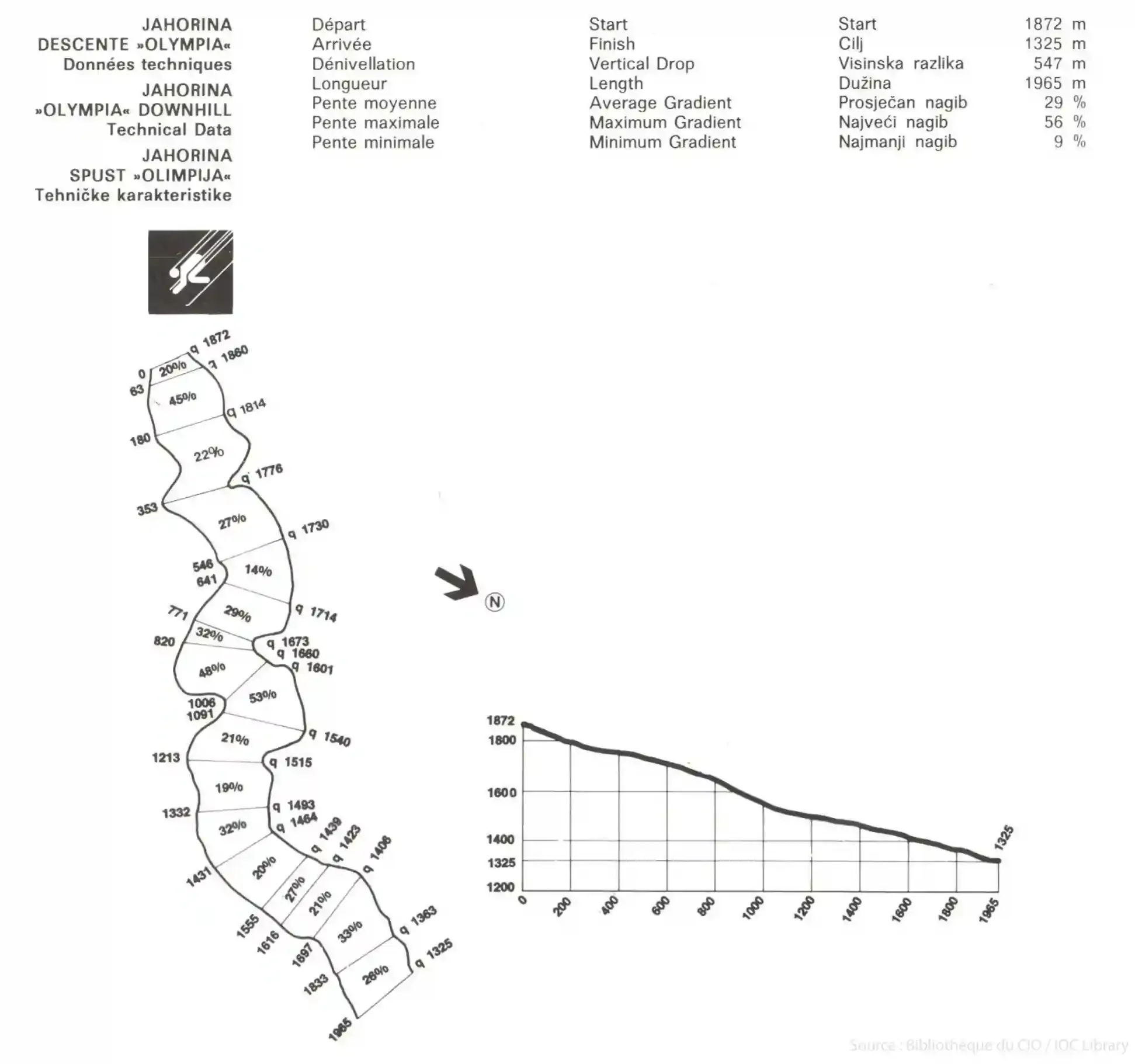
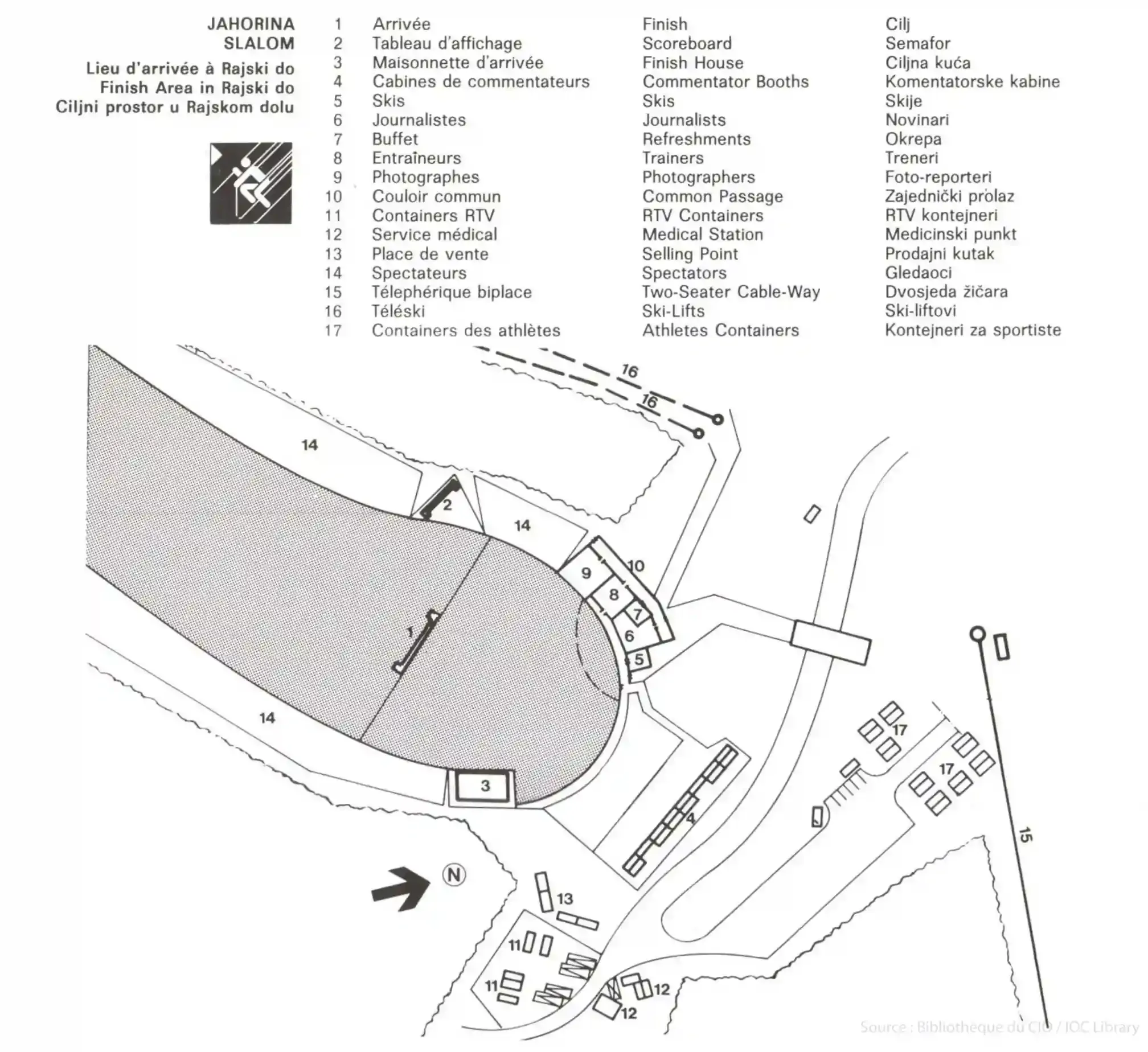
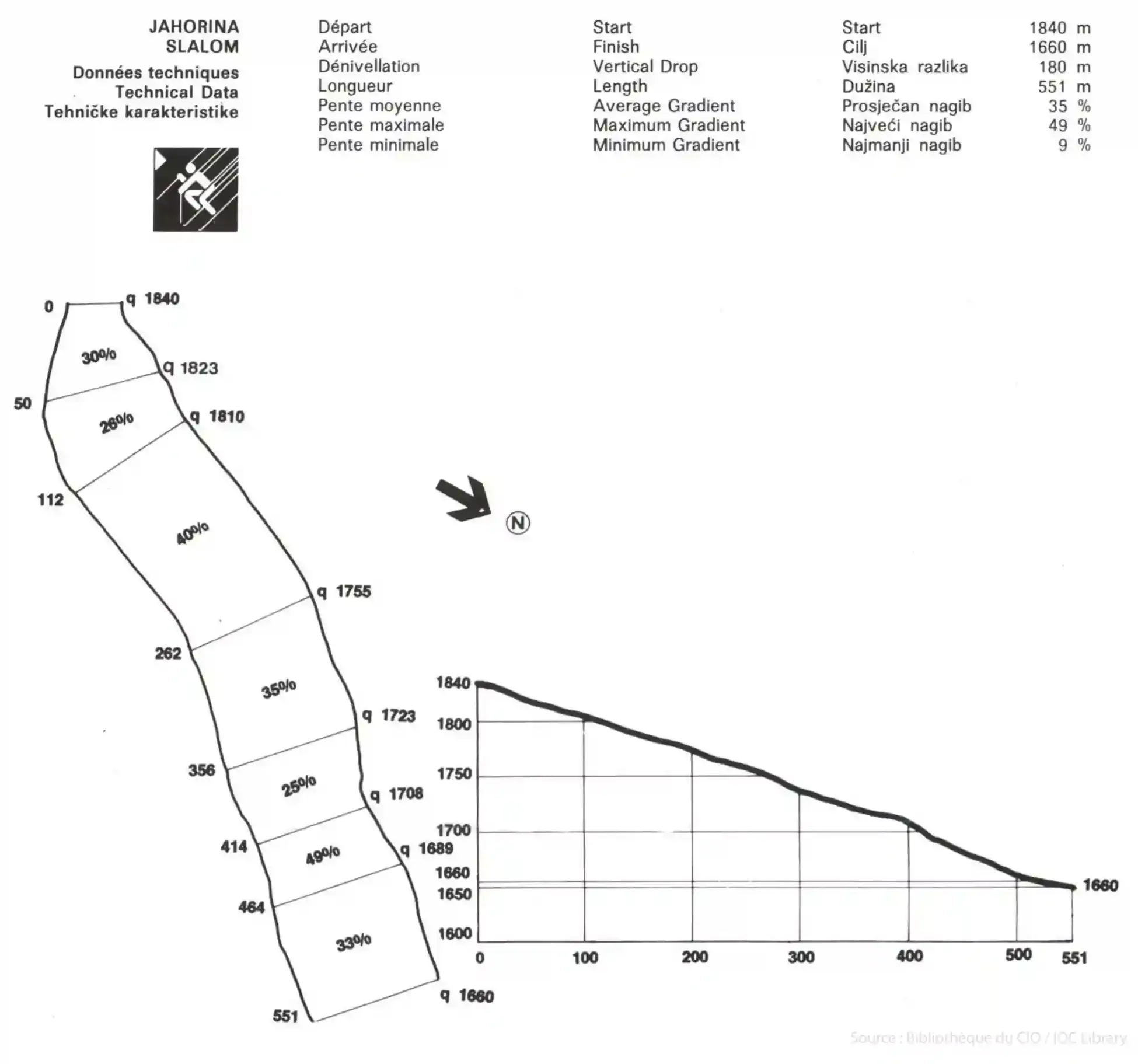
The official downhill profile lists gate sequence, gradient changes, and total vertical drop.
This giant slalom technical sheet plots turn rhythm and slope percentages across the full course.
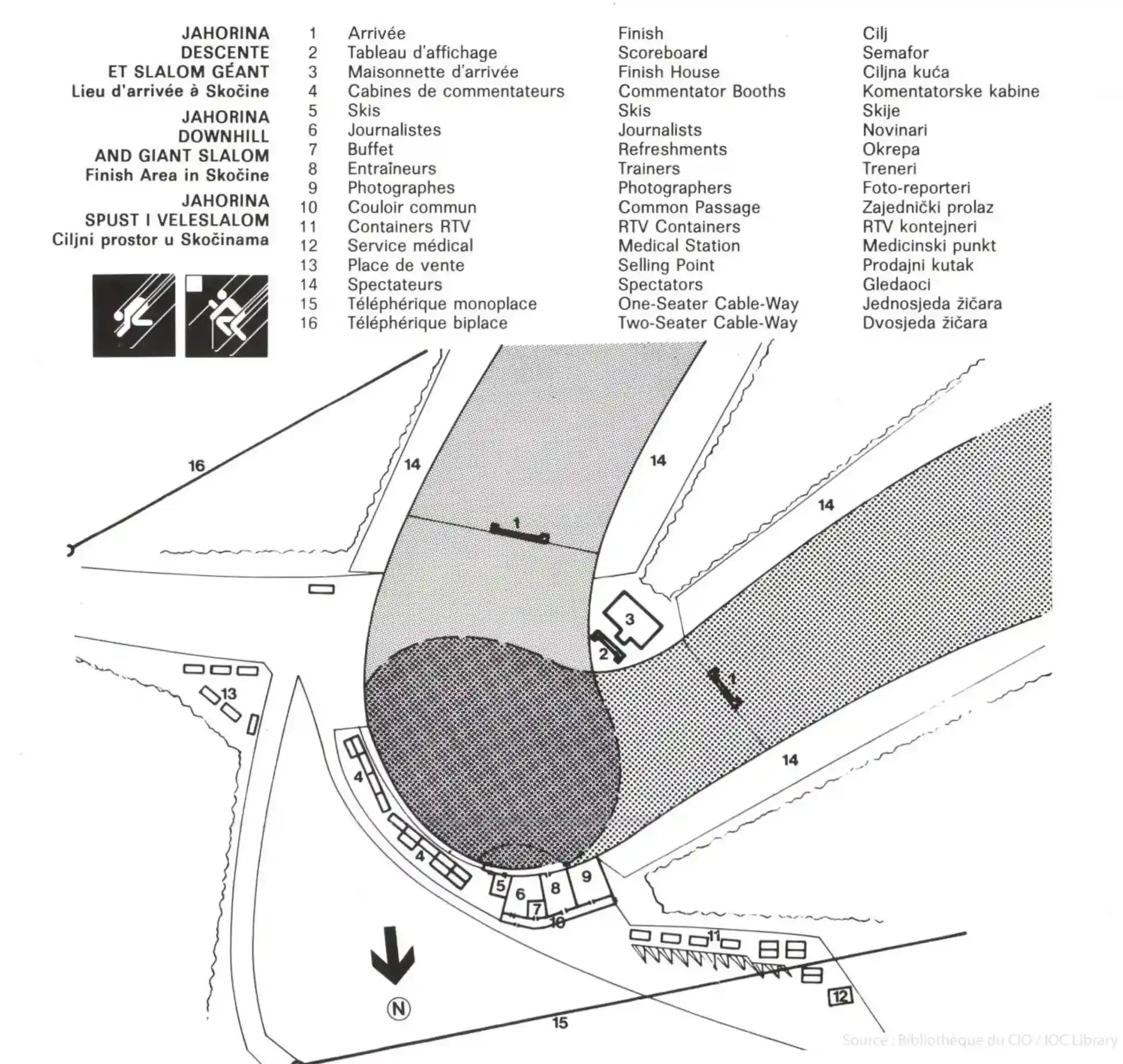
A companion giant slalom finish-area plan details stadium layout and operational zones.
The slalom profile diagram records elevation steps and pitch distribution for the Rajska Dolina line.
This slalom finish map shows spectator sectors, access lanes, and timing infrastructure.
After 1984: Reuse, ruins, and a modern renaissance
Immediately following the closing of the Games, Jahorina capitalised on its new status. On 18 February 1984, the day after the final Olympic race, the venue opened its slopes to the public, inviting tourists to ski the same runs as the Olympic medallists. Throughout the late 1980s, the mountain continued to develop, hosting European Cup races and expanding its accommodation capacity.
The war and its aftermath (1990s–2000s)
The resort’s history darkened dramatically with the outbreak of war in the 1990s. Due to its commanding position, Jahorina became a strategic artillery stronghold. While the mountain itself was not a primary frontline battleground like Trebević, the infrastructure suffered immense damage.
- Hotel Jahorina: The former Olympic sub-press centre was used to house refugees and displaced persons during the conflict. It survived the fighting only to be destroyed by an accidental fire (sources cite 1995 or 2002), leaving a massive concrete ruin at the base of the slopes for decades.
- Landmines: Perhaps the most enduring legacy of the war was the contamination of the mountain with landmines. For years after the conflict, off-piste areas remained dangerous; as late as 2011, incidents involving mines in the "wild" areas of the mountain were still reported, though the groomed runs were cleared.
- Infrastructure: The lift network and support buildings fell into disrepair, with reports from the late 1990s describing the area as a "moonscape" of damaged concrete and shrapnel-scarred structures.
A new era of investment (2017–Present)
After years of slow recovery, Jahorina underwent a thorough modernization cycle beginning around 2017, aiming to restore its status as a premier regional ski centre. This phase was catalysed in part by the hosting of the 2019 European Youth Olympic Festival (EYOF), which brought competitive alpine skiing back to the mountain.
-
Lifts and Vertical Transport: The aging Olympic-era fleet was largely replaced with modern installations. Key additions include:
-
Gondola Poljice: A new flagship 10-seater cabin lift opened in the 2020s, replacing the old transport line at the resort's main entrance.
-
Gondola Javor-Partizan (Emir Kusturica): Opened in November 2019, this 10-seater Leitner installation connects the Prača and Poljice sectors. It was specifically designed to operate in high winds that would ground other lifts.
-
Chairlifts: Several new six-seater chairlifts were installed, including at Rajska Dolina, Trnovo, and Ogorjelica, significantly increasing uphill capacity to over 17,000 skiers per hour.
-
Ravna Planina Link: A gondola project ("Jahorina Express") was initiated to connect the town of Pale directly to the mountain. While the first phase at Ravna Planina is operational, the full connection to Jahorina remains a planned future phase (as of recent sourcing).
-
Snow Security: To combat variable winters, the resort installed a comprehensive TechnoAlpin snowmaking system covering approximately 80% of the slopes (including the entire vertical of the main runs). This infrastructure features a large artificial lake on the summit and "SnowFactory" technology to guarantee cover regardless of air temperature.
-
Accommodation and Facilities: The landscape of the base area has been transformed. Most notably, the charred ruins of the original Hotel Jahorina were finally demolished in 2020. In its place, investors constructed the Hotel Jahorina Mountain Resort & Spa, a massive luxury complex that symbolizes the mountain's shift from post-war recovery to modern tourism. Other additions include the expanded "Olympic Bar" at the summit and the renovation of state-owned facilities like the Hotel Rajska Dolina.
Post-war damage and modern lift replacement
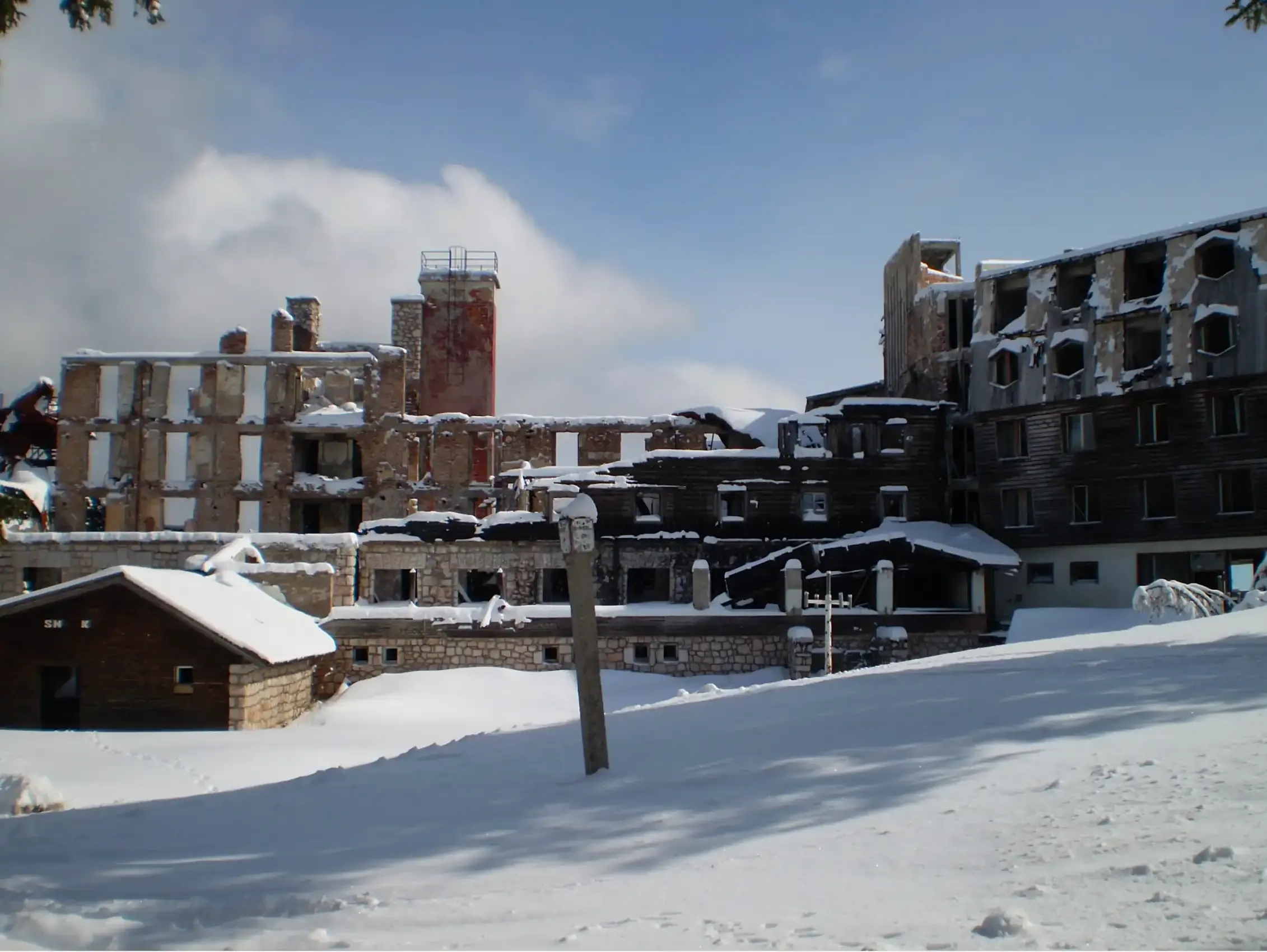
The burned-out shell of former Hotel Jahorina shows the long post-war period of abandonment.
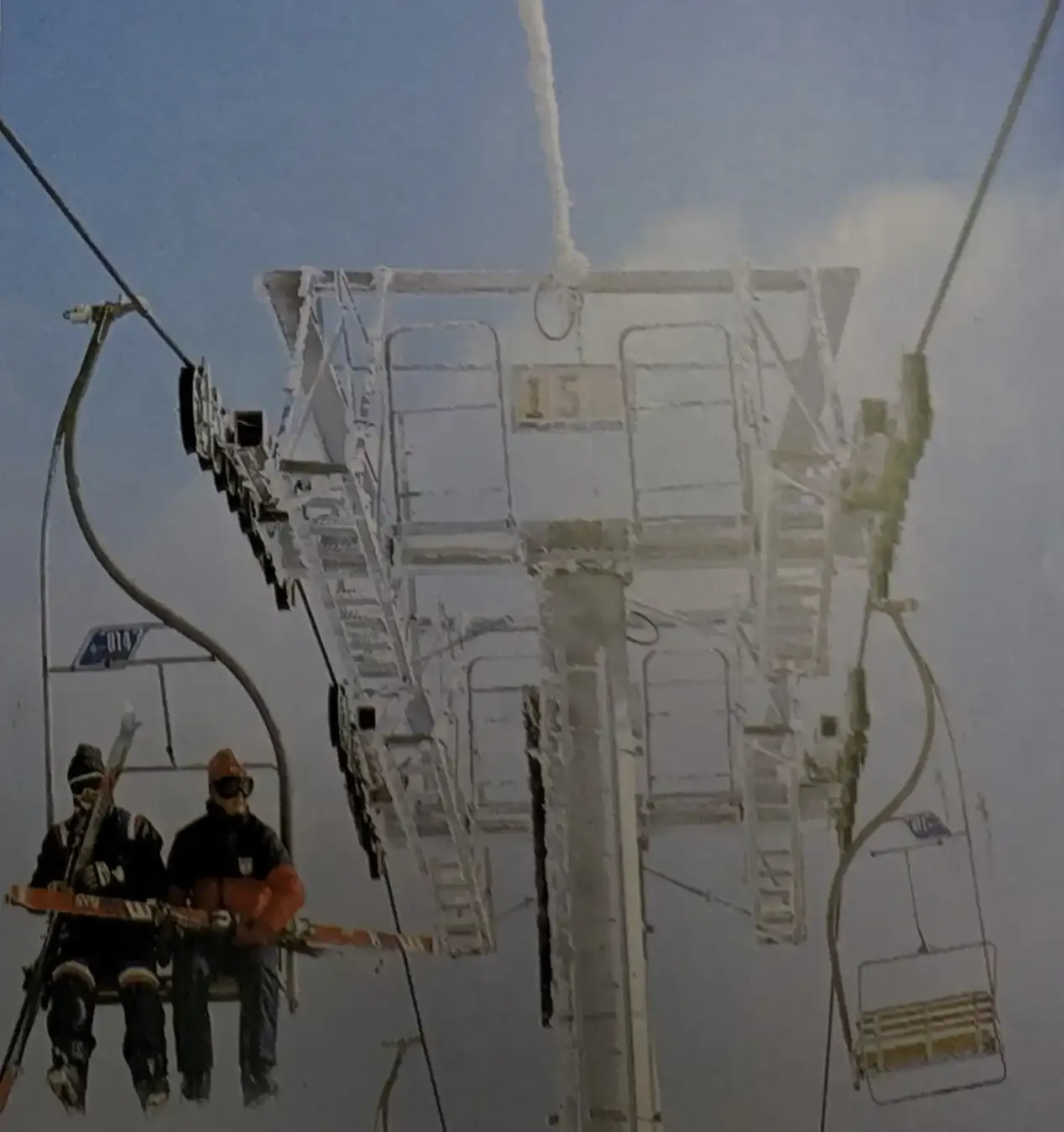
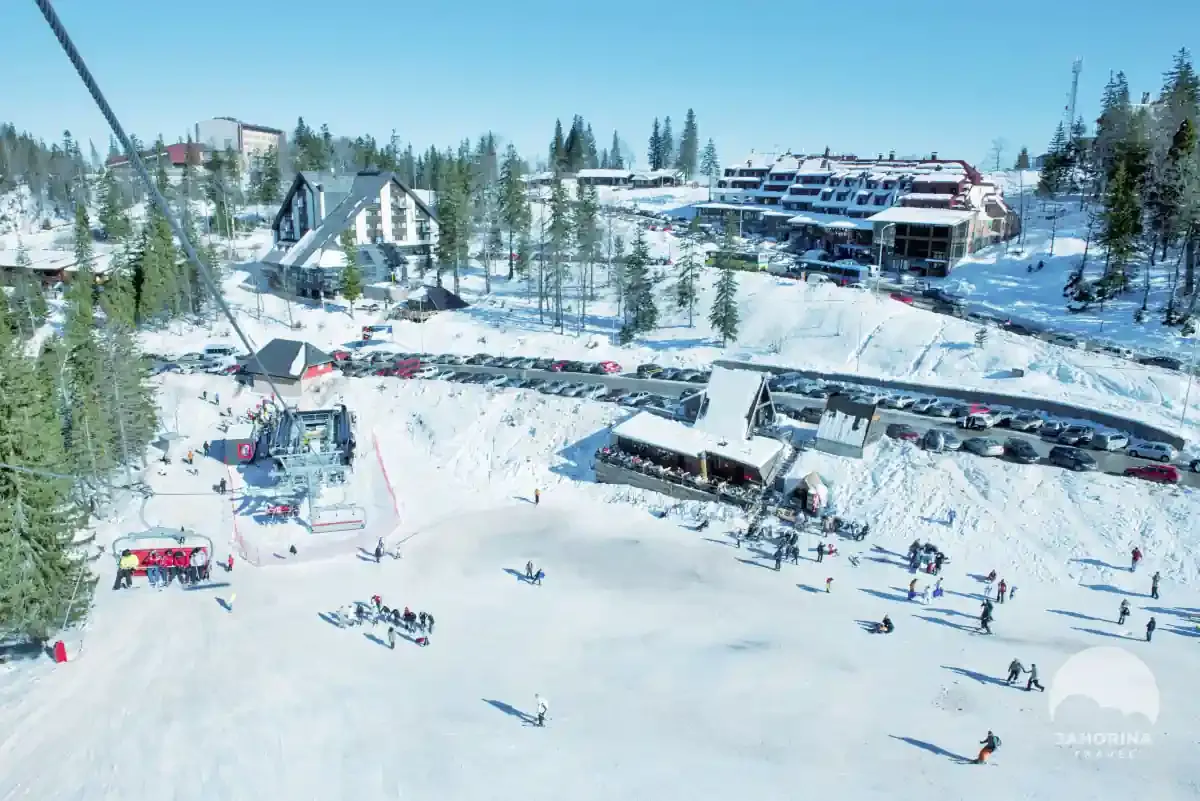
Skiers queue at a modernized lift base where high visitor throughput defines today's resort operations.
A contemporary gondola line demonstrates the large-capacity transport installed in the 2010s and 2020s.
Another view of the same gondola corridor shows the rebuilt Poljice sector in clear winter conditions.
A modern station complex in Rajska Dolina illustrates the scale of recent infrastructure investment.
A current chairlift scene confirms the full replacement of most Olympic-era lift hardware.
Then and now: what remains from the Olympic period
Unlike some of Sarajevo’s other 1984 venues, Jahorina has not remained a "museum" of the Games but has evolved into a modern resort. However, specific elements from the Olympic era remain visible to the observant visitor.
What remains:
The Olympic Courses:
The most authentic legacy is the terrain itself. The Olympic Downhill (Olimpijski spust), considered one of the most demanding sections, was officially reopened in January 2026 after 42 years, restoring the full historic alignment for skiers. The Slalom and Giant Slalom runs in the Rajska Dolina (Paradise Valley) sector also remain active and are clearly marked on piste maps.
Hotel Bistrica:
Built specifically for the Games (opened 1983) on the site of a former villa, this hotel still stands and operates. While renovated, it retains its original 1980s architectural footprint and serves as a tangible link to the accommodation provided for Olympic officials and guests. Symbols and Names:
What is gone:
Hotel Jahorina:
The building that housed the women’s press centre survived the war as a shell but was finally demolished in 2020 to make way for new development.
Original Lifts:
The single-seater chairlifts and T-bars from 1984 have been entirely removed and replaced by modern high-speed chairlifts and gondolas.