
Skenderija Complex
As the urban heart of the 1984 Winter Olympics, the Skenderija Complex served as the Games’ primary social and logistical anchor. While the mountains hosted the descent, Skenderija provided the stage for the celebration, functioning as the Main Press Centre and the central venue for medal ceremonies. This sprawling multi-purpose site transformed from a 1960s cultural monument into a state-of-the-art ice sports hub, blending competitive athletics with a vibrant public life of shopping and culture.
Fast Facts
- Location: City centre, left bank of the Miljacka River.
- Architects: Živorad Janković, Halid Muhasilović, and engineer Ognjeslav Malkin.
- Awards: Federal Borba Award (Yugoslavia’s highest architectural honour) and the April 6th Award of Sarajevo.
- 1972 Core: Dom Mladih (Youth House) and Mirza Delibašić Hall (Main Hall).
- Olympic Expansion: Ledena dvorana (Ice Hall) and Privredni grad shopping centre (completed 1983).
- Total Area: 70,000 square meters.
- Role in '84: Ice hockey, figure skating compulsory figures, training, Main Press Centre, and Victory Ceremonies.
- Medal Events: 32 of the 39 official victory ceremonies were held on the Skenderija plateau.
- Press Capacity: Nerve centre for approximately 7,000 media representatives.
- Status Today: Fully operational for sports and trade; Ledena dvorana remains impacted by its 2012 roof collapse.
Skenderija in one glance: A complex, not one building
Skenderija is not a single arena, but a vast, multi-layered urban environment designed to consolidate culture, sport, and commerce into one "Agora", a contemporary meeting place. Located on the site of a 15th-century bazaar established by Skender Paša and emerging during a period of intensive post-war construction, the complex was a progressive experiment in social planning, integrating a modern traffic bridge while repurposing the existing steel bridge as a dedicated pedestrian corridor.
The site is defined by its raw materials: a Brutalist mix of exposed concrete, oak wood, and clay tiles. It was one of the first buildings in Yugoslavia to use raw concrete for its exterior design, a bold choice that initially met with skepticism but ultimately secured its architectural identity.
The complex is organized around a central elevated square, or plateau, which serves as the primary outdoor gathering space. Beneath and around this plateau are four distinct components: the 1972 core (comprising the Youth Centre and the Main Hall), the Ledena dvorana (the 1980s Olympic Ice Hall addition), the Privredni grad (an extensive underground shopping mall), and the Main Press Centre.
Plans and aerial orientation
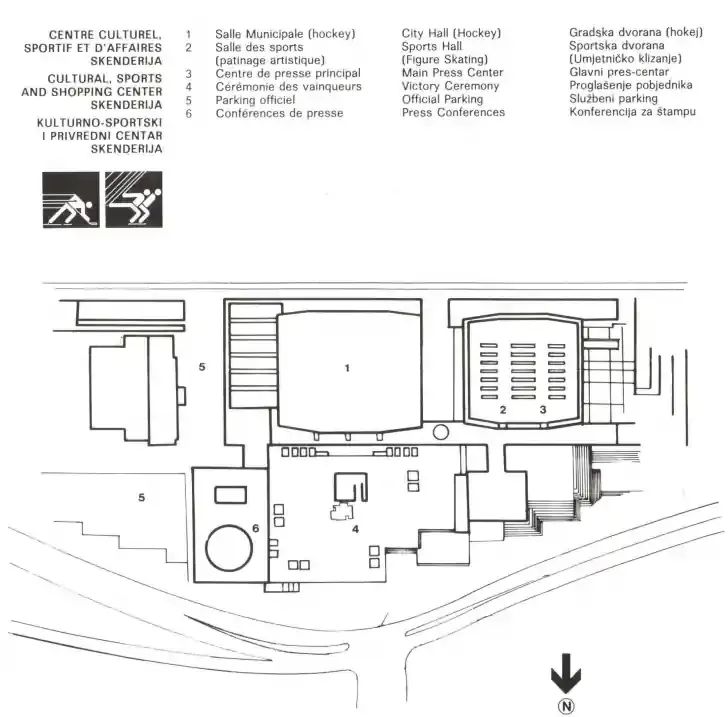
A period master plan of the Skenderija complex details the main halls, press areas, ceremony zones, and circulation around the plateau.
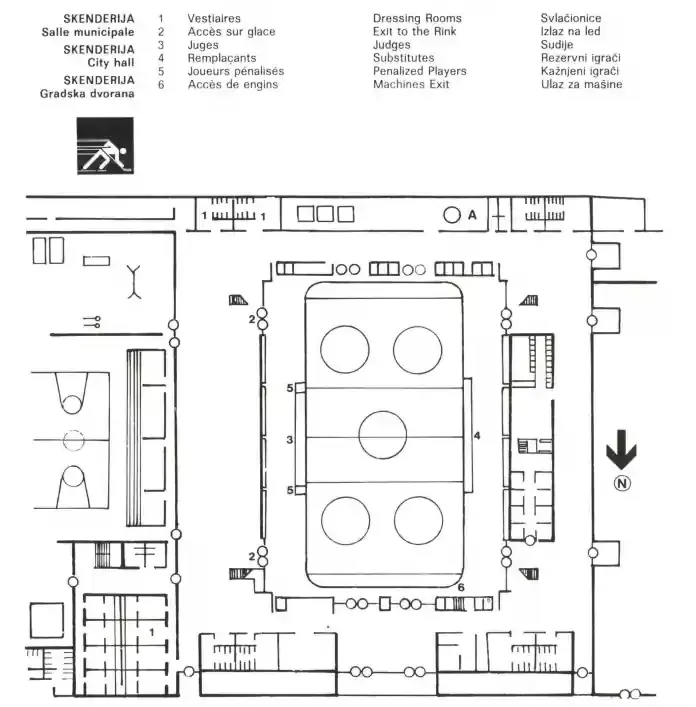
This technical floor plan of the City Hall ice-hockey venue shows access points for athletes, officials, and services.
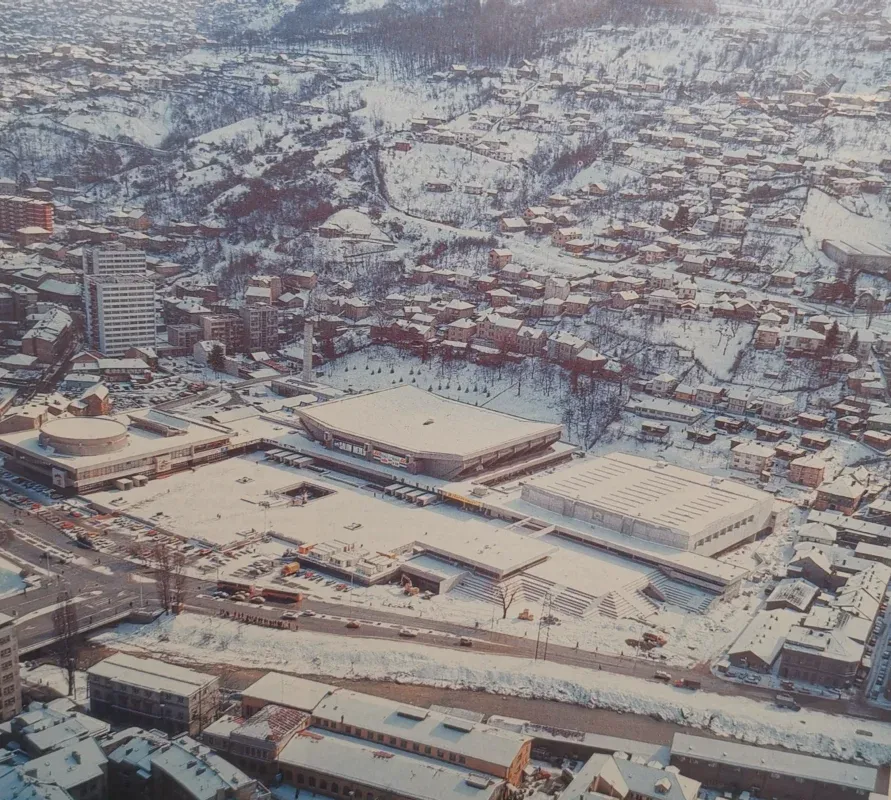
An aerial view of Skenderija during winter preparations shows the expanded Olympic footprint taking shape.
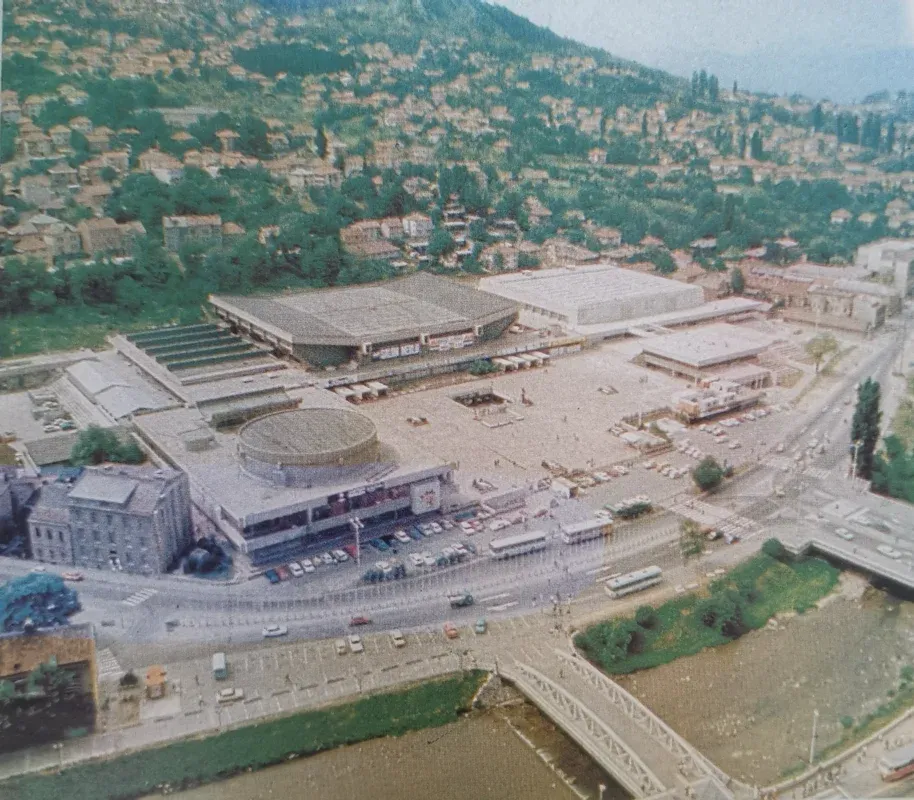
This pre-Games aerial overview captures the full complex with its plateau, halls, and surrounding hillside neighbourhoods.
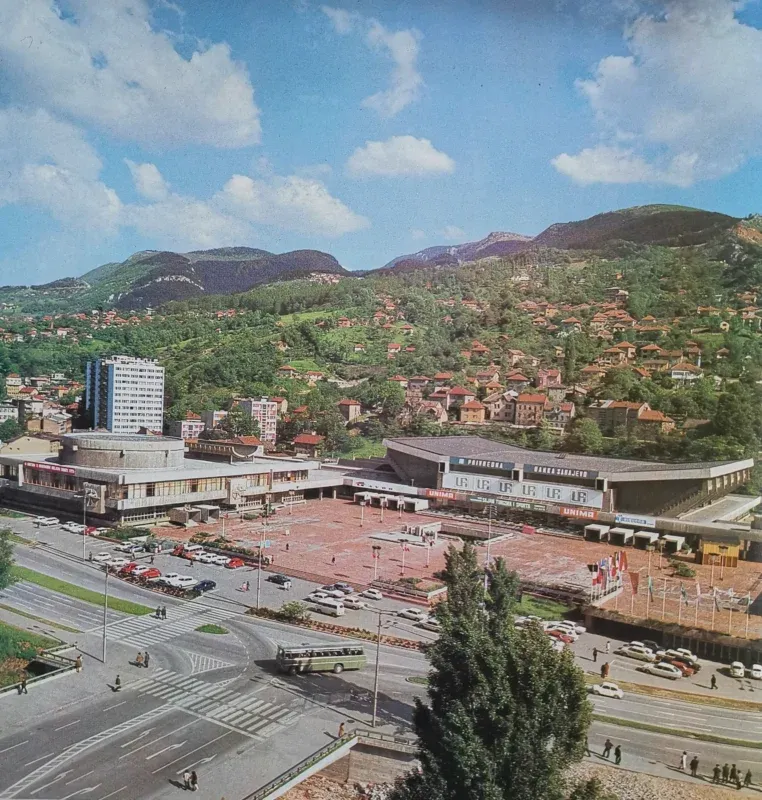
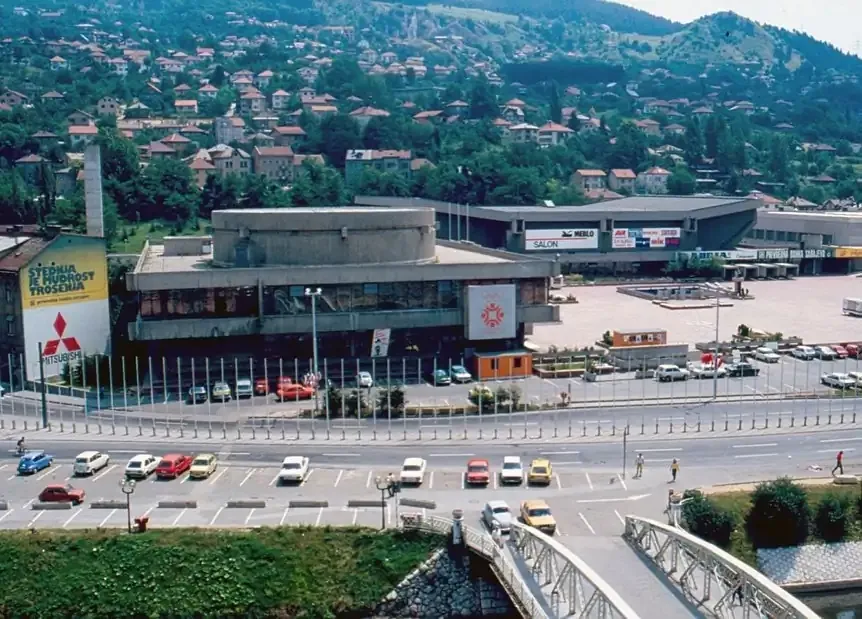
A river-side view of the main buildings highlights the plateau edge, central rotunda, and large sports halls.
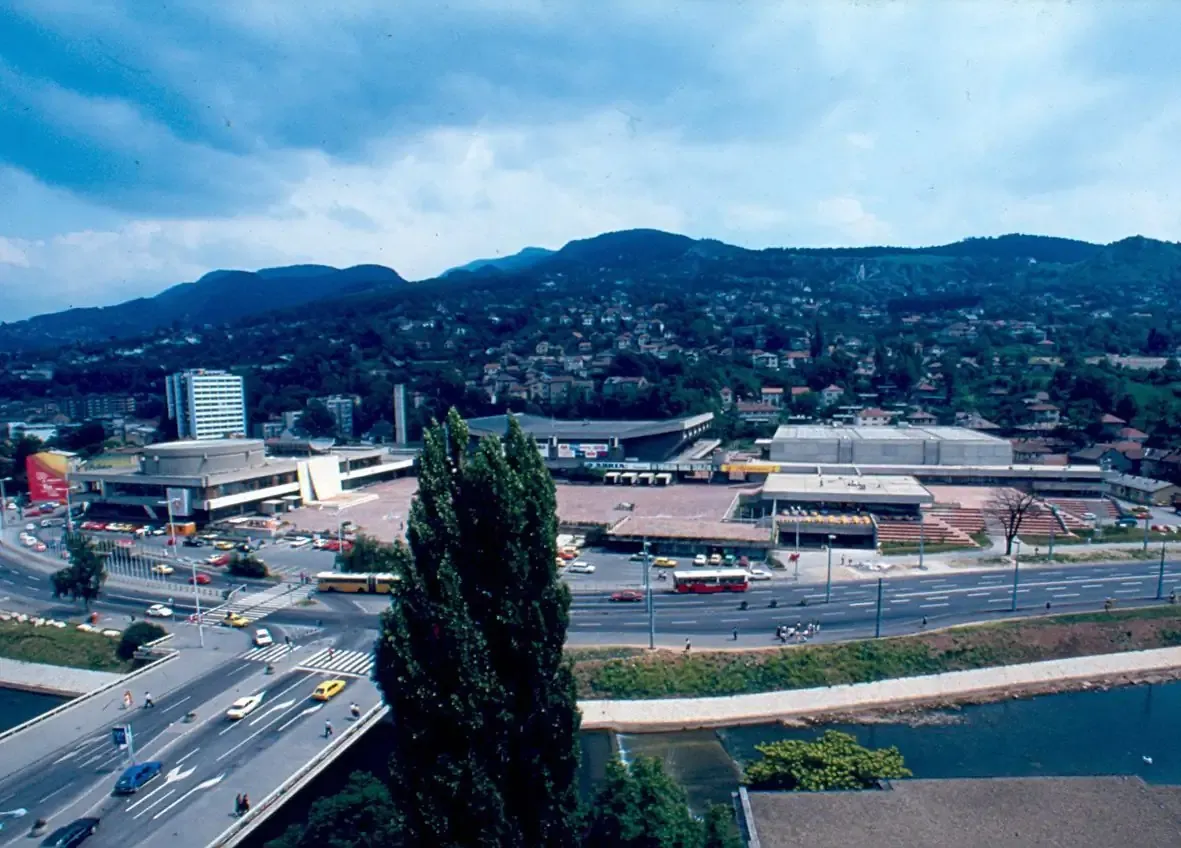
A wide urban panorama links Skenderija to the Miljacka corridor and the city road network.
An oblique aerial view emphasizes the pedestrian bridge approach, road access, and the stepped urban platform.
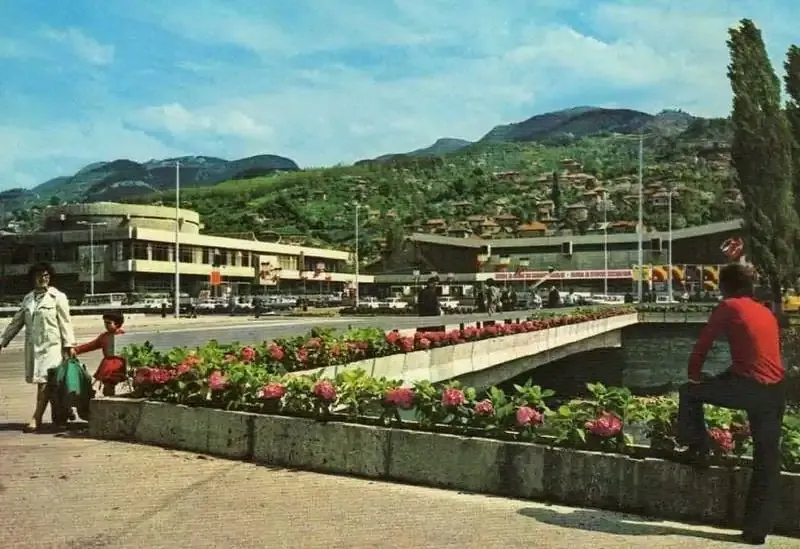
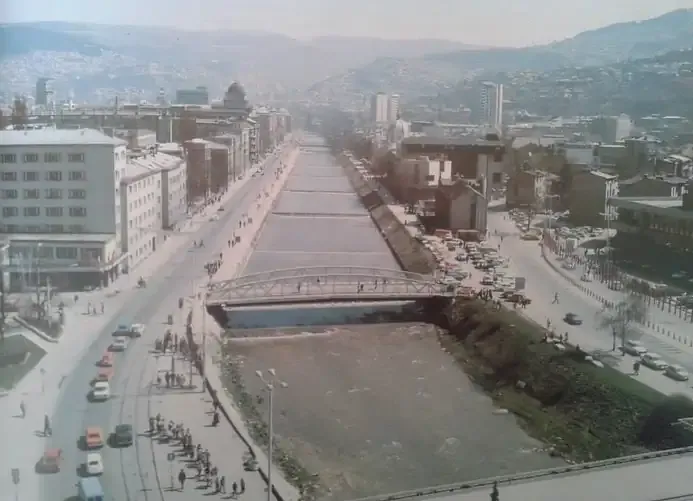
This 1970s riverfront view looks down the Miljacka axis with Skenderija integrated into the central embankment.
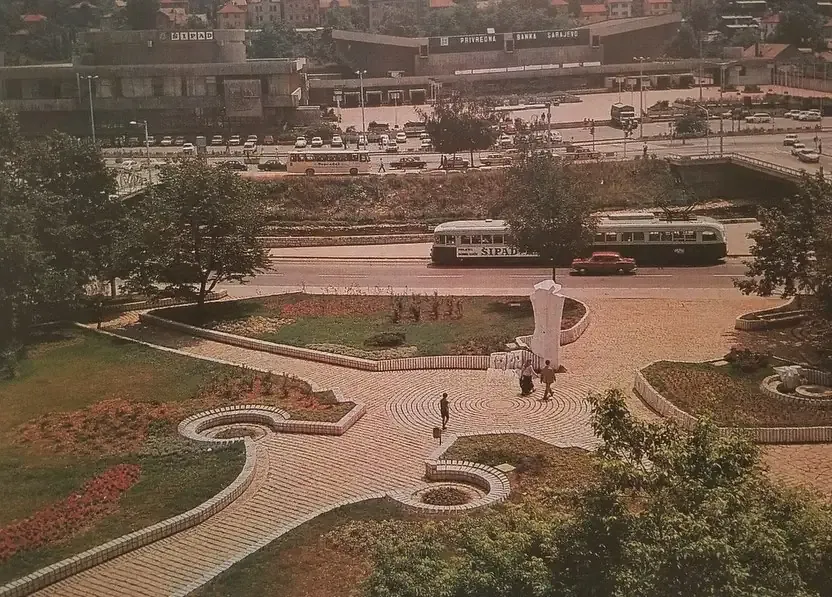
A postcard-era image from the 1980s displays landscaping, tram traffic, and the complex in everyday city use.
The 1972 core: Youth Centre and Main Hall
The foundations of Skenderija were born from Sarajevo’s rapid expansion in the 1960s. Recognizing a lack of large-scale exhibition and indoor sporting space, the city commissioned a complex that would become a "monument of modern Bosnian-Herzegovinian architecture."
A Star-Studded Opening Night
The core was officially opened on 29 November 1969 (Republic Day) with the premiere of the film Battle of Neretva. The event was a global spectacle, attended by Josip Broz Tito and international icons like Yul Brynner, Orson Welles, Omar Sharif, and Carlo Ponti (Sophia Loren was absent due to illness).
- The Picasso Connection: The film's official poster was designed by Pablo Picasso, who requested a crate of the finest wine as his only payment.
- Anecdotes: Yul Brynner initially faced security issues after losing his documents, while the eccentric Orson Welles arrived late by car from Dubrovnik. Entering the hall just as his character was killed on screen, Tito reportedly smiled and remarked, "Just as they killed him?"
- The Atmosphere: The plaza was dominated by a large model of the destroyed Neretva Bridge, and student volunteers who helped build the complex were rewarded with tickets to the premiere.
Mirza Delibašić Hall (Main Hall)
The Main Hall established the site's world-class reputation long before the Olympic bid. Designed with bold structural solutions by engineer Ognjeslav Malkin, the hall’s diverse facilities earned the authors the Federal Borba Award, the first time this prestigious Yugoslav accolade was given to a project in Bosnia and Herzegovina. Before 1984, it hosted the 1970 World Basketball Championships and the 1973 World Table Tennis Championships.
Dom Mladih (The Youth House)
Adjacent to the hall is Dom Mladih. In the years leading up to the Olympics, this venue became a "cult gathering place" and one of the most modernist, Western-styled clubs in Yugoslavia. It was the launchpad for the "Sarajevo School of Pop-Rock," where legendary stars like Dino Merlin and Bijelo Dugme began their careers. During the 1984 period, this 1972 pillar shifted from a music hub to a vital protocol and media facility.
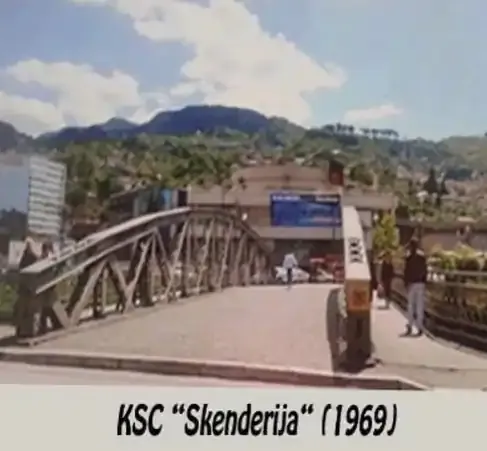
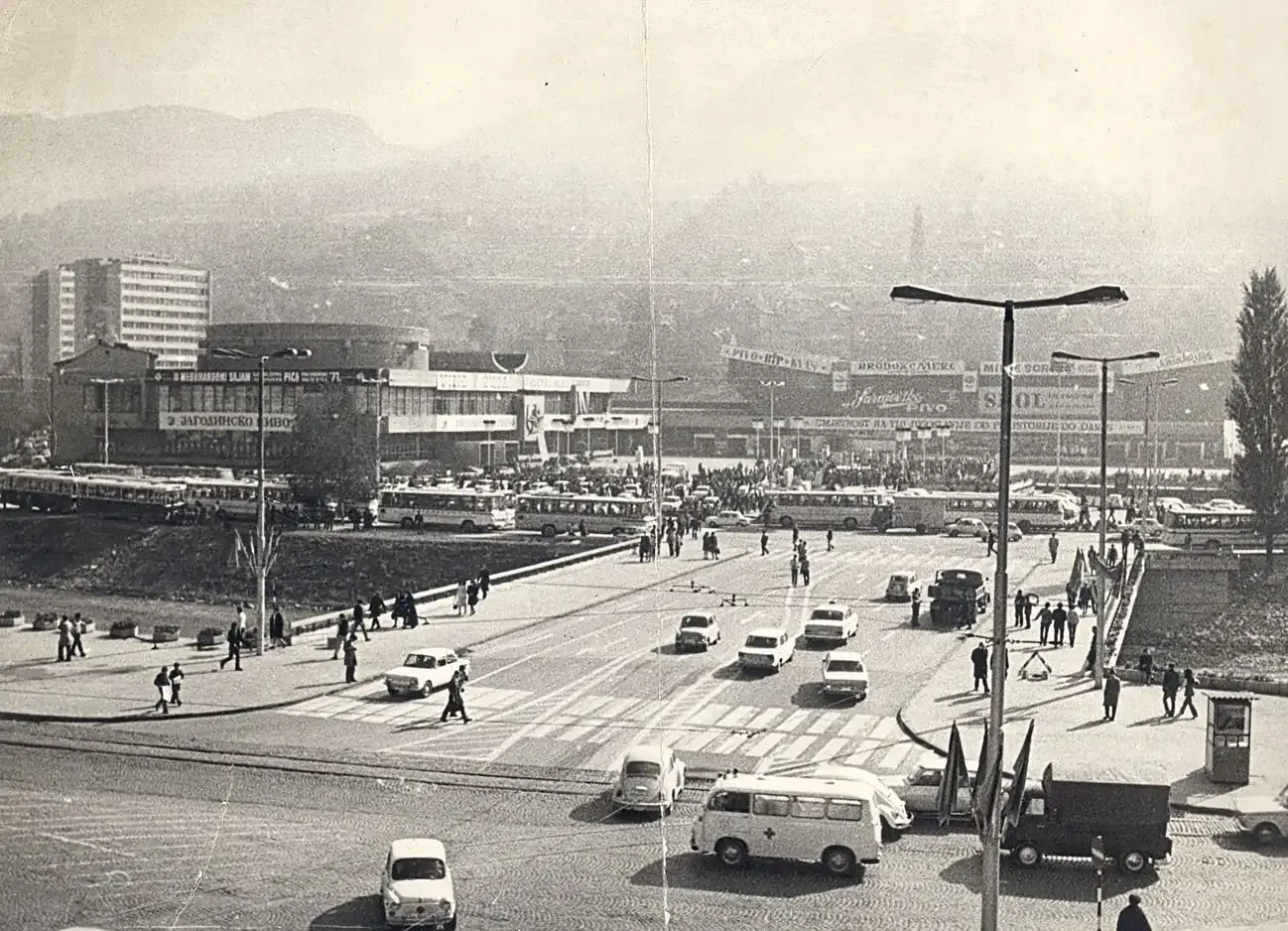
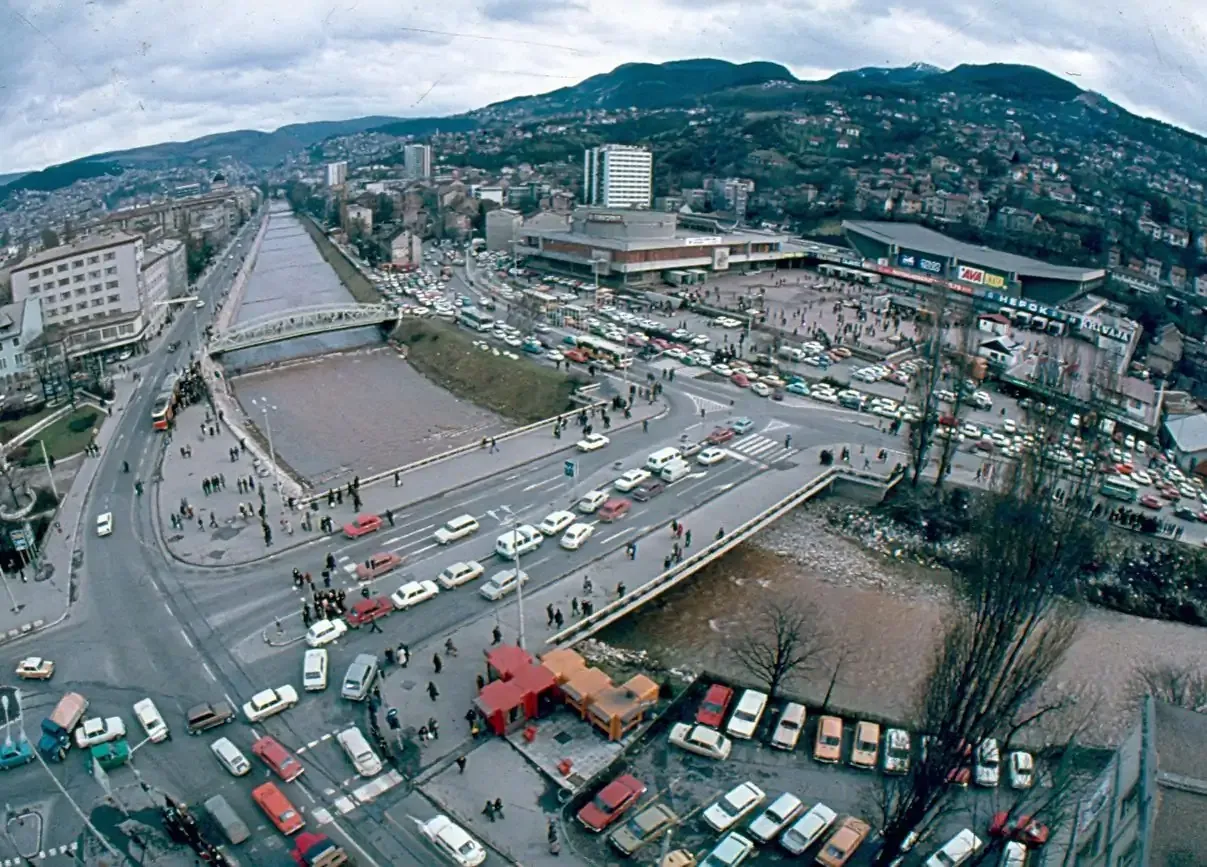
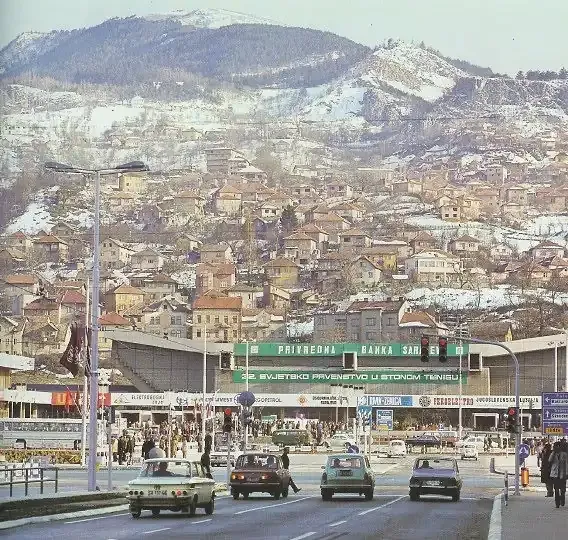
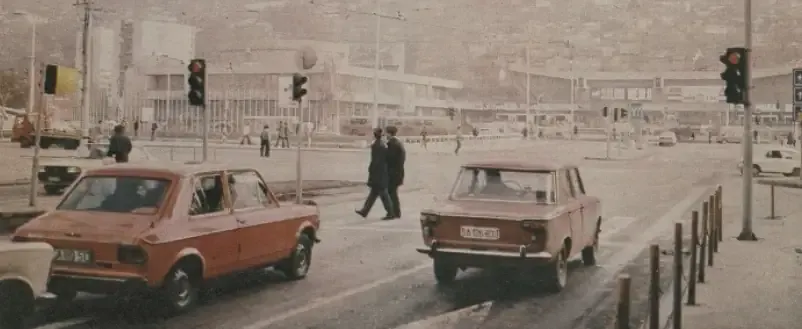
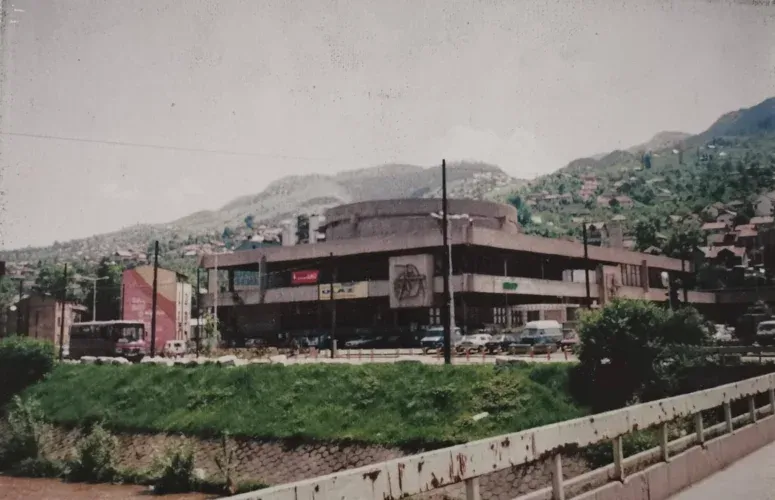
An early 1969 image of the Youth Centre connects the newly built complex to the Skenderija bridge approach.
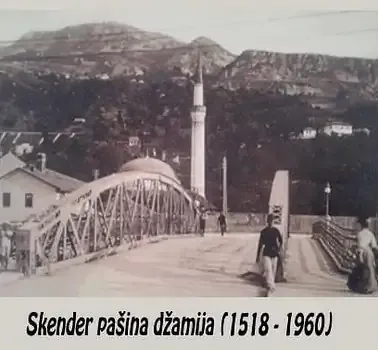
A historic image of the Skender Paša bridge shows the pre-modern crossing and district identity that predated the complex.
A 1970s street-level scene depicts Skenderija as part of daily pedestrian and tram movement.
This black-and-white 1970s photo shows the venue frontage acting as a transport and gathering hub in central Sarajevo.
A colour photo of the major crossroads captures traffic and pedestrian flows in front of the low, horizontal Skenderija massing.
A 1973 winter traffic scene shows the city approach to Skenderija with commercial signage and heavy footfall.
A 1985 view of the busy intersection illustrates post-Olympic urban density around Skenderija and the river crossings.
An angled exterior view from the 1980s shows the original Dom Mladih volume along the embankment.
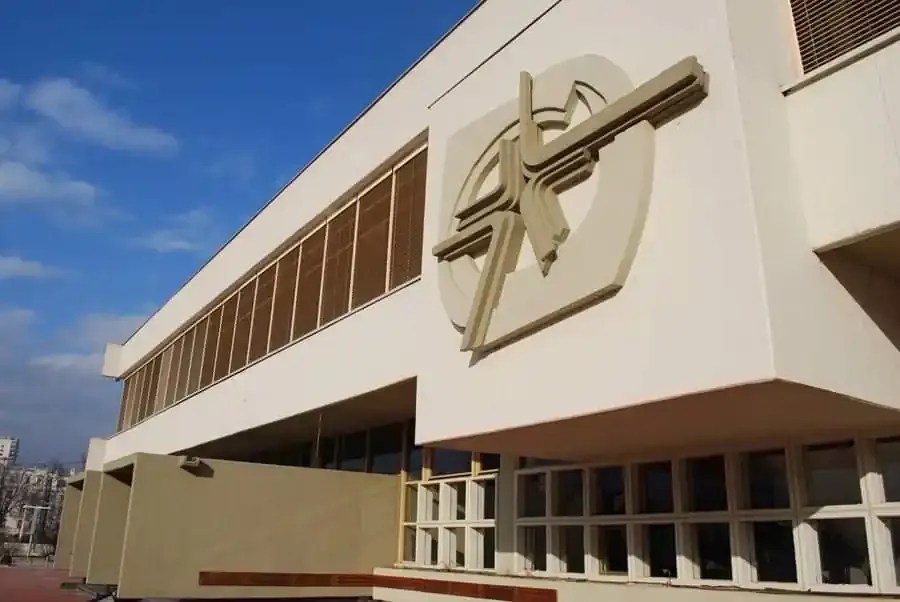
A close-up details the Youth Centre's facade symbol and its late-modernist architectural treatment.
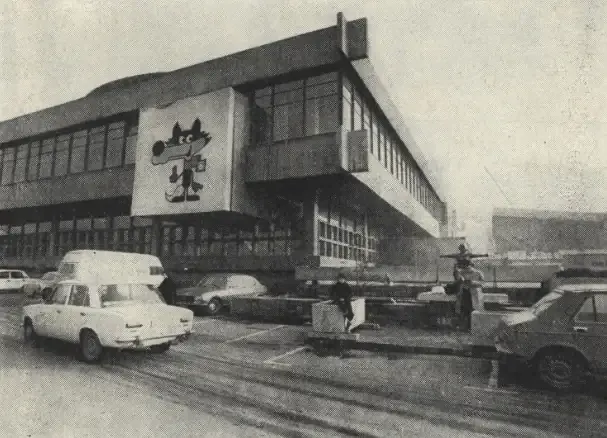
An Olympic-era facade image features the Vučko mascot iconography in public view.
Additions for the Olympic period
When Sarajevo was awarded the Games in 1978, organizers realized the existing infrastructure was insufficient for the full scale of Olympic ice sports. While the complex was originally planned with five phases, only two were realized: the original 1969 construction and the 1983 Olympic expansion. Three additional planned phases remained unconstructed.
Ledena dvorana: the Ice Hall
The most significant addition was the Ledena dvorana (Ice Hall), also known as Skenderija II. Completed in June 1983, this facility provided the city with a dedicated second ice rink. It was specifically designed to handle the heavy schedule of ice hockey and figure skating, ensuring that training and competition could run simultaneously without overtaxing the Zetra Hall.
Privredni grad: The shopping centre
Integrated into the lower levels of the complex, the Privredni grad (Business City) acted as the social and service heart for visitors. This modern shopping centre featured a dense grid of shops, restaurants, and cafes. During the Games, it provided essential amenities for international guests, functioning as a "modern city within a city" that offered everything from local Bosnian cuisine to retail services.
Main plateau: The public stage
The central plateau (the large open-air square) was refined to serve as the Games' primary victory stage. Positioned in the heart of the city, it allowed the local population to participate in the Olympic spirit without needing tickets for mountain venues. The plateau was spatially organized to separate the fenced-off medal podium from the public standing areas, creating a dramatic, accessible arena for the nightly celebrations.
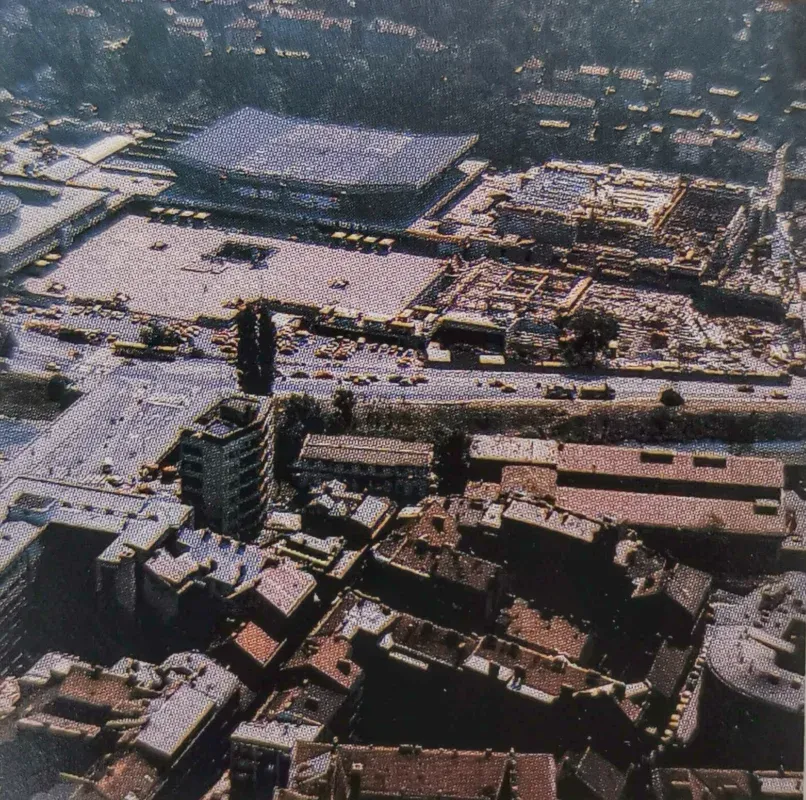
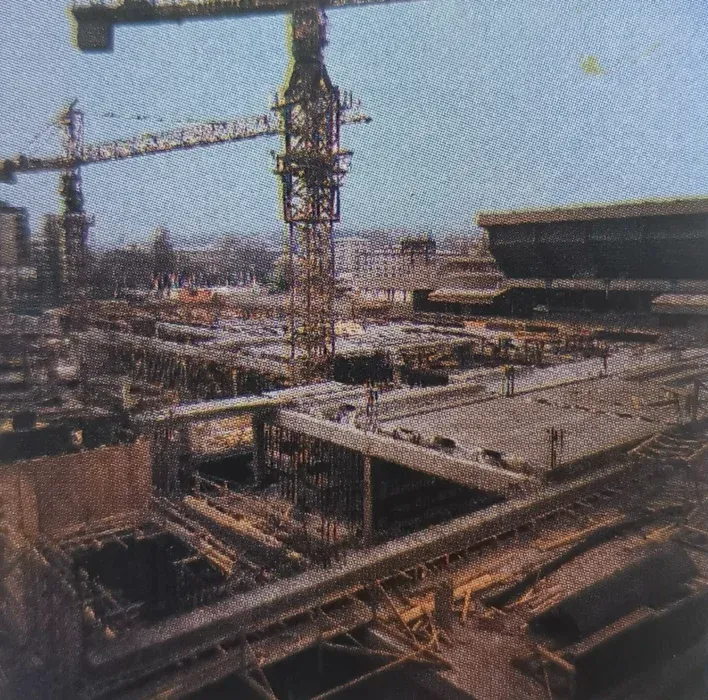
The Ice Hall construction site shows crane and slab works during the major expansion that produced Skenderija II.
An aerial view of the expansion phase reveals foundations and new hall volumes being integrated into the complex.
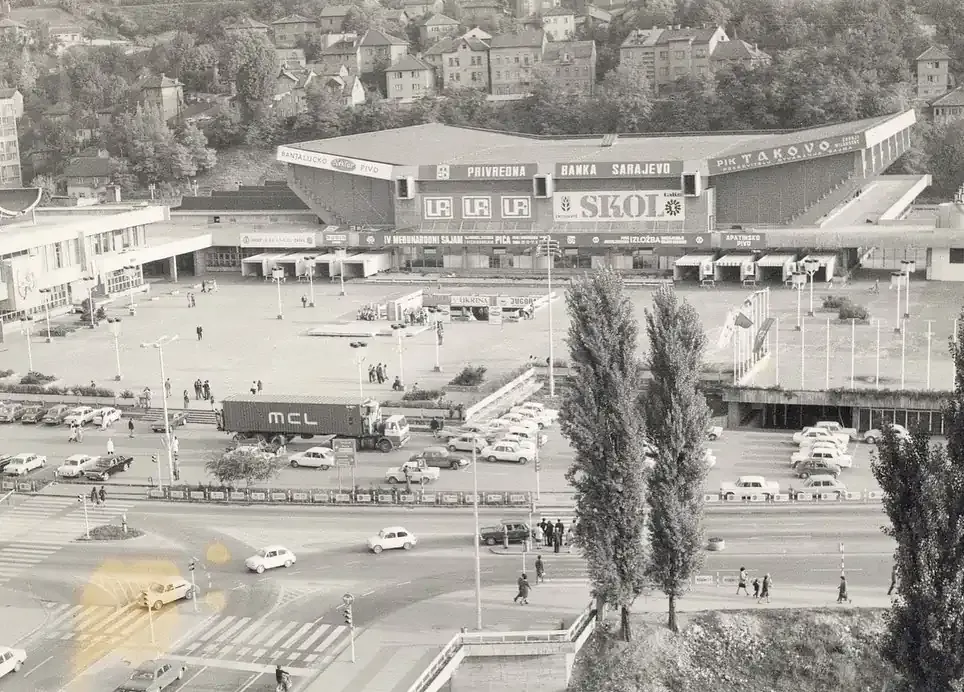
The plateau and commercial frontage are shown in full operation during the 1980s with exhibition and retail programming.
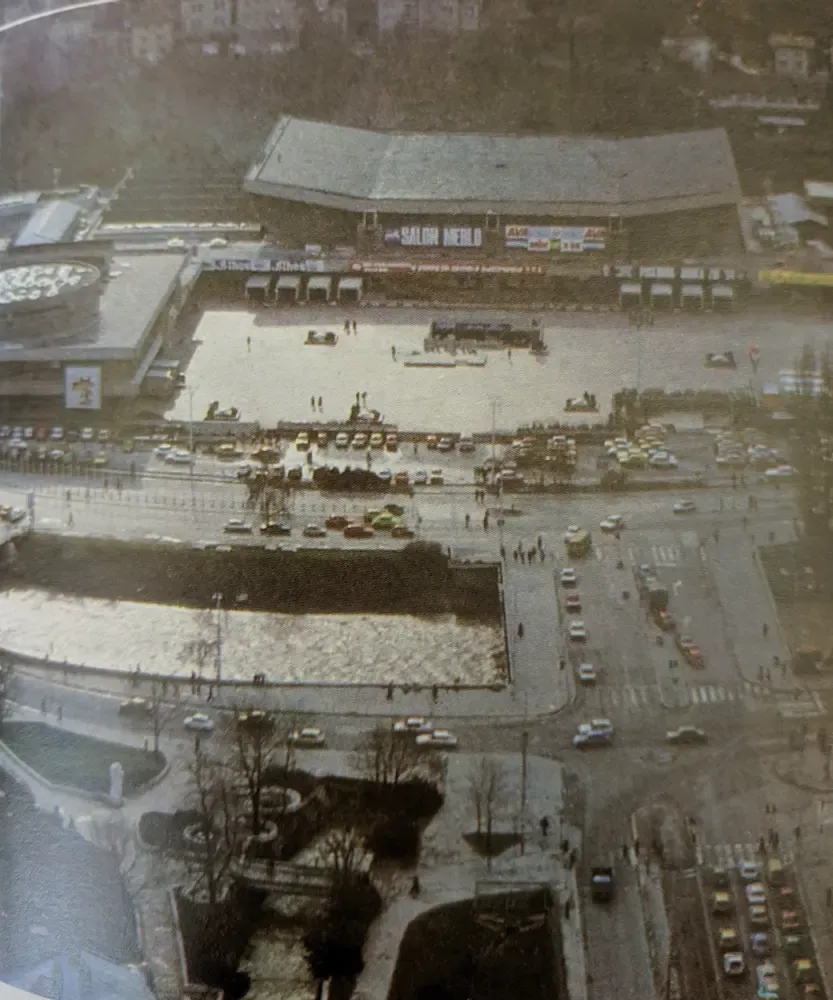
An elevated view after the Olympics shows the civic stage area and surrounding traffic grid shortly after 1984.
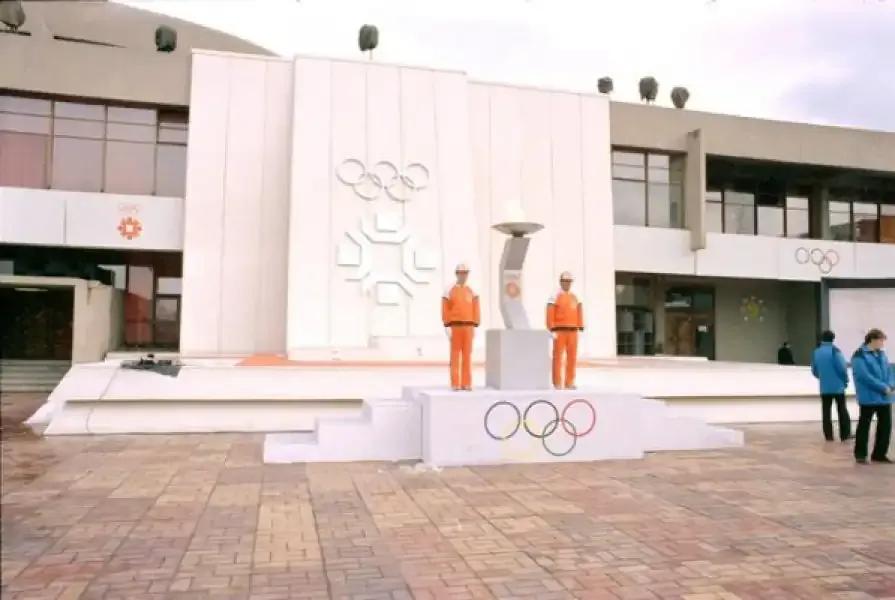
The victory podium setup at Skenderija features a ceremonial stage with Olympic marks prepared for medal presentations.
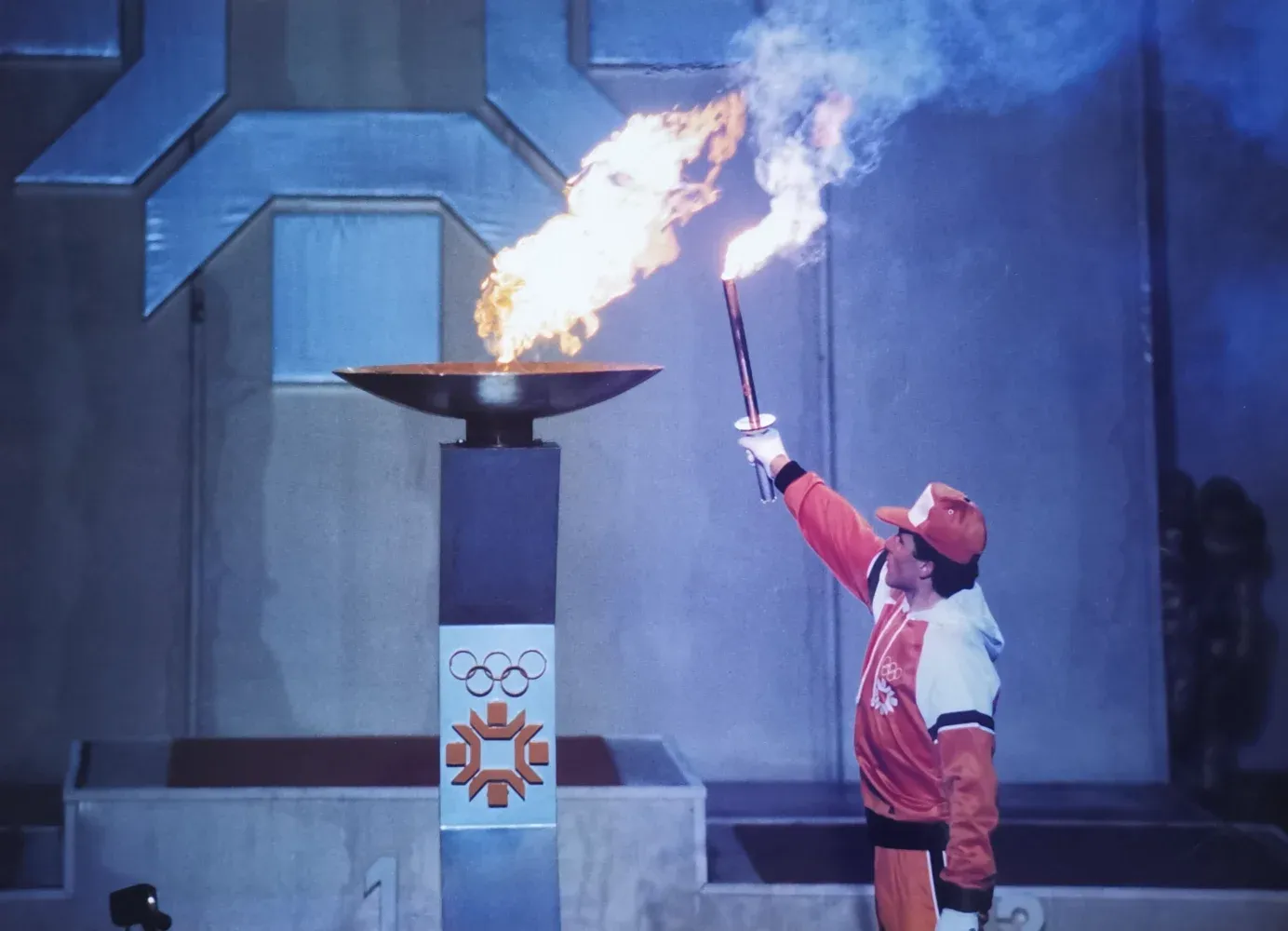
A flame moment on the Skenderija stage captures Olympic torch and cauldron imagery associated with ceremony functions.
What happened here in February 1984
During the 12 days of the Games, Skenderija was a hive of activity that balanced intense athletic focus with nightly celebration. While Zetra hosted the high-profile final matches and show-stopping free skates, Skenderija was the workhorse of the ice program.
The complex was the primary site for ice hockey group matches and figure skating compulsory figures. On 7 February, the day before the Opening Ceremony, the first hockey matches of the XIV OWG began in Skenderija’s halls. Throughout the tournament, the "City Hall" (Mirza Delibašić) and the new Olympic hall (Ledena dvorana) hosted many of the 36 matches played, providing the stage for the Soviet team's dominant path toward gold.
From 9 to 18 February, the plateau became the most important spot in the city. A total of 32 victory ceremonies were held here at 6:00 PM each evening. These were preceded by 25-minute cultural-art programs that brought Bosnian folklore to an international audience.
In the basement of the new hall, the Main Press Centre operated 24 hours a day. It served as the base for 7,000 media representatives, equipped with then-rare technologies like 15 fax machines and a 58-employee Kodak photo lab.
How the site worked: Crowds, access, and daily rhythm
Skenderija functioned as the primary interface between the international Olympic machine and the people of Sarajevo. Its central location meant it was constantly stretched to its limits by a daily influx of athletes, reporters, and the general public.
Crowd Management and Ceremonies
The plateau was the focal point of the site's rhythm. Each evening at 5:30 PM, the atmosphere shifted as cultural programs began, followed by the victory ceremonies at 6:00 PM. To manage the thousands of spectators, the medal podium was strictly fenced off. Accredited guests stood within four meters of the athletes, while the general public occupied the remaining expanse of the plateau.
Logistics and Media Flow
Movement within the complex was highly regulated to protect the "nerve centre" of the Games.
- Media Access: Journalists used specific staircases and entrances (primarily Entrance No. 1) to move between the halls and the Main Press Centre to avoid the protocol lanes used during medal ceremonies.
- Ticketing: For those looking to catch the action inside, Skenderija operated its own box offices. Demand was immense; by 6 February, 88% of all ice hockey and figure skating tickets had been sold, with the remaining few released for sale at the venue on competition mornings.
- Security and Protocol: Entrance No. 2 of the Youth Centre was reserved specifically for protocol and athletes participating in the victory ceremonies. Immediately following the medals, the Youth Centre transformed into a press conference hub where media representatives could interview the winners.
Technical profile: 1984 setup
By the opening of the Games, Skenderija had been refined into a specialized sports and media engine. The complex’s technical infrastructure allowed it to maintain high-quality ice surfaces and global communications links simultaneously across its various components.
Dom Mladih (Youth Centre)
- Function: Protocol centre and press conference hub.
- Interiors: Modernist design featuring a dance hall and an amphitheatre.
- Capacity: 2,000 visitors in the main hall; 600 in the amphitheatre.
- Olympic Role: Hosted the immediate post-medal ceremony press briefings for winners.
Mirza Delibašić Hall (Main Hall)
- Function: Primary indoor arena for hockey and figure skating.
- Capacity: Approximately 5,616 seats (sources note expansion up to 6,000 for the Games).
- Surface: Refrigerated artificial ice rink.
- Aesthetics: Known for its signature bare concrete and "Yugoslav" modernist style.
Ledena dvorana (Olympic Ice Hall)
- Function: Practice, official shows, and competition matches.
- Area: 21,751 m² of new construction (Skenderija II).
- Capacity: Up to 8,000 viewers (sources vary between 5,000 and 8,500 depending on configuration).
- Infrastructure: Part of a joint power plant with Zetra; utilized advanced compressors and thermal pumps for ice maintenance.
Main Press Centre (MPC)
- Location: Basement of the new Ledena dvorana hall.
- Workspace: 750 desks and 31 dedicated editorial rooms.
- Technology: 96 telephones, 50 telex machines, and 15 fax machines, a high-tech rarity for Yugoslavia at the time.
- Photo Lab: A 58-employee professional lab operated by Kodak.
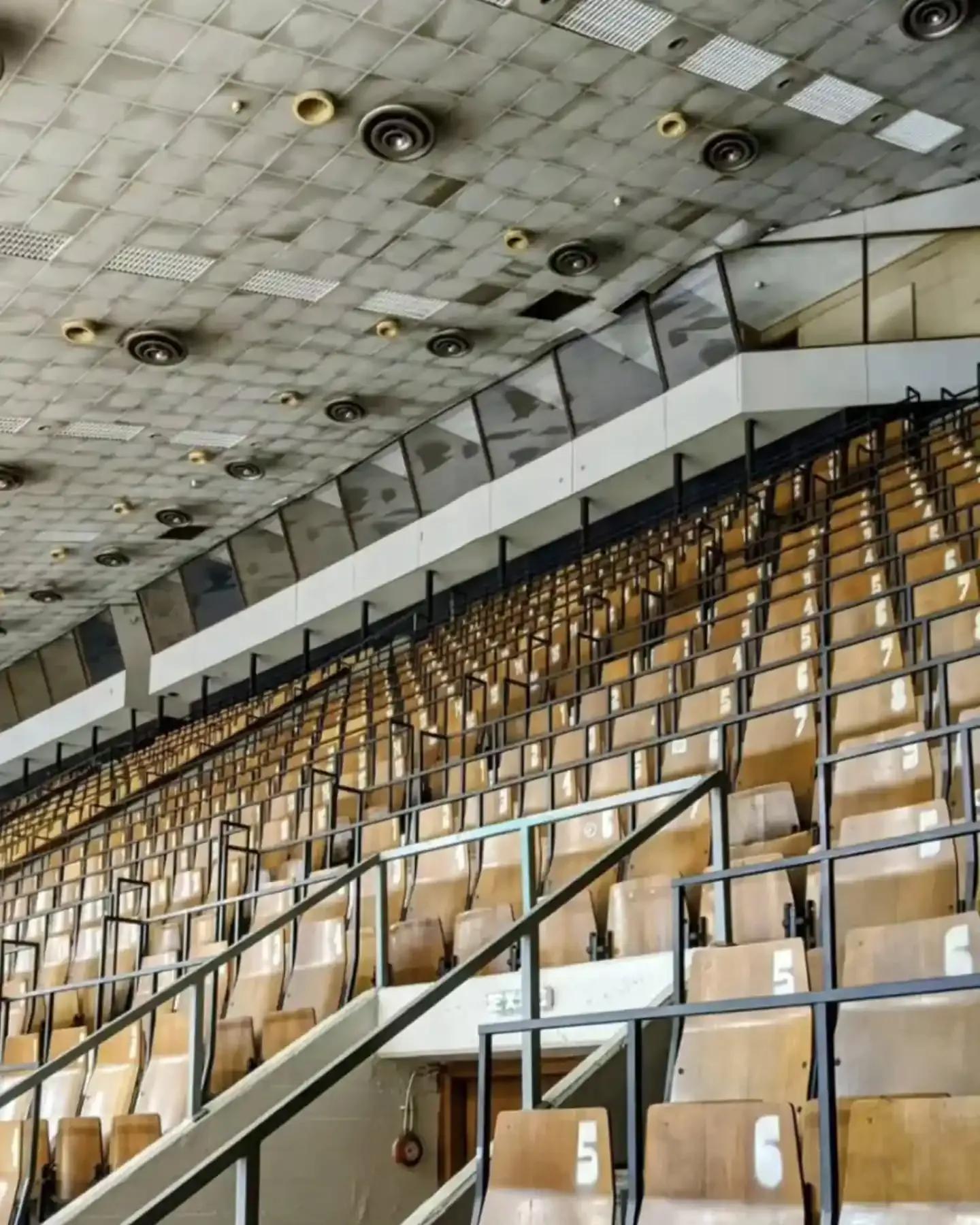
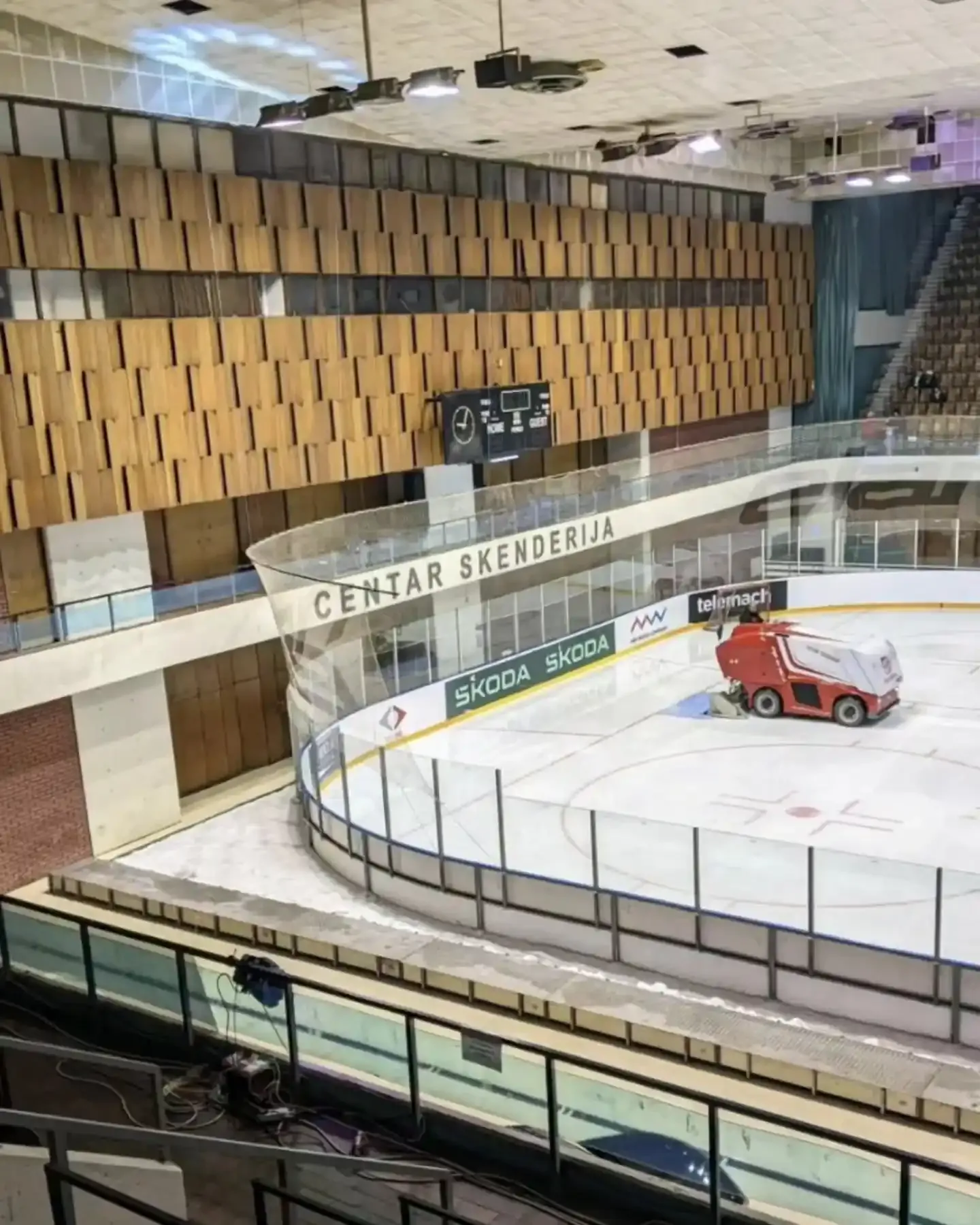
The main stands and ceiling systems show raked seating and technical infrastructure in the primary indoor arena.
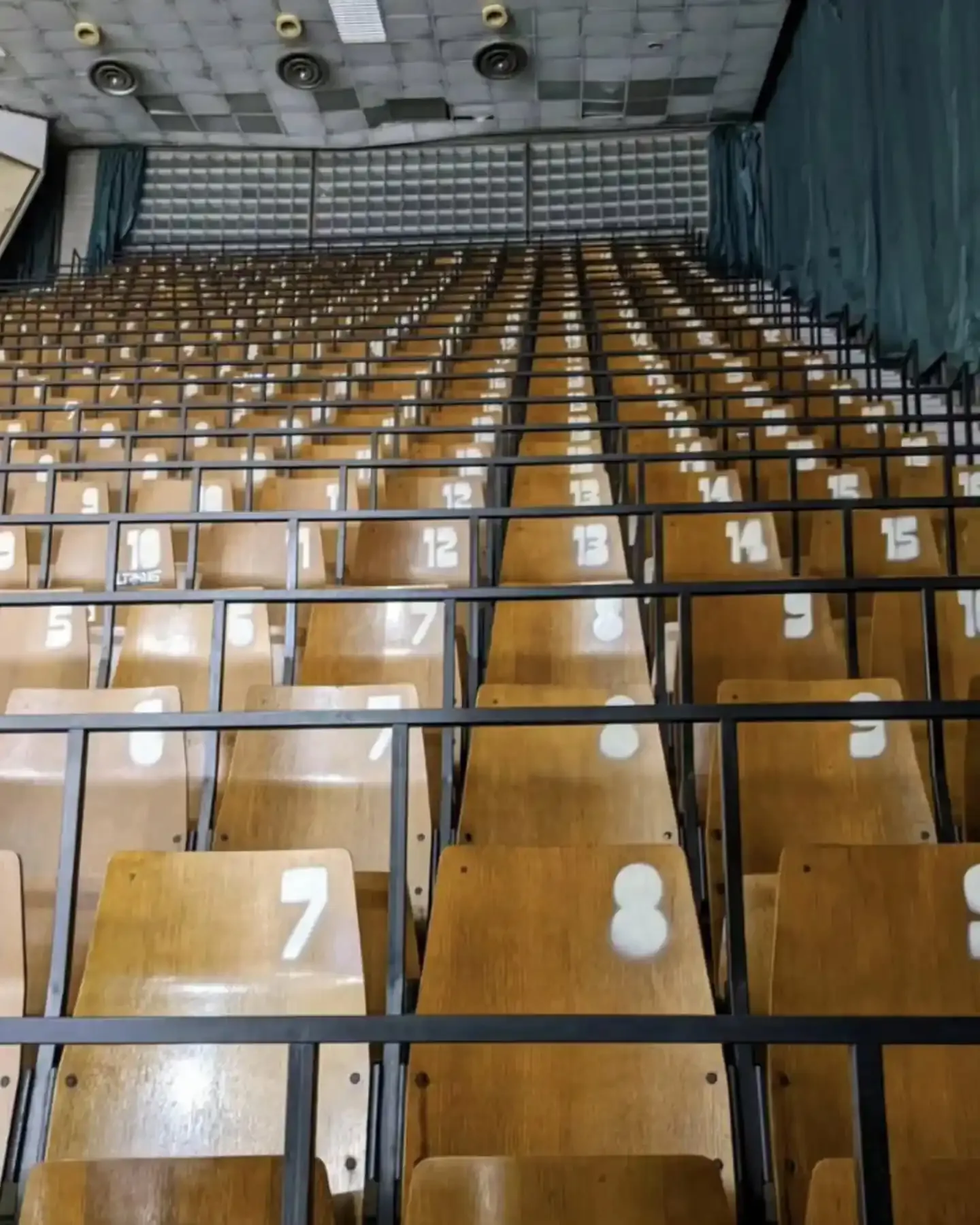
A front-facing view of the numbered seating tiers highlights the preserved wooden tribunes and original hall geometry.
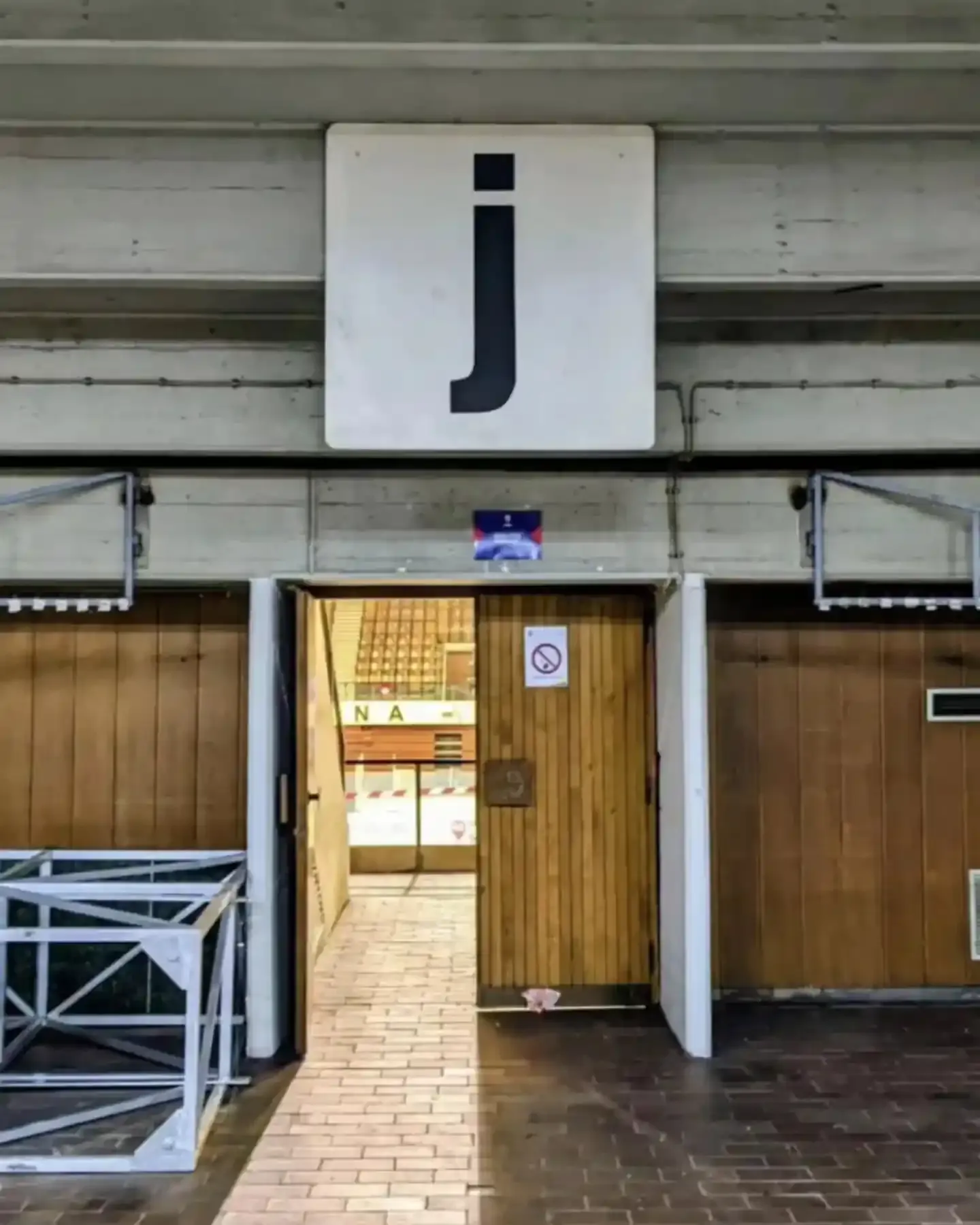
The Sector J entrance sequence shows the internal circulation point connecting the concourse to seating and rink zones.
A view of rink-side access at Sector J looks from the stands toward the ice edge and service operations.
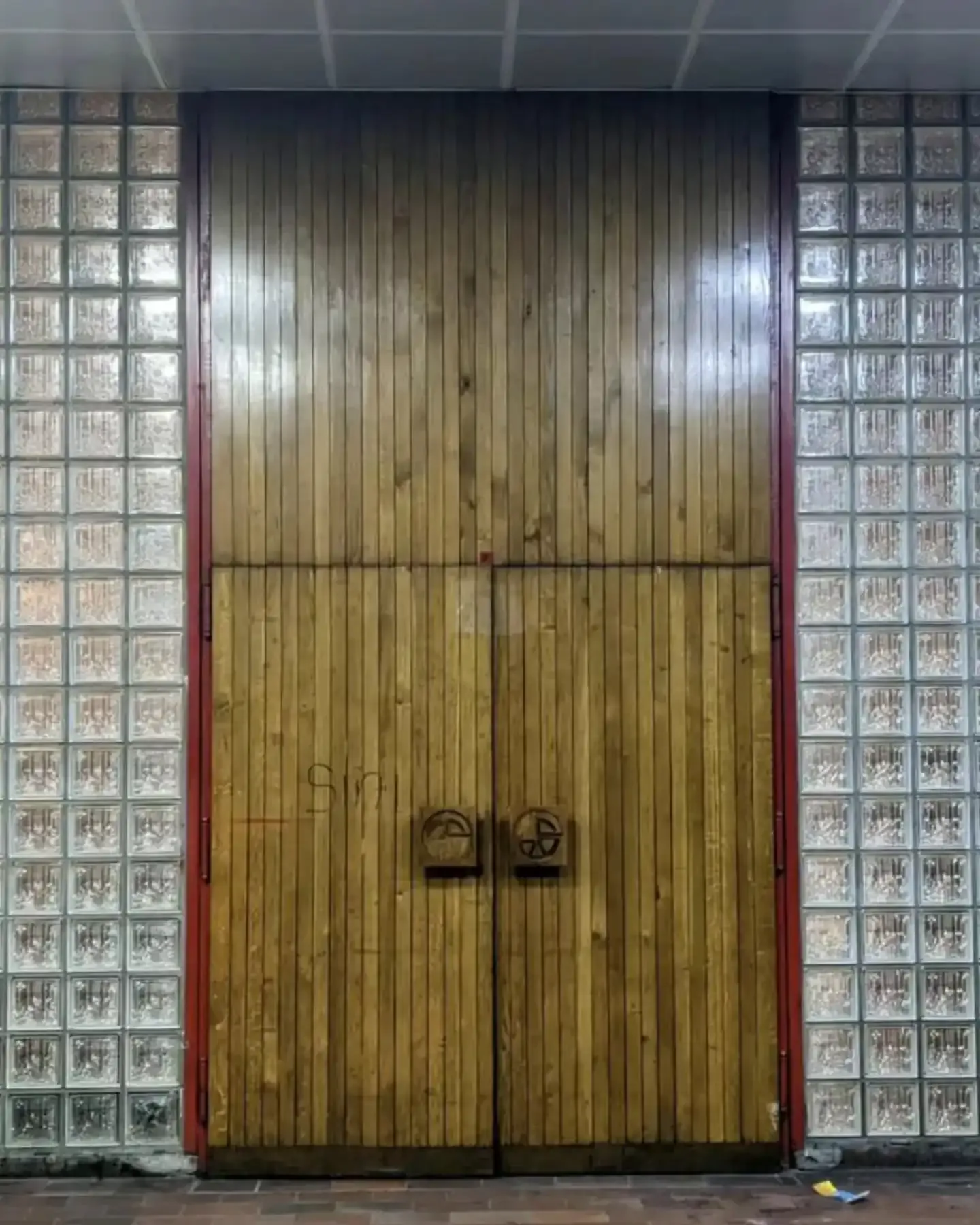
A wooden partition and glass-block wall illustrate the material palette characteristic of Skenderija’s late-modern interior language.
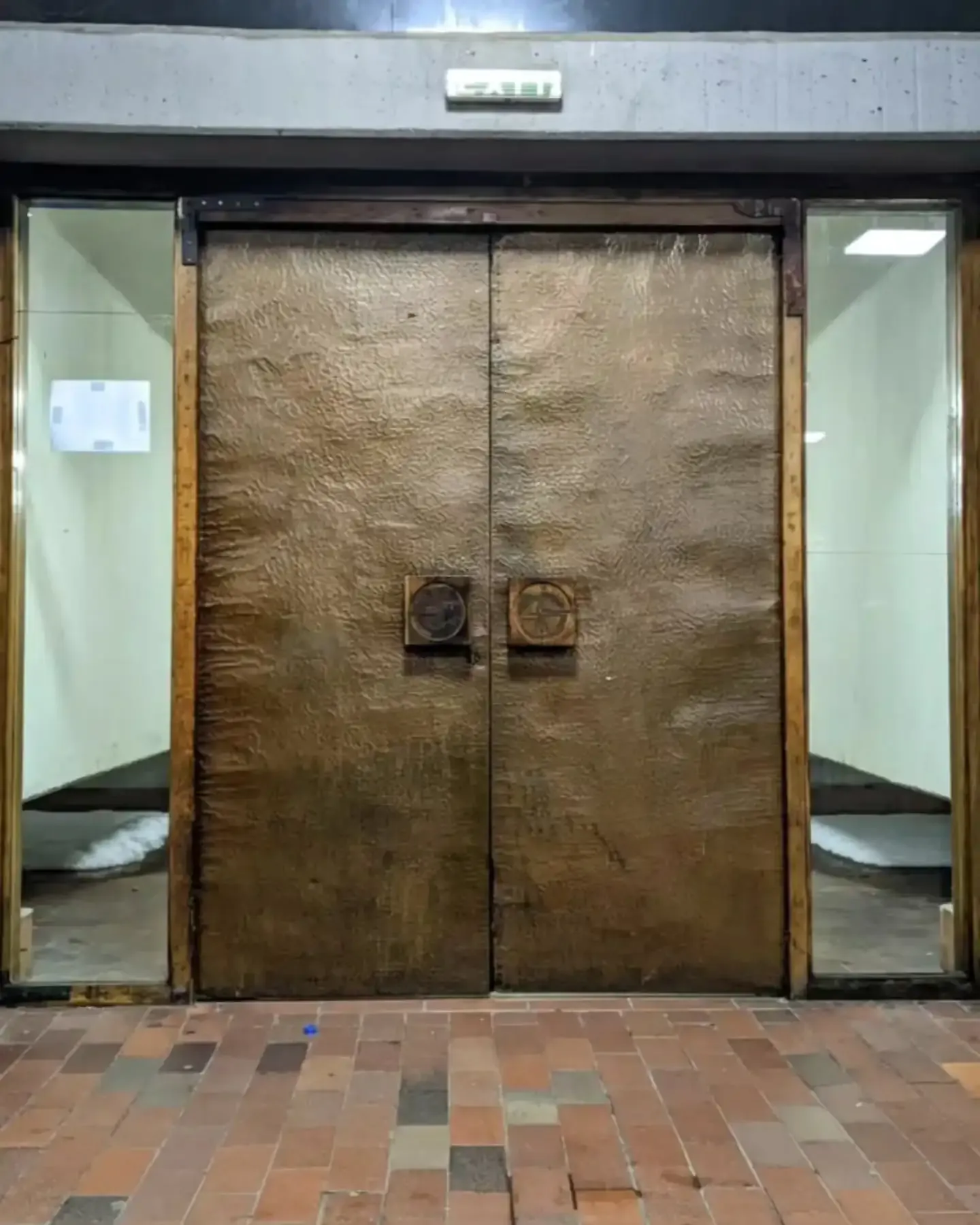
A heavy bronze-toned interior door features an original-style monumental doorway and handles within the circulation core.
Then and now: Change, damage, and survival
The decades following the 1984 Games saw Skenderija transform from a symbol of Olympic triumph into a site of wartime endurance and post-war struggle. While other venues were built exclusively for the Olympics, Skenderija’s pre-existing cultural importance made its survival a matter of civic identity.
War and Destruction (1992–1995)
During the Siege of Sarajevo in the 1990s, the complex was targeted by heavy shellfire. The Dom Mladih (Youth Centre) suffered the most catastrophic damage, being completely burned out and rendered unusable. While the main structure of the Mirza Delibašić Hall survived without collapsing, the site was repurposed for the survival of the city; the UN used the complex as a staging ground for humanitarian relief and the storage of vital supplies.
Reconstruction (1999–2006)
Following the war, the complex initially fell into disrepair as the city prioritized residential recovery. However, in 1999, the city government initiated a slow rebuilding process to restore Skenderija as a trade and economic hub. Financed by various private companies, the renovation lasted until 2006. The Dom Mladih was eventually restored and officially reopened in 2007, returning to its role as a cultural and music venue.
The 2012 Tragedy and Ruins
Skenderija faced a new crisis on 12 February 2012. Under the weight of record-breaking snowfall (estimated at 160 kg per square meter) the roof of the Ledena dvorana (Ice Hall) collapsed. The structure had been designed to sustain only 100 kg per square meter. This collapse turned the primary Olympic ice venue into a ruin. While some repairs were undertaken in 2016, the hall’s status has remained a point of public concern and debate.
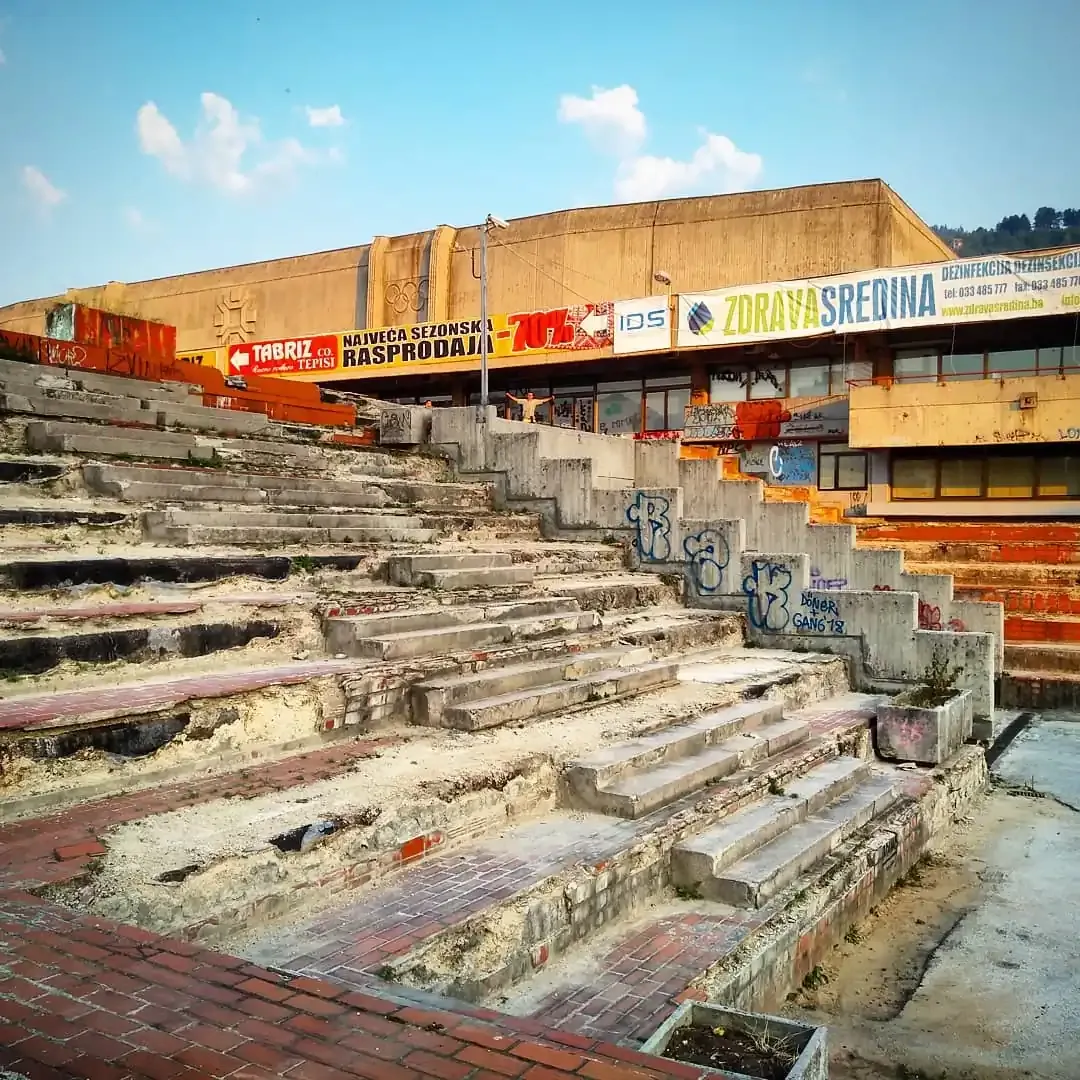
The degraded amphitheatre and terrace steps show visible wear in outdoor seating zones after decades of heavy use.
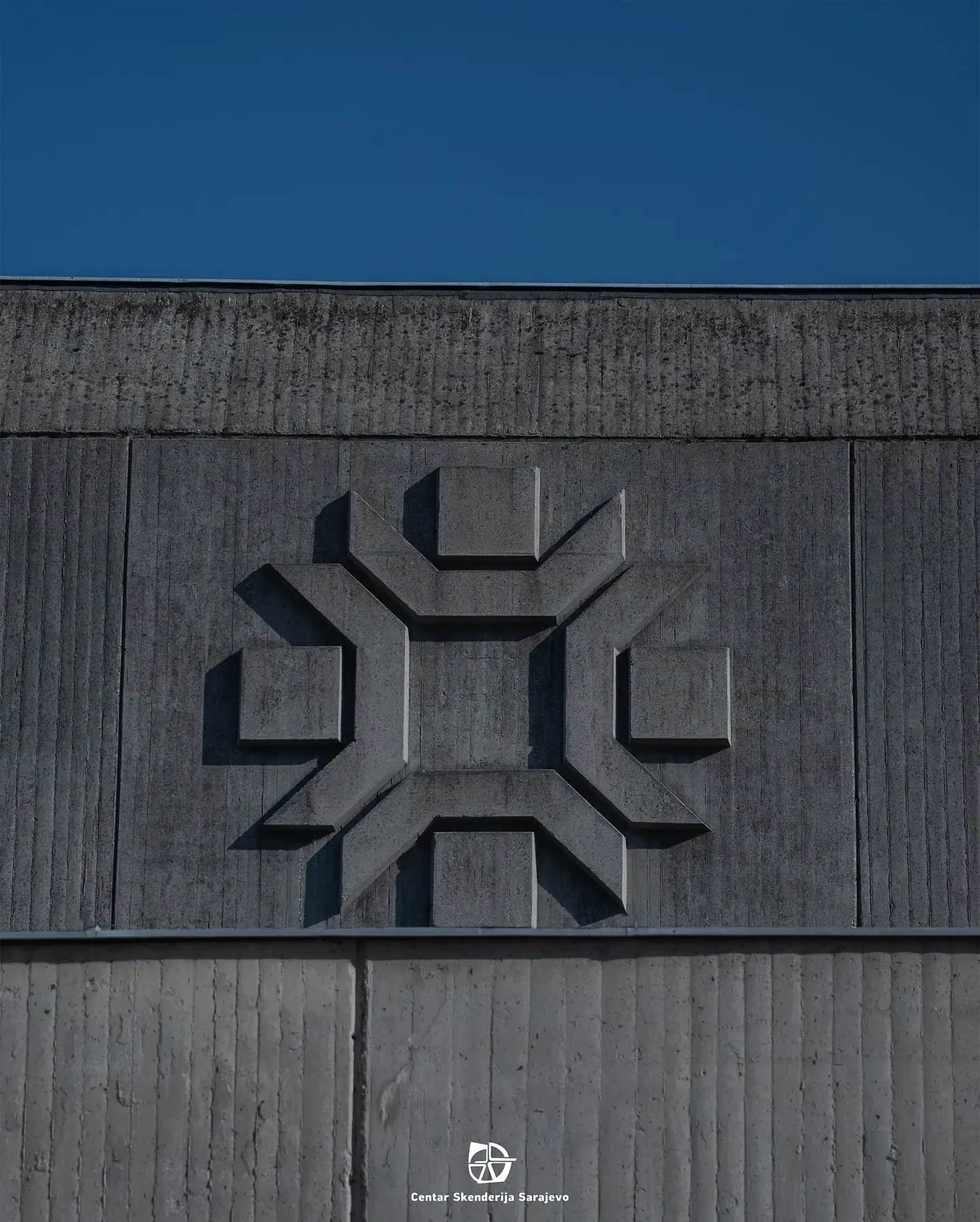
A close-up of the concrete emblem relief shows the carved geometric symbol embedded in exposed facade panels.
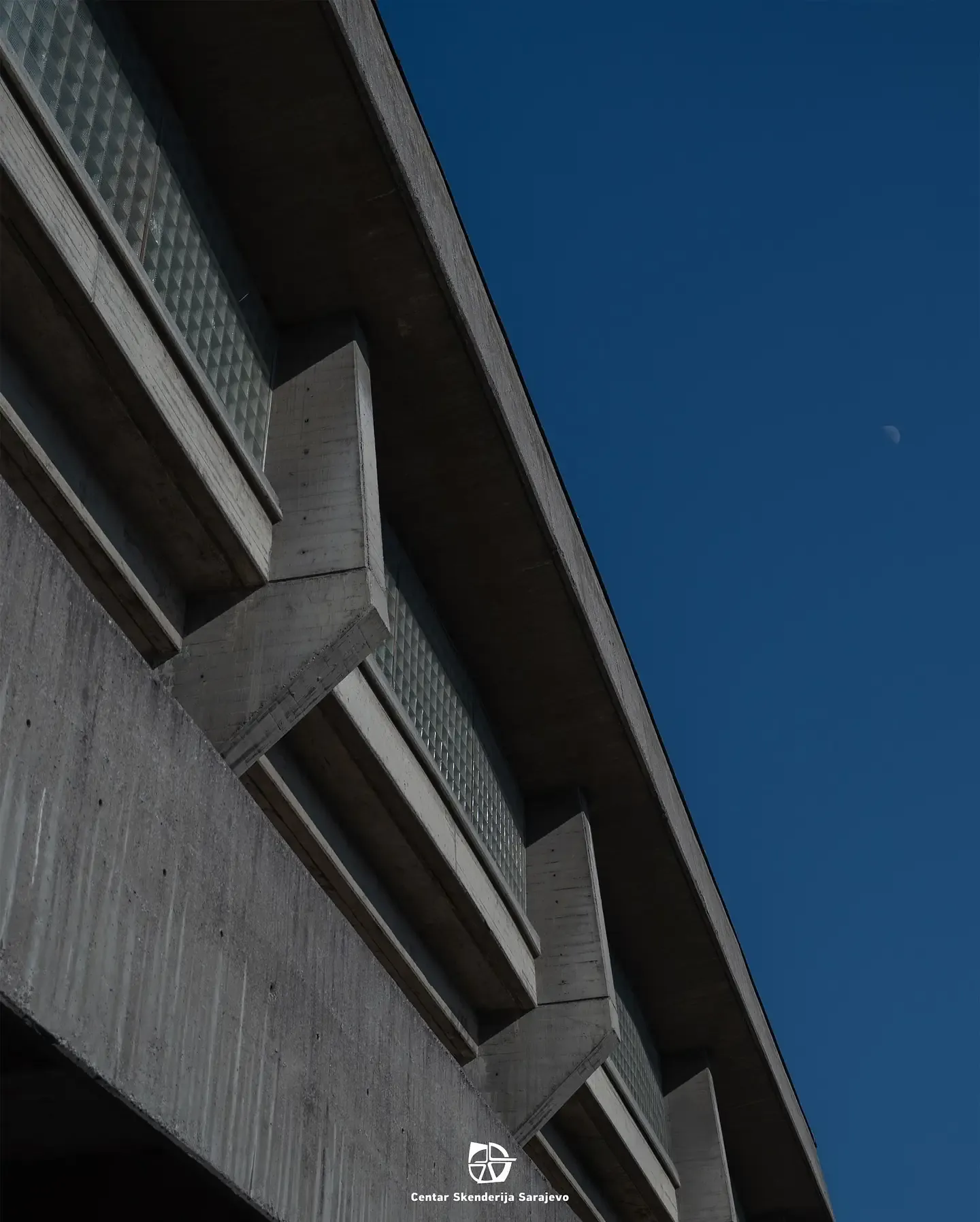
A detail of the cantilever and glass-block articulation highlights projecting structural members and glazing modules.
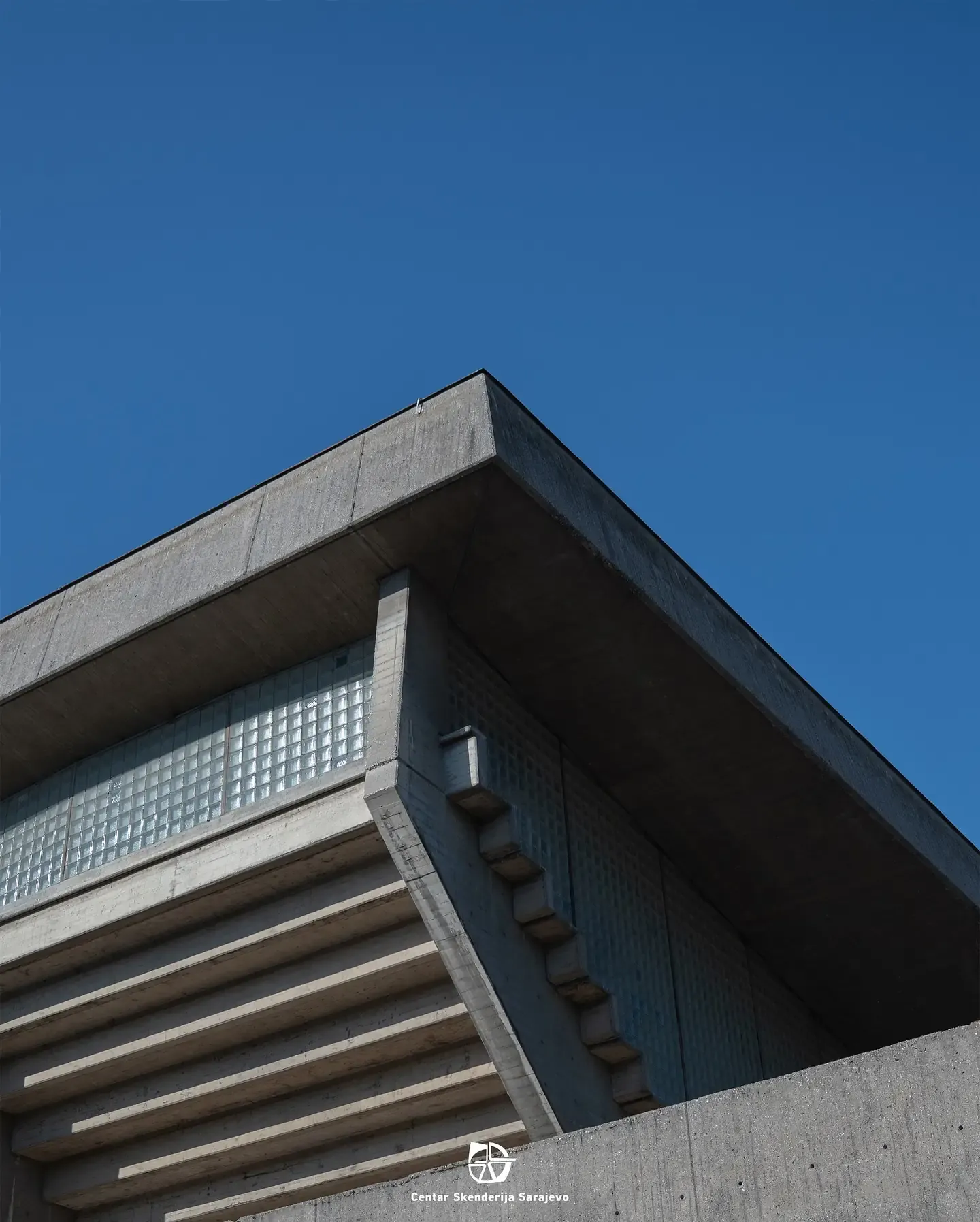
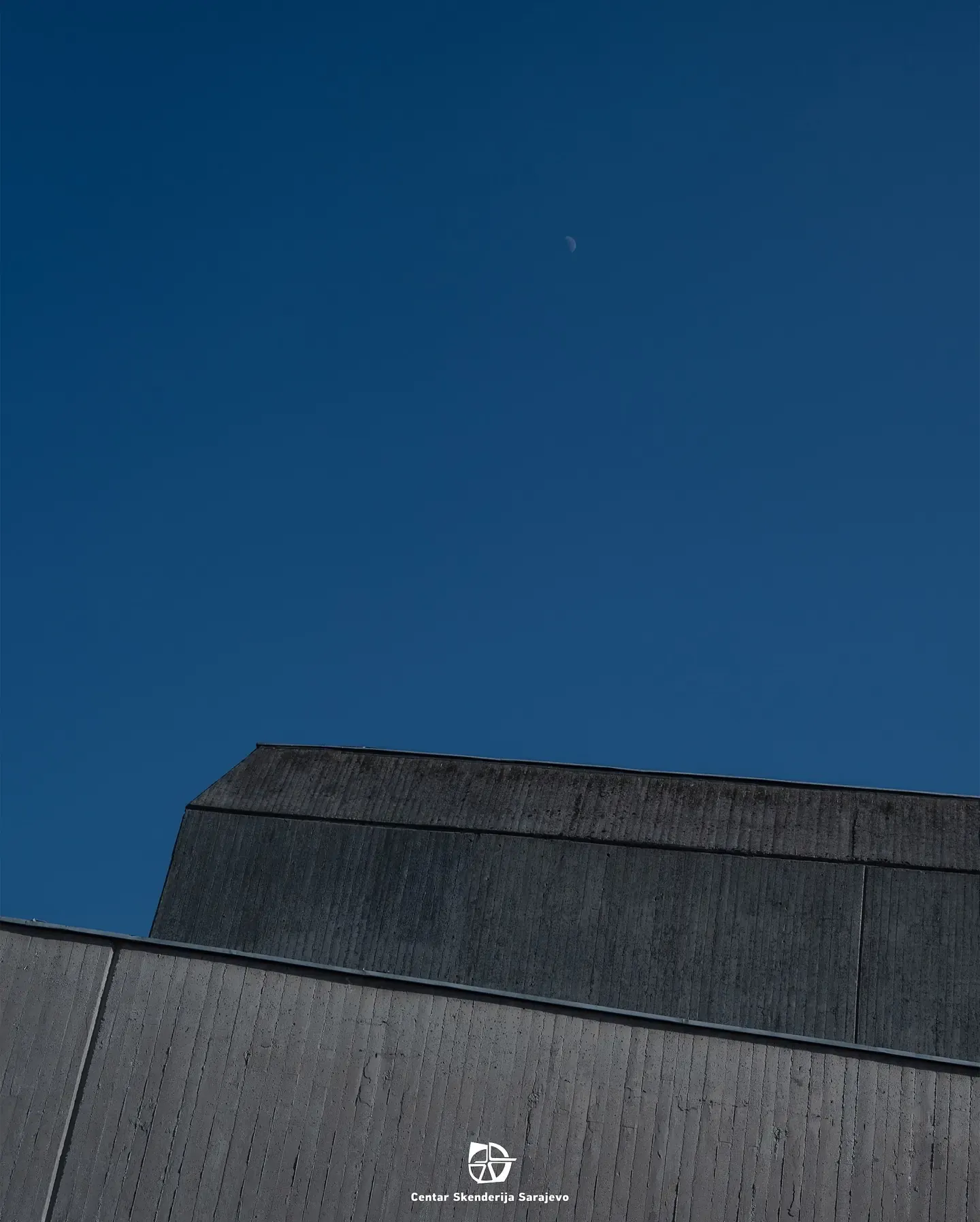
The corner facade profile displays an angular edge condition combining deep slab lines with glass-block infill.
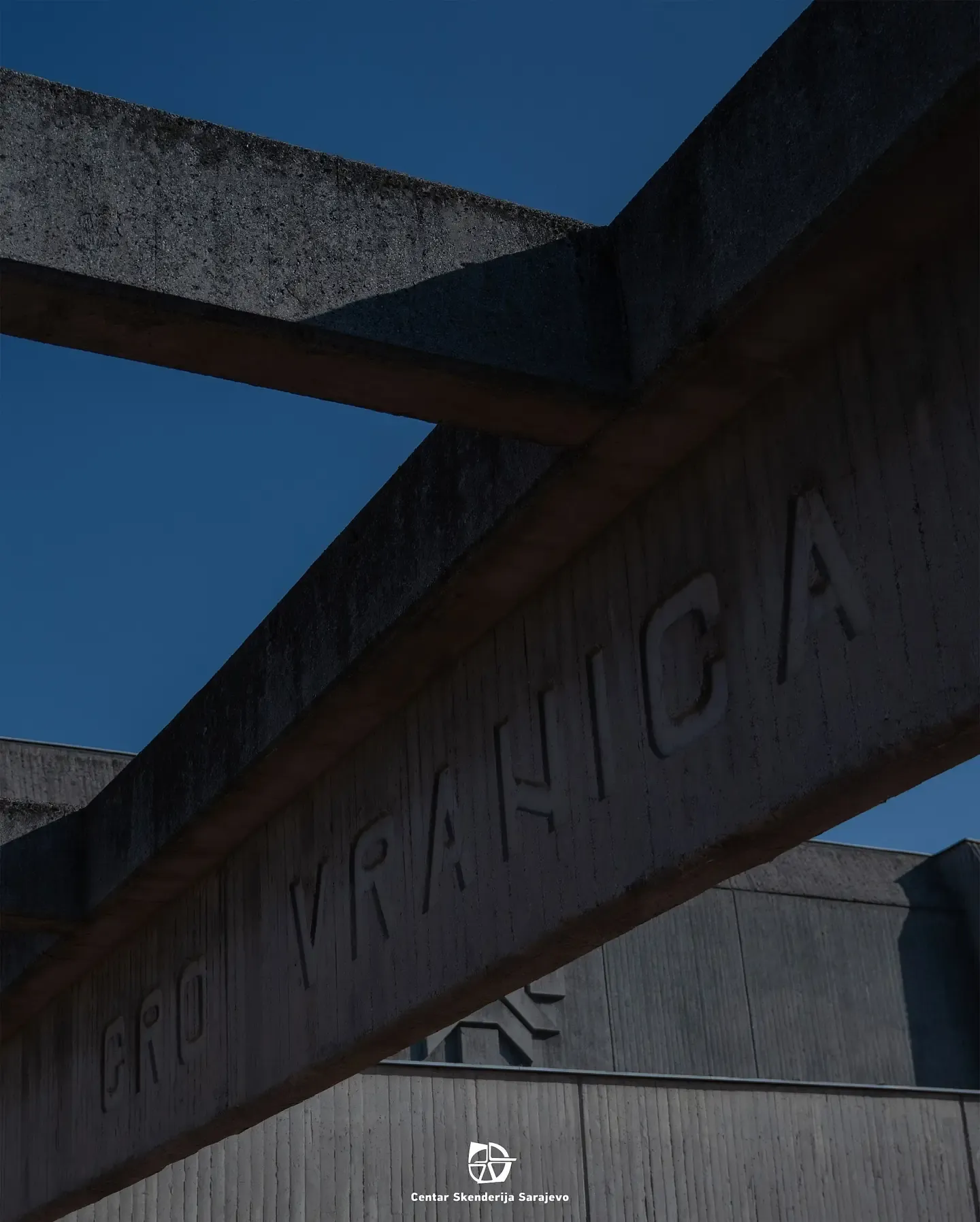
A preserved GRO VRANICA beam inscription shows the original construction-era naming.
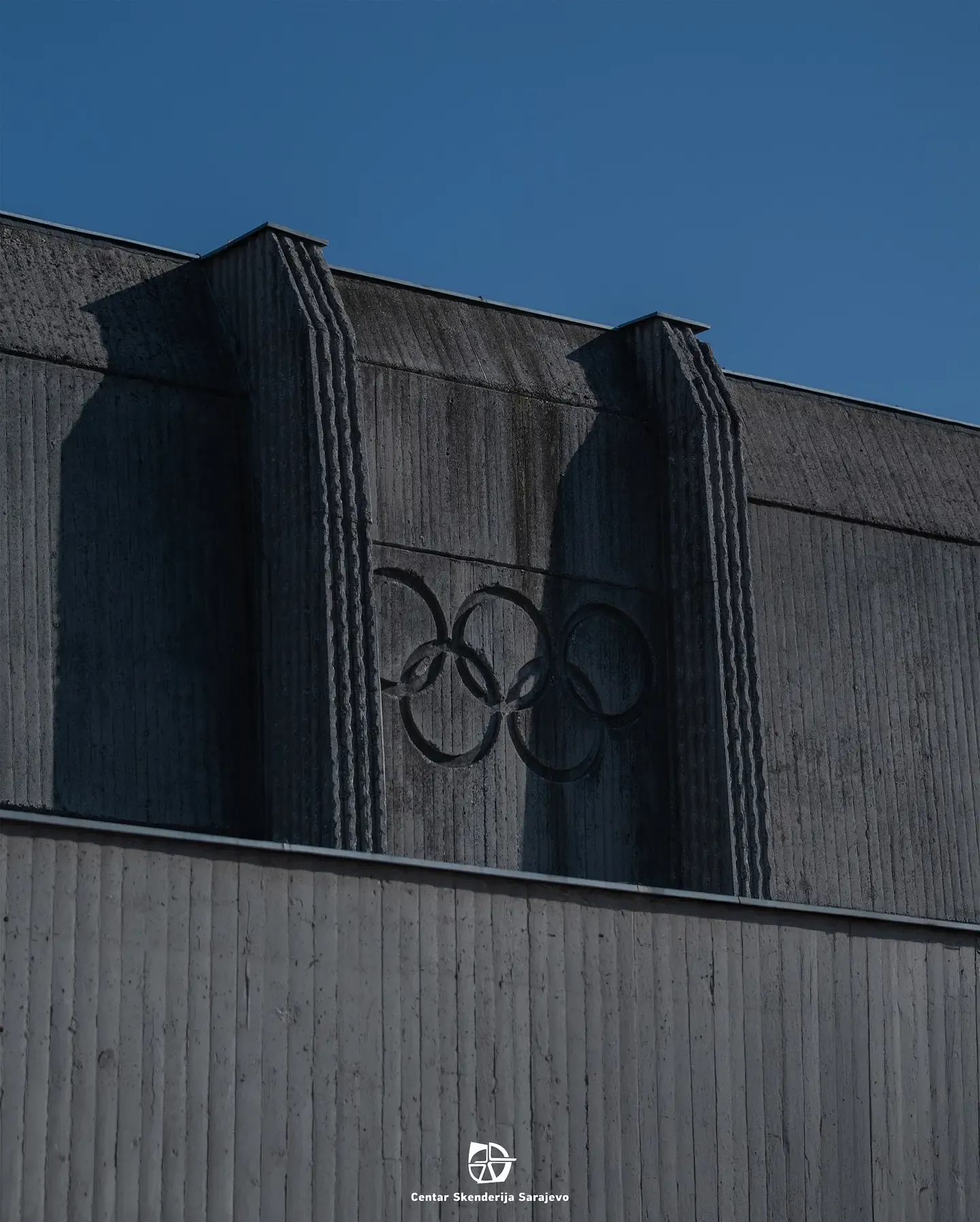
The Olympic rings relief is shown in shadow, with the weathered motif integrated into vertical concrete ribs.
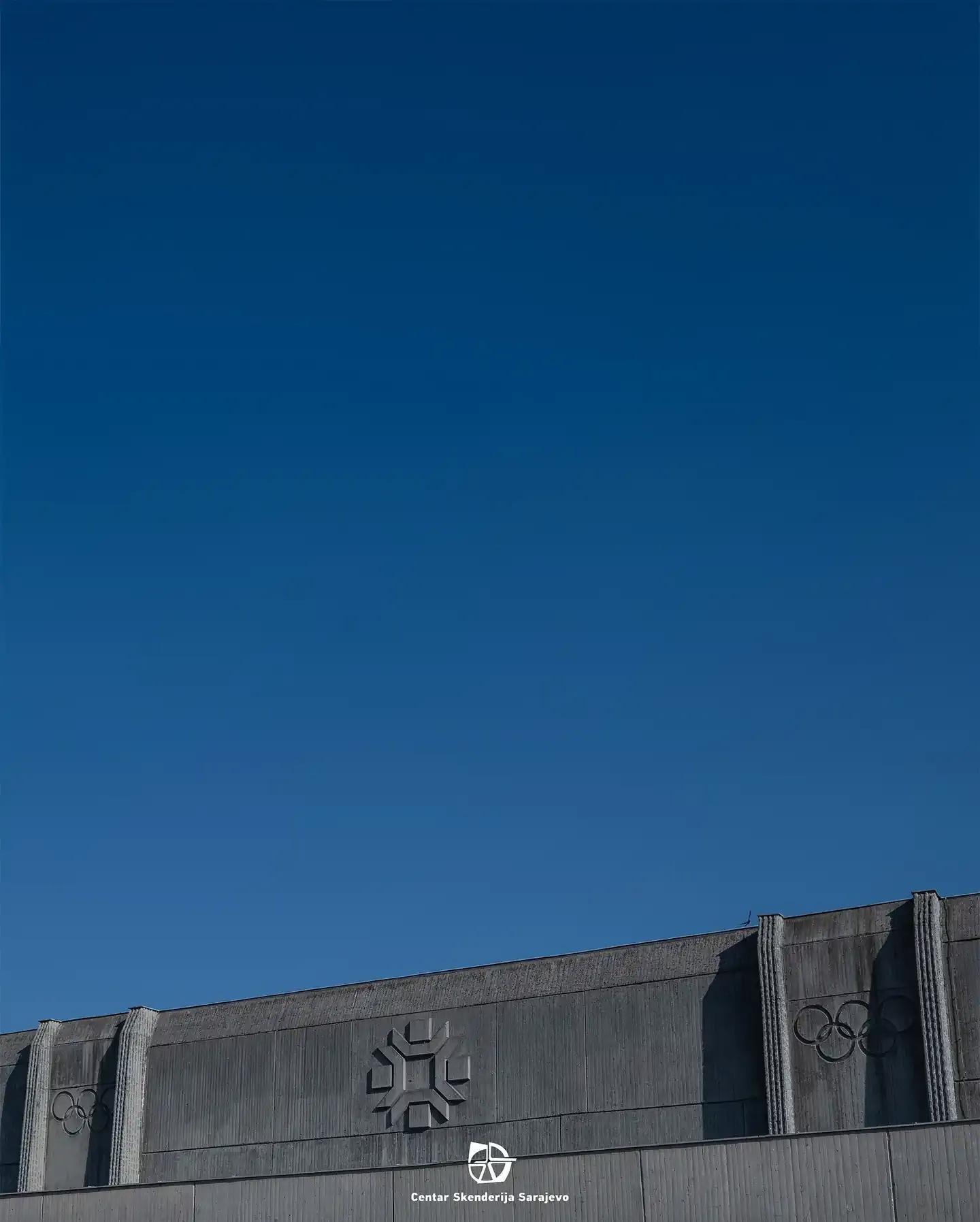
The roofline composition shows the interplay of the emblem, Olympic rings, and horizontal massing.
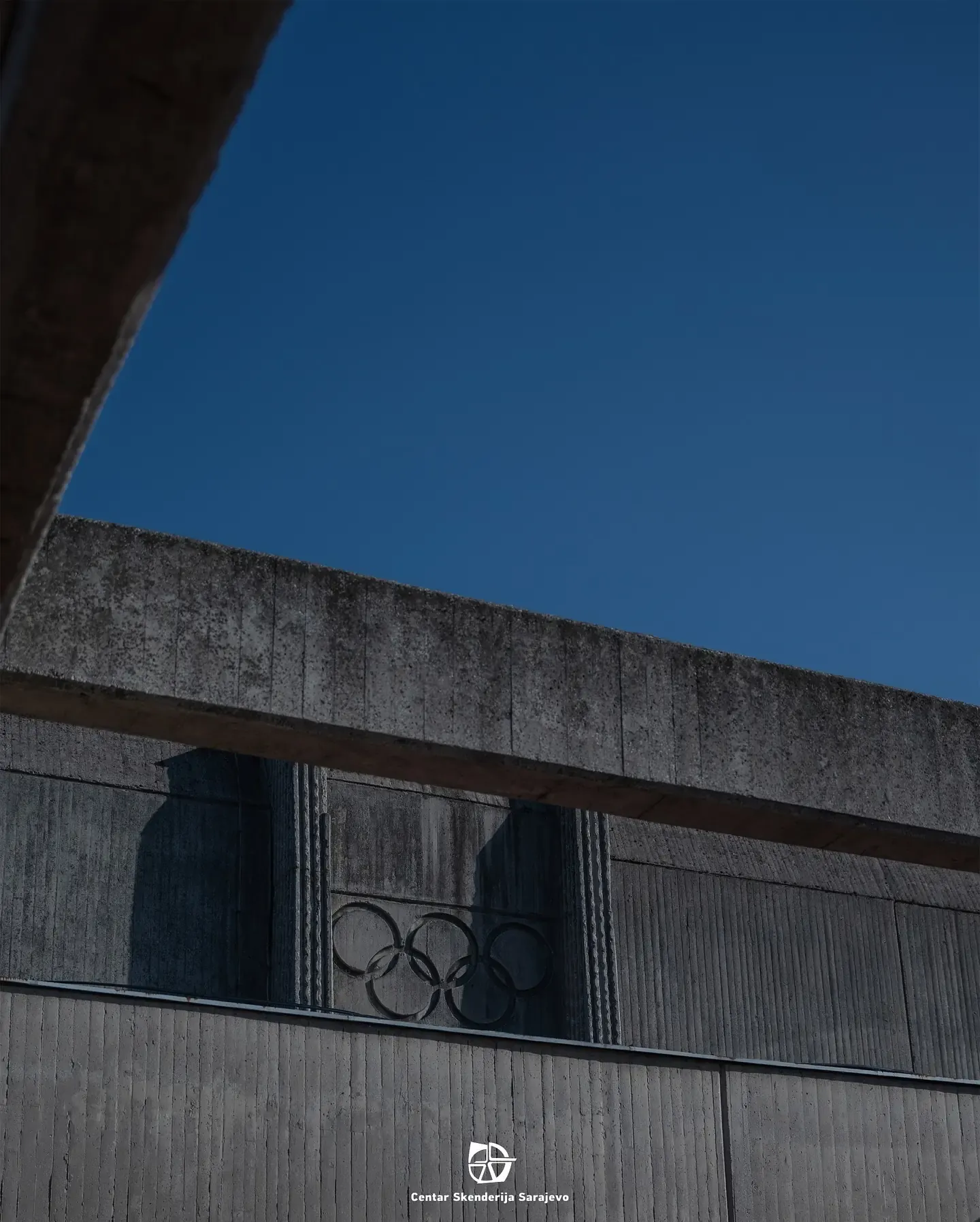
Framed rings sit behind beam elements, with layered concrete members creating depth around the rings relief.
The emblem-and-rings facade assembly combines the Games icon and rings within the upper facade rhythm.
Status today
Today, Skenderija remains a functional yet contested landmark. It attracts approximately 500,000 visitors annually for trade fairs, basketball matches, and cultural events, yet its architectural integrity is the subject of intense local discussion.
- Mirza Delibašić Hall: Currently serves as the home of the Bosna Royal Sarajevo basketball team.
- Dom Mladih: Fully operational as a multi-functional venue for concerts and youth culture.
- The Shopping Centre: "Privredni grad" continues to host shops and restaurants, though it faces competition from newer modern malls.
The complex’s future is uncertain. Recent years have seen a clash between heritage advocates and "investment urbanism." Proposals have ranged from demolishing the "concrete rose" to build a "Small Dubai" luxury development, to officially naming the complex a national monument to protect its unique Brutalist architecture.