
Torch relay
By dividing the flame into two streams (East and West) the 1984 relay was designed to embrace every corner of Yugoslavia, turning a 5,000-kilometre journey into a unified demonstration of peace and logistical precision.
Fast Facts
- Dates: January 29–February 8, 1984
- Total Distance: 5,289 km (main routes); 2,879 km (local relays)
- Number of Torchbearers: Approximately 1,600 on the main route
- Route Structure: Bifurcated "East" and "West" routes starting from Dubrovnik
- Regions Covered: All six Yugoslav republics and two autonomous provinces
- Torch Manufacturer: Mizuno (Japan)
- Support Vehicles: Mitsubishi (Japan)
- First Runner in Yugoslavia: Veselin Djuho (Water Polo)
- Lighting Ceremony: Sanda Dubravčić at Koševo Stadium, February 8
- Key Design Element: A simplified, pipe-like fixture with a red handle
Route at a Glance
- Start: Dubrovnik (after transfer from Olympia via Athens)
- The Split: The flame was divided into two separate torches on January 30 to cover the country simultaneously.
- West Branch (2,687 km): Followed the Adriatic coast (Split, Rijeka), moved inland to Slovenia (Ljubljana, Maribor), crossed into Croatia (Zagreb, Kumrovec), and descended into central Bosnia.
- East Branch (2,602 km): Zigzagged through Montenegro (Titograd), Kosovo (Priština), Macedonia (Skopje), and Serbia (Niš, Belgrade, Novi Sad) before entering eastern Bosnia.
- Reunion: The two flames merged back into one at Vraca Memorial Park in Sarajevo on February 7.
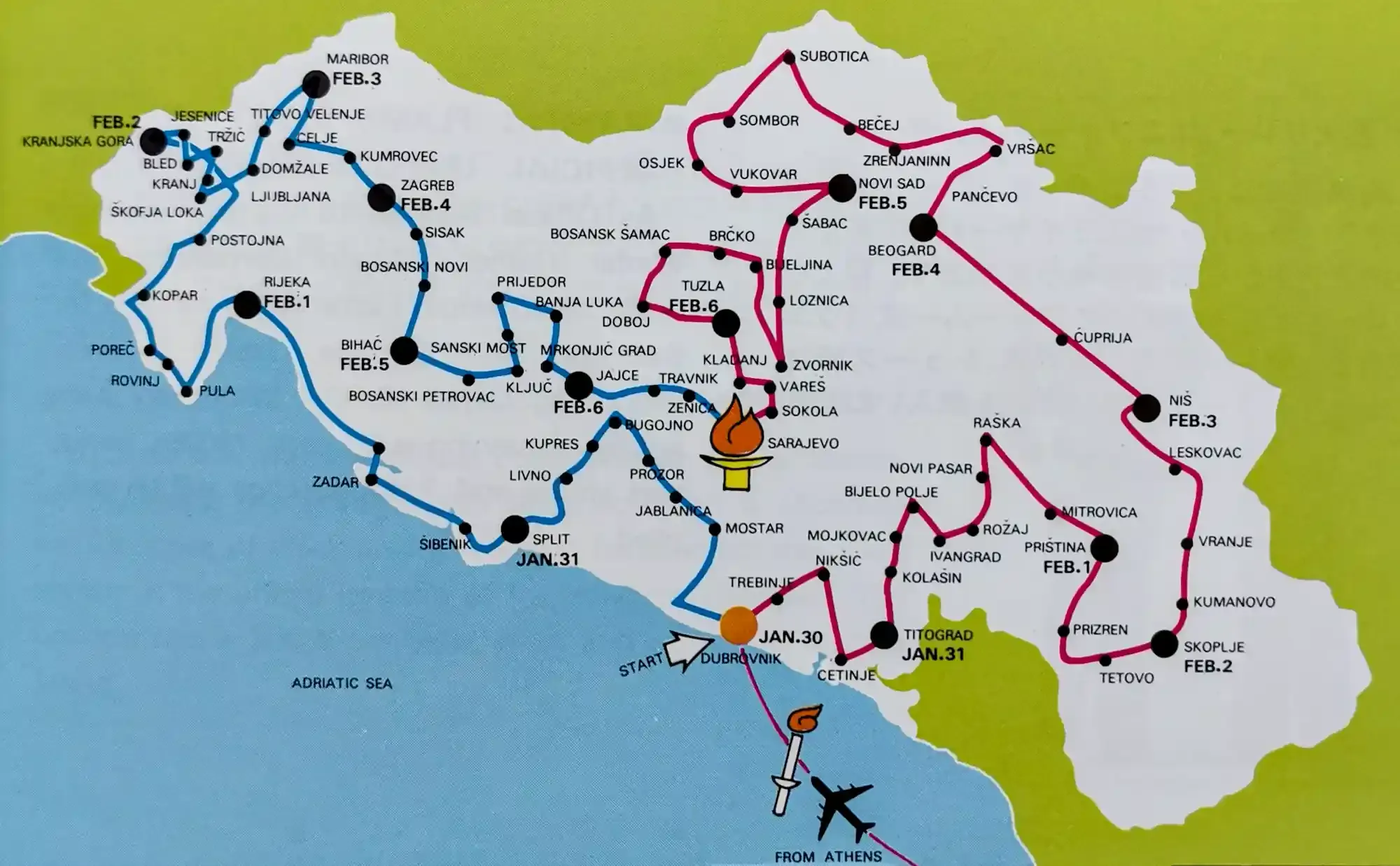
The official route map across Yugoslavia diagrams the West route, East route, and local relay branches.
United by the Flame: Symbolism and Strategic Goals
The fundamental concept of the 1984 relay was to ensure the Olympic presence was felt throughout the entire Socialist Federal Republic of Yugoslavia. To achieve this, organisers devised a bifurcated strategy: rather than a single linear path, the flame was split into two separate relays (East and West) allowing it to visit all socialist republics and autonomous provinces. This approach was intended to promote the "Olympic idea" and showcase the country's unity, with the route explicitly planned to visit capitals, historic sites, and sports centres.
The relay was framed not just as a sporting prelude but as a validation of the host nation. Reports from the Organising Committee described the event as proof of Yugoslavia's support for Olympism, with the flame’s journey serving as a massive, decentralized festival of "youth, culture, sports, and love." The strategic inclusion of 89 additional "local relays," where a torch was ignited from the main flame and carried to smaller towns and winter centres, further extended this reach, adding nearly 3,000 kilometres to the total footprint.
From Olympia to the Adriatic: Logistics and Transfer
The journey began on January 29, 1984, in the ancient sanctuary of Olympia, Greece. Following the traditional lighting ceremony by the Temple of Hera, the flame was transported by car and plane to the Panathenaic Stadium in Athens. Here, it was formally handed over to the Sarajevo delegation, led by Anto Sučić, Vice President of the Organizing Committee.
To cross the Adriatic, the flame was placed in a safety lamp (specifically described in accounts as a miner's lamp) and flown on a special JAT (Yugoslav Airlines) aircraft to Dubrovnik. The arrival in Dubrovnik on the evening of January 29 marked the flame's first touch on Yugoslav soil. It was Veselin Djuho, a member of the national water polo team, who had the honour of carrying the torch for the first mile from the airport, transferring it to a special vehicle that would take it to the city for a "magnificent welcome" under the banner of Libertas (Freedom).
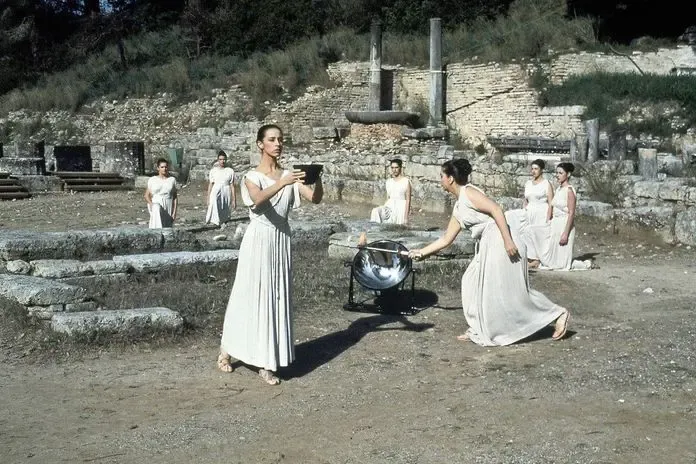
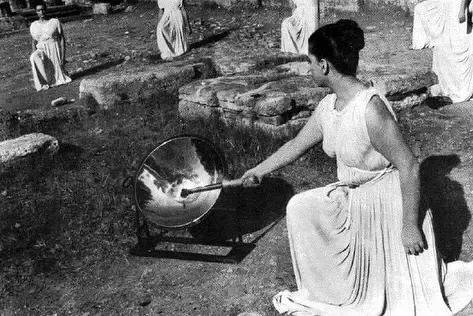
The lighting ceremony in Olympia shows the ceremonial ignition sequence in Greece before the transfer to Yugoslavia.
A black-and-white press image captures the ceremonial ignition ritual at Olympia from a period publication.
The Route: 5,289 Kilometres Across East and West
On the morning of January 30, the single flame became two. Departing Dubrovnik, the relays embarked on a massive zigzag across the Balkans that would last nine days.
The West Route covered 2,687 kilometres. It moved briefly inland before turning back to the Adriatic coast at Split, then followed the shoreline north to Rijeka. From there, it wound through Slovenia, visiting the capital Ljubljana and making a U-turn at Maribor. Notable stops included Kumrovec, the birthplace of Josip Broz Tito, and the Croatian capital of Zagreb, before the route headed south into central Bosnia to approach Sarajevo.
The East Route covered 2,602 kilometres. It travelled through Montenegro to Titograd (now Podgorica), crossed into Kosovo to visit Priština, and continued to Skopje in Macedonia. Turning north, it passed through Serbian cities including Niš and Kragujevac to reach Belgrade and Novi Sad in Vojvodina. Finally, it traced a winding course through eastern Bosnia (Srebrenica, Bijeljina, Brčko) towards the host city.
To accommodate communities off the main roads, the local relays carried the flame an additional 2,879 kilometres, largely by vehicle but with 349 kilometres covered by hand. In total, the flame stopped overnight in 18 towns, where it burned in special bowls installed for the occasion.
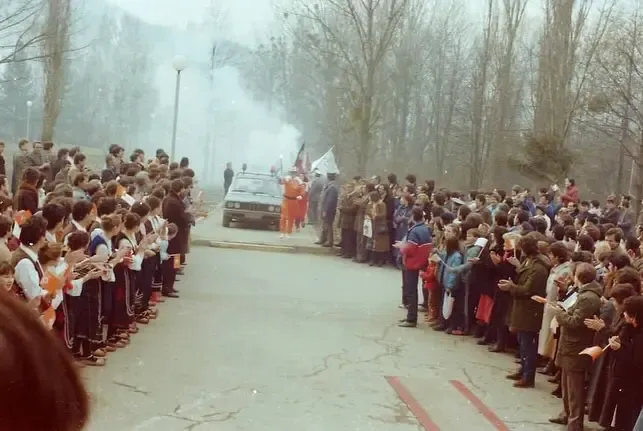
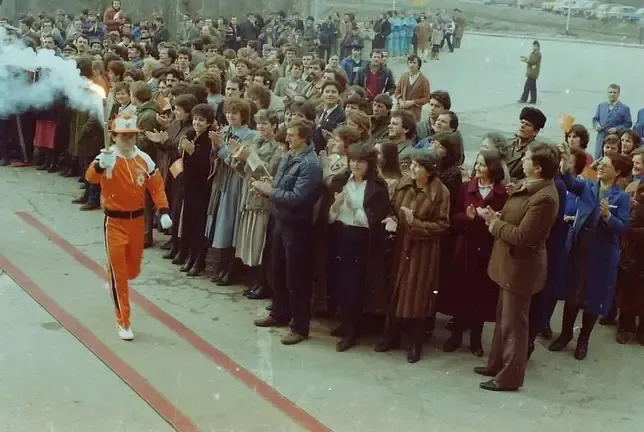
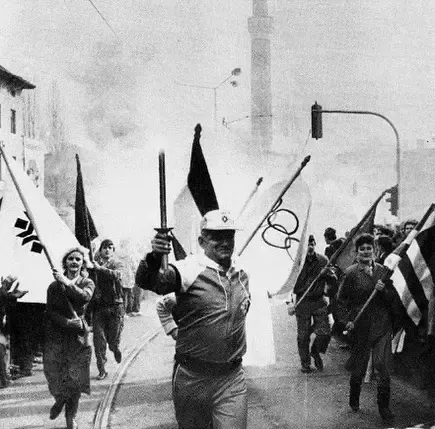
Spectators line both sides of the relay corridor road as the torch procession approaches.
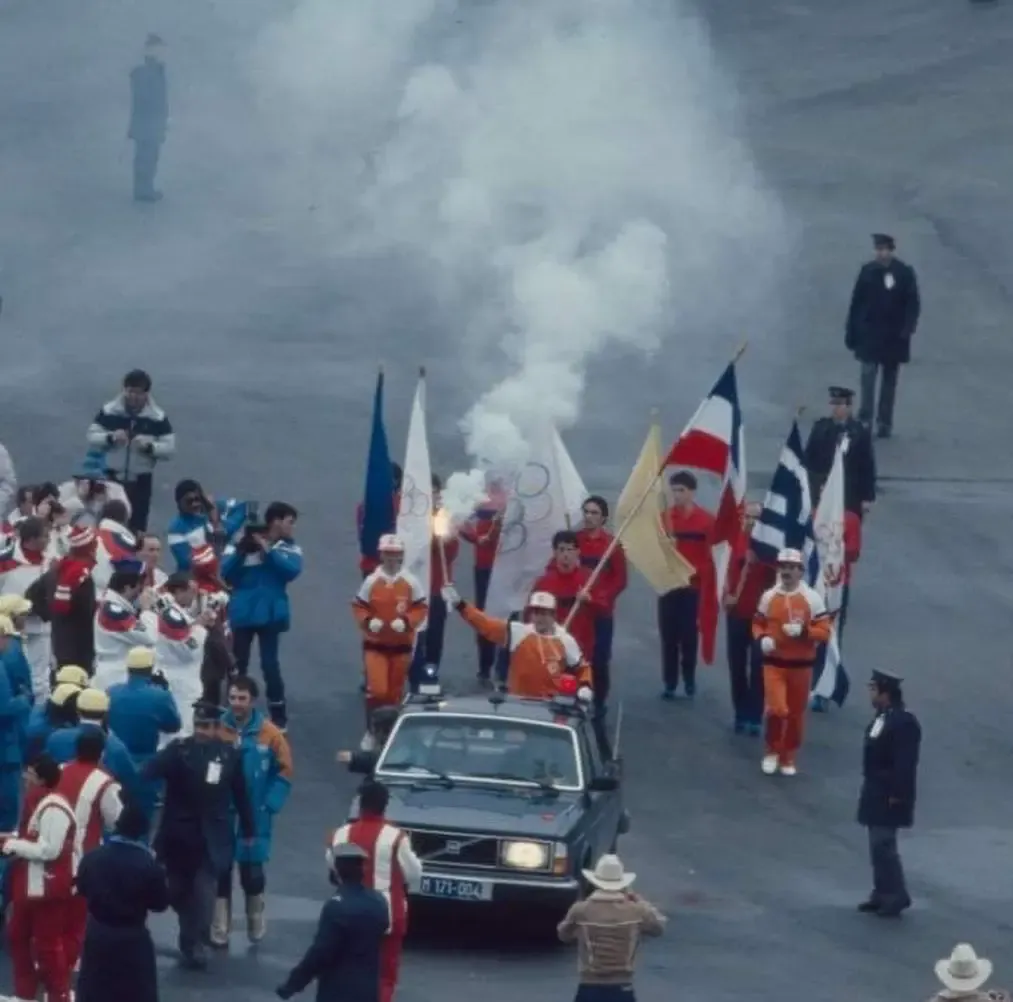
A handoff run shows the relay exchange moment accompanied by a flag escort and crowd applause.
A motorcade procession features an escort car, flags, and torchbearers in an organized city event.
The Torch: Japanese Design and Technical Specifications
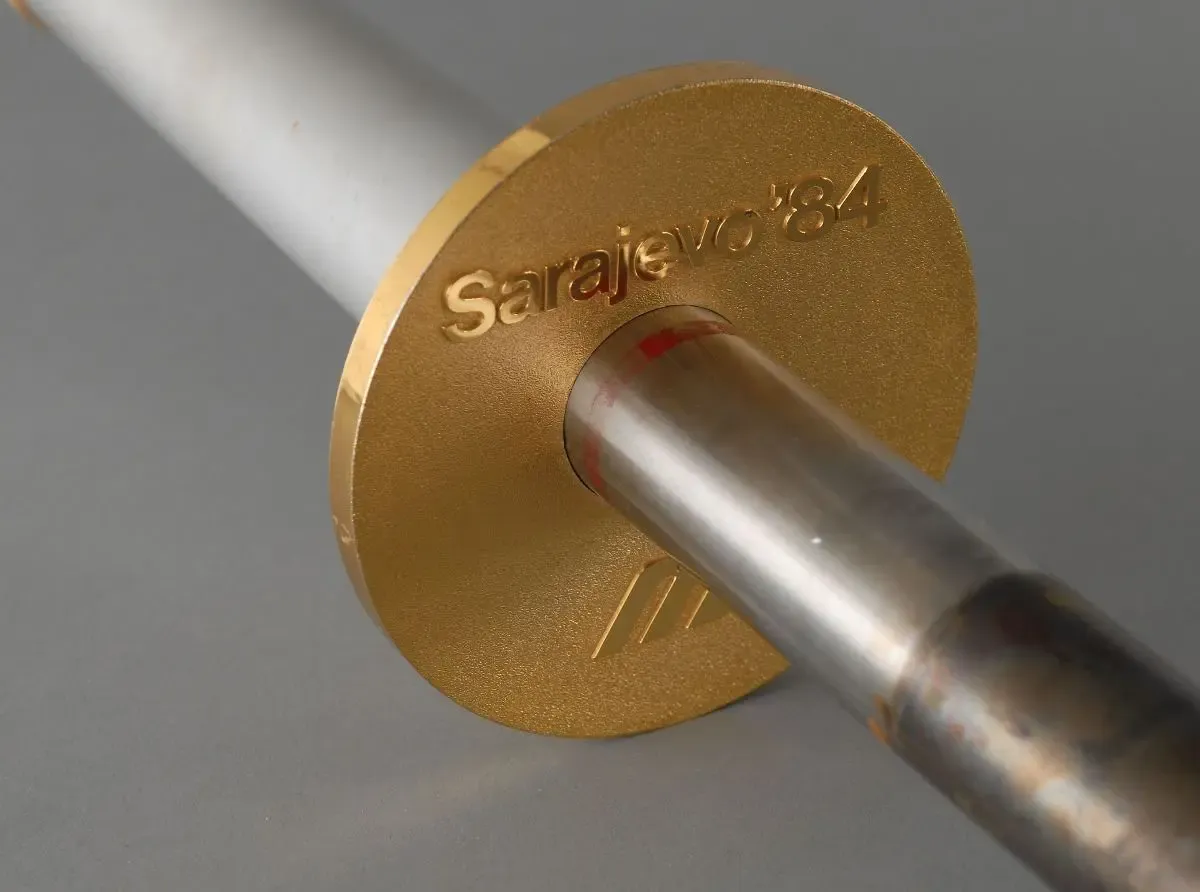
The physical torch used to carry the flame was a study in functional simplicity. Manufactured and donated by the Japanese sporting goods company Mizuno, the torch was described as a "largely unadorned pipe-like fixture." It featured a red handle and a metallic upper body branded with the "Sarajevo '84" logo and the Olympic rings.
The logistics of keeping the flame alive across thousands of kilometres of winter roads required significant technical support. Mizuno also supplied the uniforms for the bearers, while Mitsubishi provided the fleet of special vehicles used to transport the flame and the accompanying crews. For the overnight stops in various cities, the Austrian company BP AG supplied 17 special flame bowls, as well as the main saucer for the Koševo Stadium.
While the organisers were prepared for heavy snow (keeping skiers ready to carry the flame in safety bowls if roads became impassable) the clearing services on the route were so effective that the relay proceeded without the need for these emergency measures.
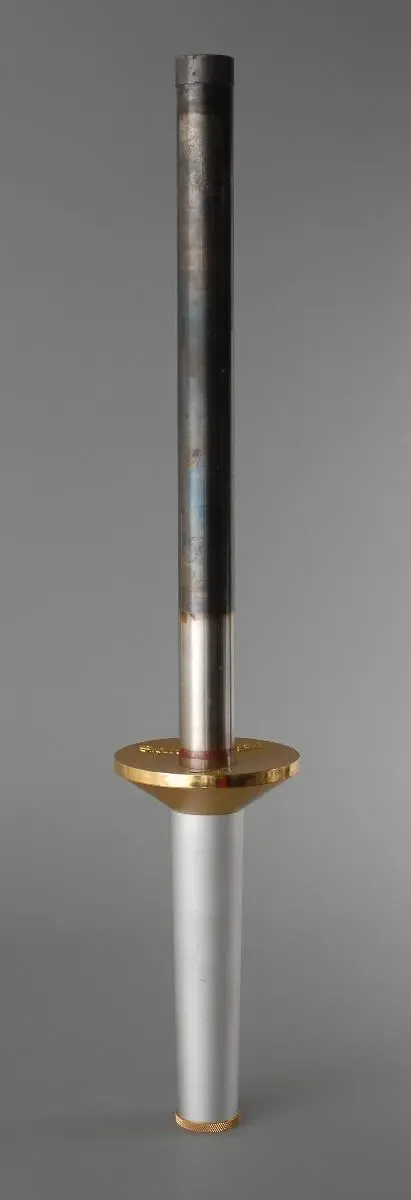
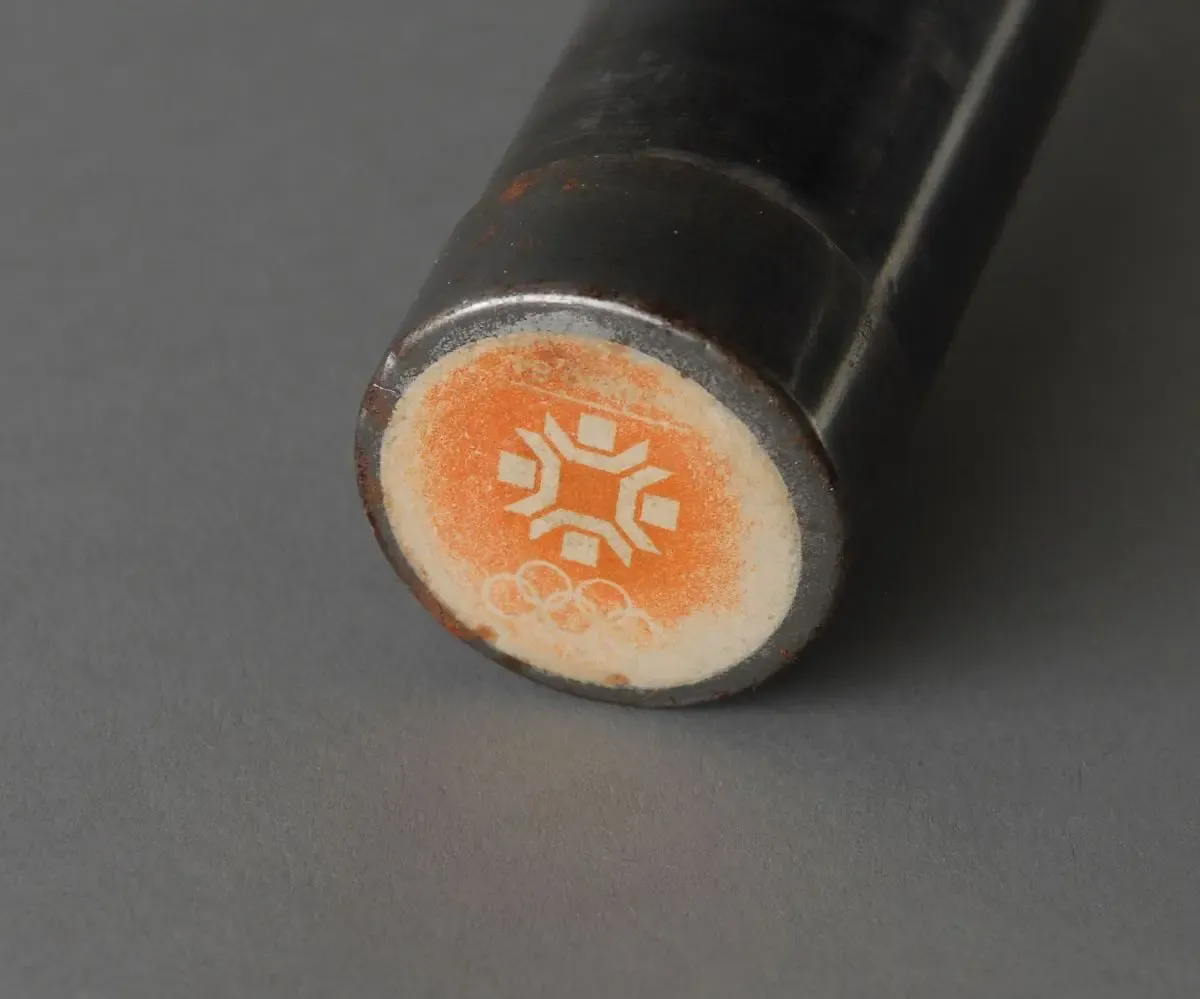
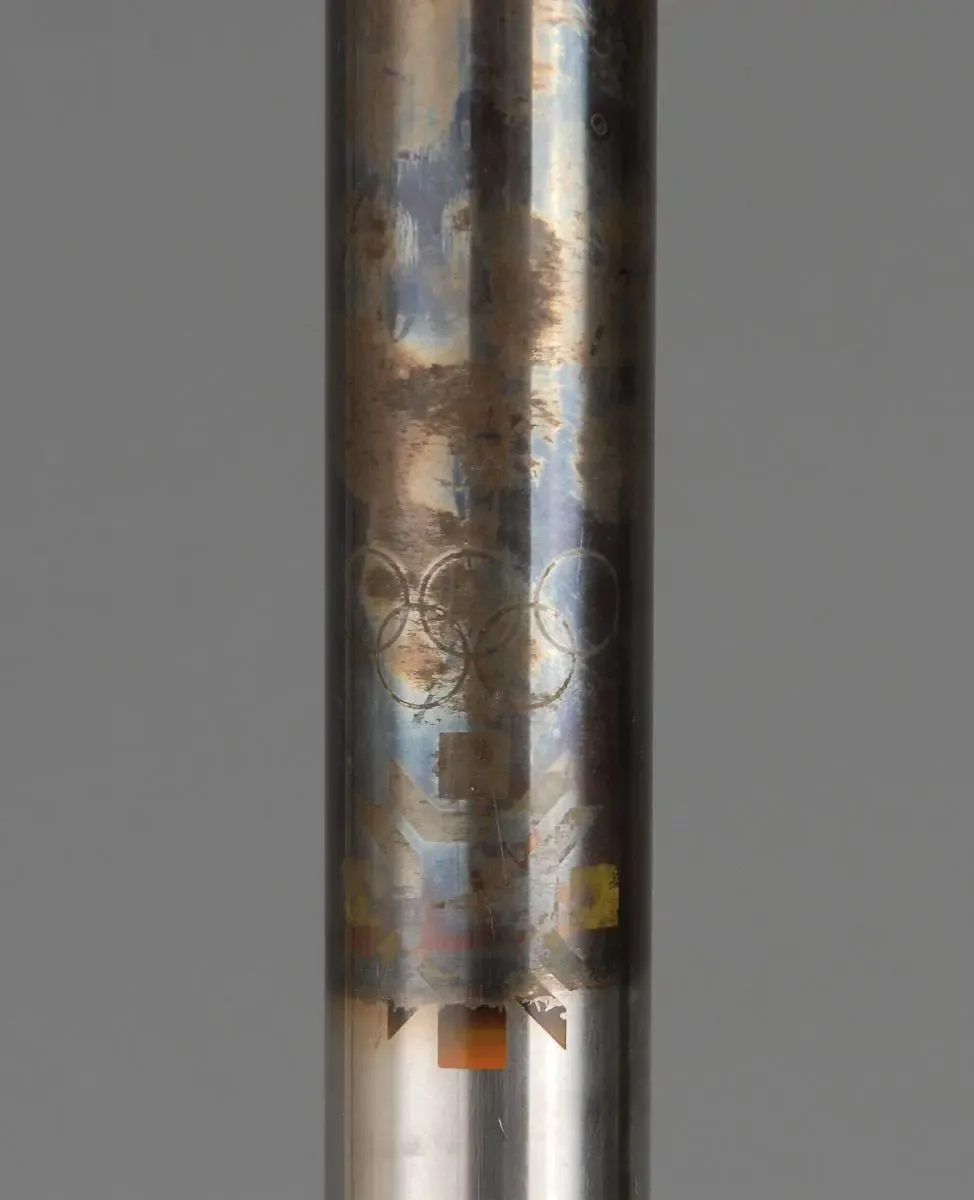
The full torch profile reveals the complete view of the minimalist pipe-like form designed for the Games.
A detail of the torch's upper ring shows a close-up of the guard with the embossed "Sarajevo '84" marking.
The torch base cap detail features the end-cap with the Games emblem and Olympic rings.
A detail of the torch's metal body shows the upper shaft finish with visible wear and etched Olympic symbols.
Torchbearers: 1,600 Stories from the Road
While the route was vast, the relay relied on individual hands to bridge the distance. On the main East and West arteries, approximately 1,600 bearers carried the flame. These participants were selected by special municipal boards and were drawn from a cross-section of Yugoslav society: distinguished athletes, exemplary workers, and students.
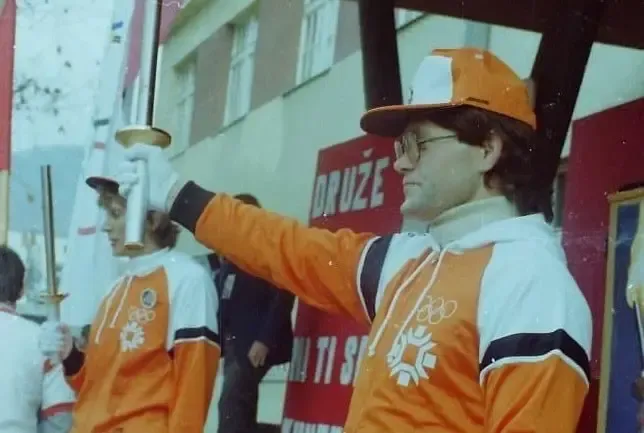
Local involvement was intense. In the town of Ključ, the flame was carried by young athletes flanked by a "bouquet of flags." In Tuzla, a delegation of 20 prominent locals, ranging from high school students to soldiers, escorted the torch to the city’s sports centre. Specific regional heroes were frequently highlighted; on Mount Jahorina, the flame was borne by Rajko Kušić, a world student judo champion, while on Mount Bjelašnica, it was passed to Zineta Balta, a young handball player. The uniform provided by Mizuno (a distinct tracksuit) became a symbol of this collective effort, worn by runners from the Adriatic coast to the inner highlands.
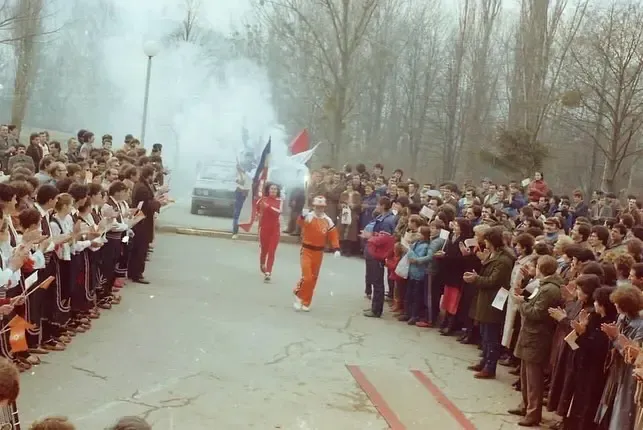
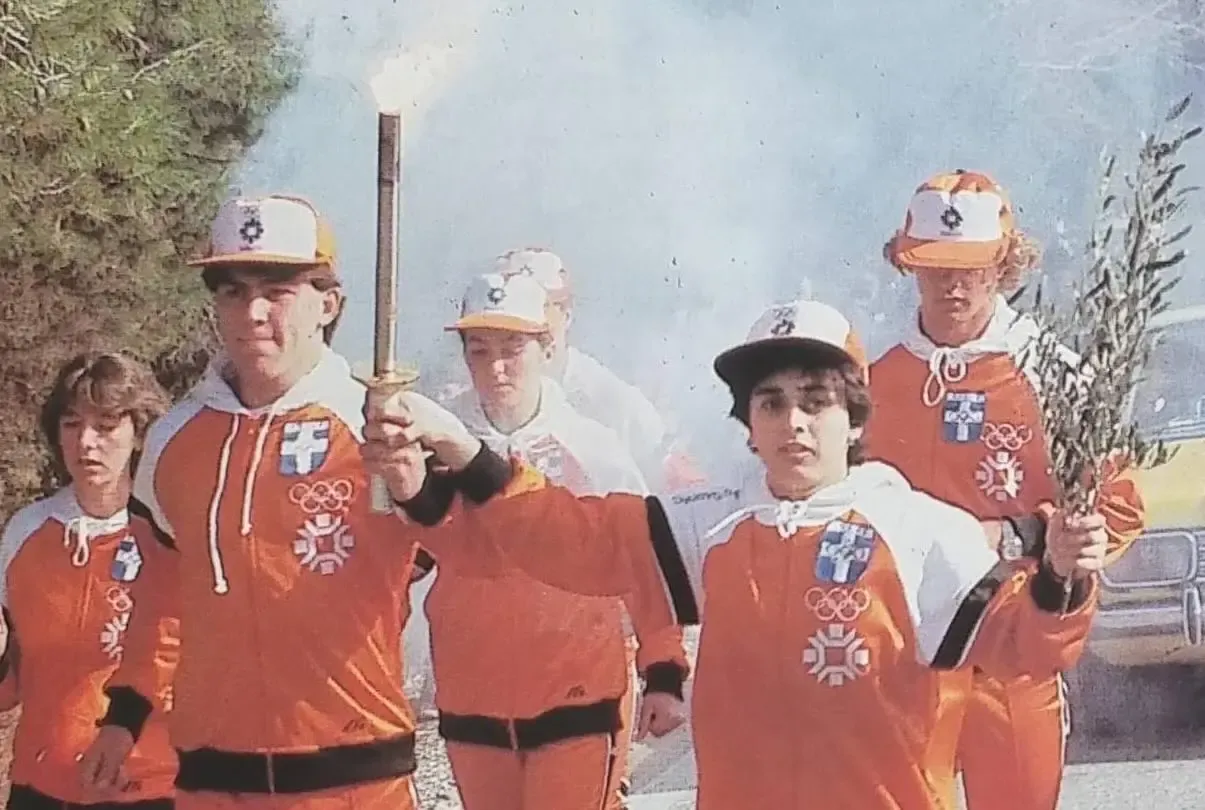
A torchbearer passes the crowd while carrying the flame during a local segment of the relay.
A portrait of a bearer in the official tracksuit offers a close view of the Sarajevo '84 relay uniform.
Young athletes carry the flame during a youth relay segment as part of a local branch event.
A period press photo of a street run shows the relay moving through an urban center.
"A Piece of the Sun": Public Reception and Atmosphere
The relay was framed by the press and organisers as bringing "a piece of the sun" to the winter landscape. Reports described the flame as a source of metaphorical warmth, with one account noting that "the people of Sarajevo are warming themselves by the Olympic flame."
Public turnout was massive. Official reports estimate that over 1.5 million people attended the arrival ceremonies and events along the route. In cities where the flame stayed overnight, the atmosphere turned into a "festival of Olympism," often accompanied by cultural programmes and fireworks. The weather played a dramatic role in the narrative; while Athens had offered a "spring day," Sarajevo and the surrounding mountains were covered in heavy snow that fell "exactly according to protocol," relieving anxieties about a snowless Games. Despite the cold and blizzards, thousands lined the roads, transforming the transfer of the torch into a defiant celebration of the "warmth" of brotherhood.
The Final Ritual: Merging the Flames and Lighting the Cauldron
The bifurcation of the route ended on February 7, the day before the Opening Ceremony. The East and West torches arrived in Sarajevo and were ceremonially merged into a single flame at the Vraca Memorial Park. From there, the unified torch was carried to the Skenderija Cultural and Sports Center plateau. In a prelude to the main event, former Olympian Ajdin Pašović used it to light a temporary flame on a special pedestal, marking the start of the city-wide celebrations.
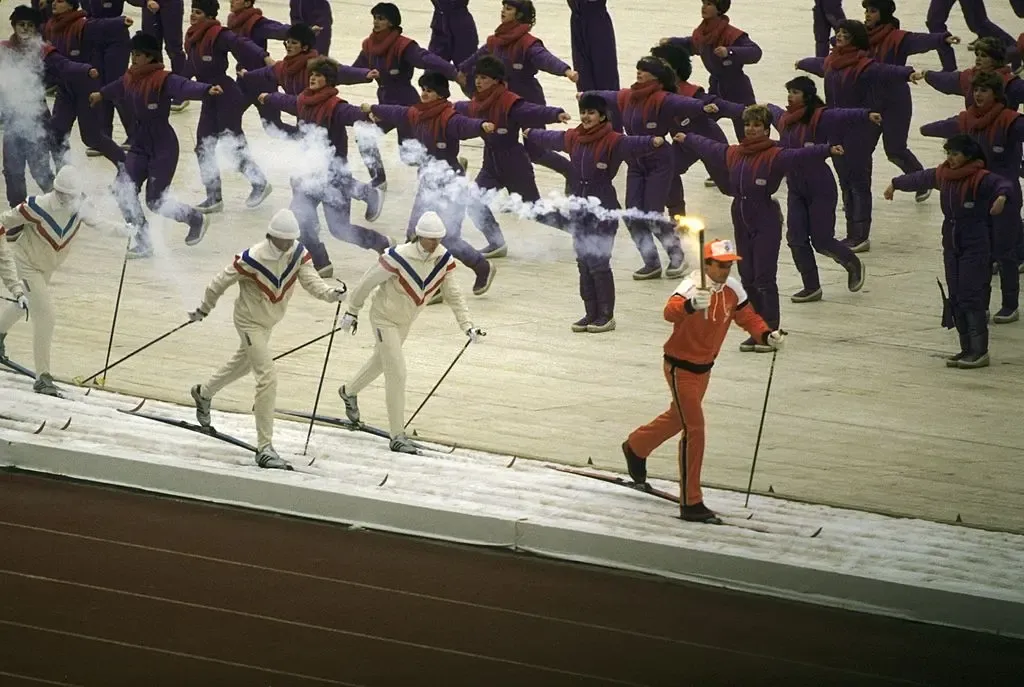
On February 8, the relay reached its crescendo at Koševo Stadium. The final leg within the stadium was performed by Ivo Čarman, a skier, who entered escorted by six other skiers. He passed the torch to the final bearer, figure skater Sanda Dubravčić. In a departure from the traditional lap, Dubravčić climbed a steep "Olympic pyramid" constructed at the end of the stadium. As she ascended, she was flanked by dancers on ornamental pedestals. At the summit, she lit the cauldron, signaling the end of the relay and the beginning of the Games, accompanied by a musical crescendo and the synchronized movement of 1,200 performers.
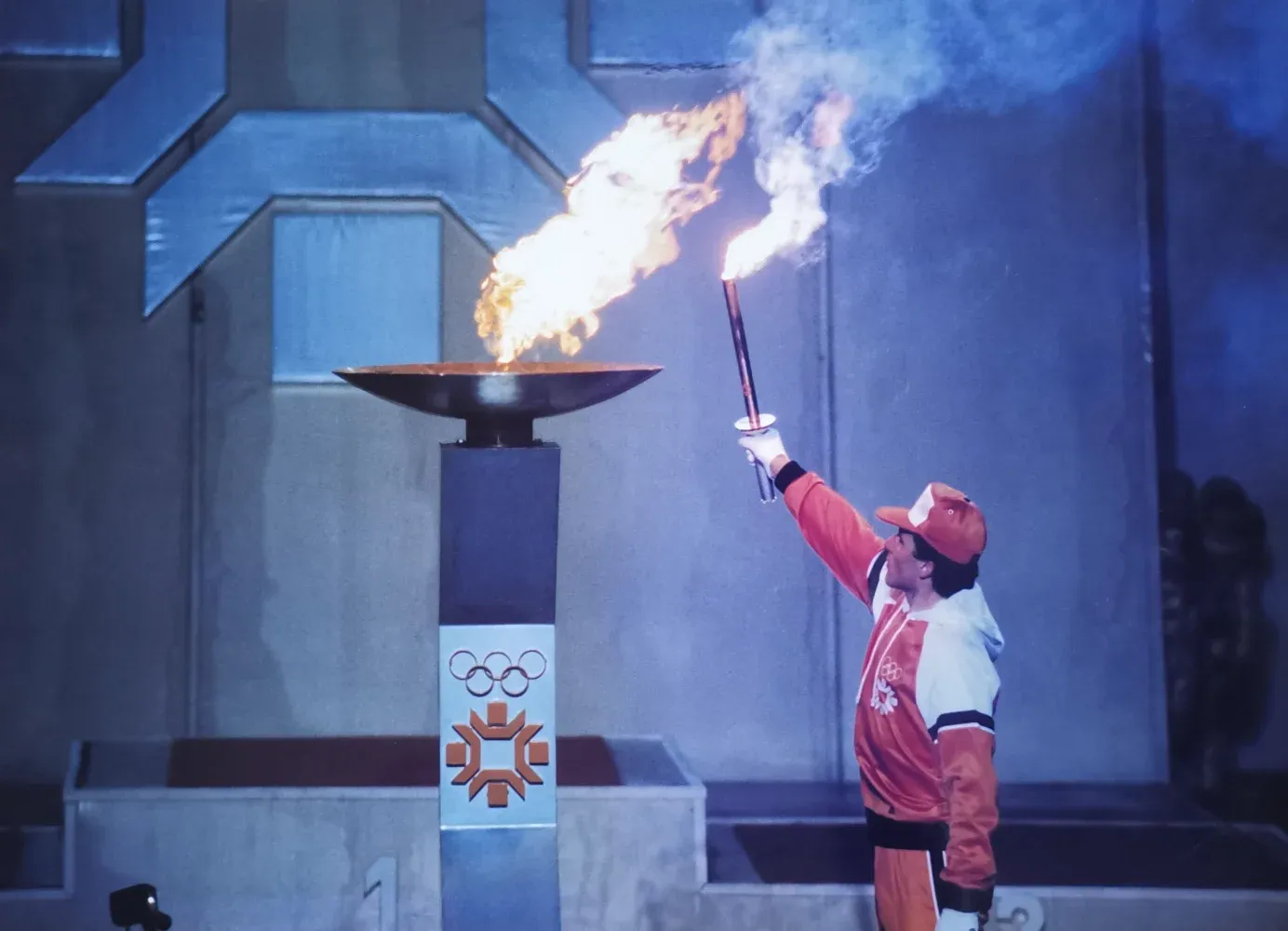
A torchbearer lights a temporary ceremonial bowl in Sarajevo as a prelude to the main ceremony.
The final leg at Koševo Stadium shows the flame entering the opening ceremony before the cauldron lighting.
Legacy: The Relay in Memory
In the years following 1984, the relay remained a poignant symbol of a "very nice dream," as described by local organizers. It represented a moment when Sarajevo felt like the "center of the world," a sentiment that persisted even as the region faced conflict a decade later. The physical legacy of the relay, the torches and the memories of the route, became part of the collection at the Olympic Museum in Sarajevo, which was later restored after wartime damage.
The ritual of the flame returned to the city 35 years later for the 2019 European Youth Olympic Winter Festival (EYOWF). The lighting of the cauldron for this event was deliberately designed to rekindle the "Olympic spirit" of 1984, linking a new generation of athletes to the historic journey that had once united the country from the Alps to the Aegean.